 lop News
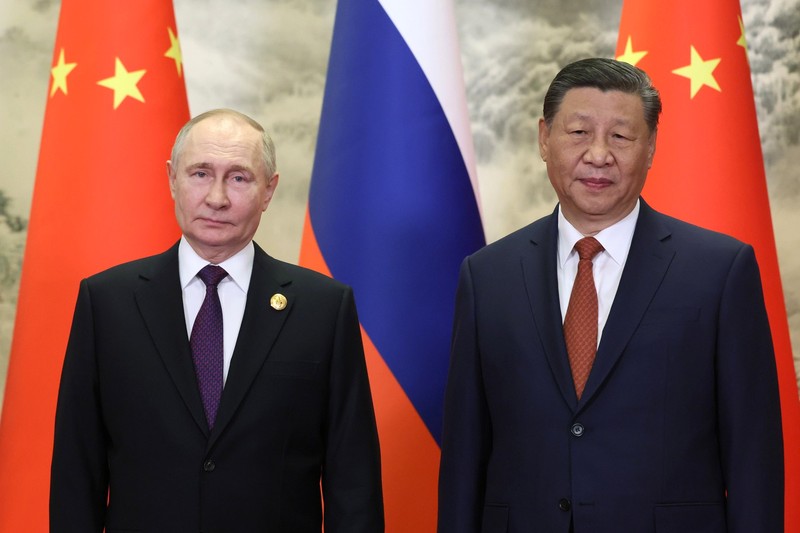
Two wars. One ceasefire call. Standing in the Great Hall of the People on Wednesday, Chinese President Xi Jinping told Vladimir Putin it was “imperative” to stop the fighting in the Middle East. He said nothing comparable about Ukraine.
The contrast was not accidental. It was the diplomatic equivalent of a spotlight — illuminating where Beijing chooses to throw its weight and where it prefers shadow.
Xi and Putin met to commemorate the 25th anniversary of the Treaty of Good-Neighbourliness and Friendly Cooperation. The timing told its own story: Putin arrived just days after Donald Trump departed Beijing following his own summit with Xi. Hosting the American and Russian presidents in the same week, Beijing cast itself as the indispensable power in a fractured world order.
A Ceasefire for Tehran, Not Kyiv
Xi’s urgency on the Middle East was unambiguous. “A comprehensive ceasefire is imperative, restarting war is even more unacceptable, and adhering to negotiations is particularly important,” he said, according to state news agency Xinhua. He referenced his four-point proposal for Middle East stability, first outlined during an April meeting with the crown prince of Abu Dhabi, promoting “peaceful co-existence, national sovereignty, international rule of law, and a coordinated approach to development and security.”
Russia’s Deputy Foreign Minister Sergei Ryabkov said Moscow was ready to assist with US-Iran talks. The conflict, which began with US-Israeli strikes on Iran in late February, has disrupted global energy markets and largely closed the Strait of Hormuz — a far greater threat to China’s economy than Russia’s.
On Ukraine, the joint statement said only that “the root causes” of the conflict must be removed — phrasing borrowed directly from Kremlin rhetoric justifying the invasion. Beijing declined to condemn a war that violates international law while also refusing to endorse it.
German Chancellor Friedrich Merz said Tuesday he hoped Xi would persuade Putin “to end this war in Ukraine which he cannot win.” No such persuasion appeared to be on the agenda.
The Junior Partner
If the ceremony signaled parity, the underlying dynamics did not. Russia’s economy is under mounting strain, and Moscow now imports more than 90 percent of sanctioned technology through China, according to Bloomberg News. China has denied providing weapons to any party in the Ukraine conflict, but Western analysts say its economic and diplomatic backing has sustained Russia’s war effort.
“Putin needs this more than Xi,” said Timothy Ash, an associate fellow at Chatham House. “Russia is now the junior, dependent partner, following Putin’s disastrous war in Ukraine.”
The two sides planned to sign roughly 40 documents, with Putin and Xi personally overseeing 21. Among them: an extension of the bilateral friendship treaty and discussions on the long-delayed Power of Siberia 2 gas pipeline. Russia hopes Middle Eastern energy disruption will make China more flexible on pricing. China, as ever, has its own ideas about what it will pay.
The Architecture of Multipolarity
Xi and Putin share a stated vision of a “multipolar world” challenging US dominance. Xi warned of “unilateral hegemony running rampant.” Putin called their relationship “a model of partnership.”
But multipolarity, as practiced here, is less about equality among nations than about leverage. China wants Russian energy at a discount. Russia needs Chinese technology and financial infrastructure to survive sanctions. Both want the US-Israel war on Iran to end — Beijing to stabilize energy supplies, Moscow to see a Western rival weakened at no cost to itself.
The joint statement contained no major breakthroughs, according to BBC Monitoring analyst Vitaly Shevchenko, restating previously known positions. The tea meeting between the two leaders — described by Kremlin aide Yuri Ushakov as “one of the most important events of the visit” — may have been the day’s most honest moment. Diplomacy at this level is often about what is poured rather than what is signed.
What the visit demonstrated is how selective peacemaking functions as a geopolitical instrument. Xi can demand a ceasefire in one theater while facilitating the prosecution of war in another, and face no contradiction — because in Beijing’s framework, there is none. The Middle East threatens Chinese economic interests. Ukraine does not. Principle, in the multipolar order, tracks neatly along the route of pipelines and trade corridors.
Putin departed with a treaty extension and the optics he needed. Xi kept his options open, his energy deals in play, and his silence on Ukraine intact. That silence was itself a statement — perhaps the most consequential one of the week.
Sources
- Xi tells Putin it’s ‘imperative’ to stop conflict in Middle East – but not Ukraine — Euronews
- ‘China holds the cards’: Why Putin’s visit to Beijing after Trump matters — Al Jazeera
- Putin and Xi renew plans to build major gas pipeline during talks in Beijing — BBC News
- Xi steps up appeal for Mideast ceasefire at start of Putin talks — Moneyweb (Bloomberg)
Discussion (9)