 lop News
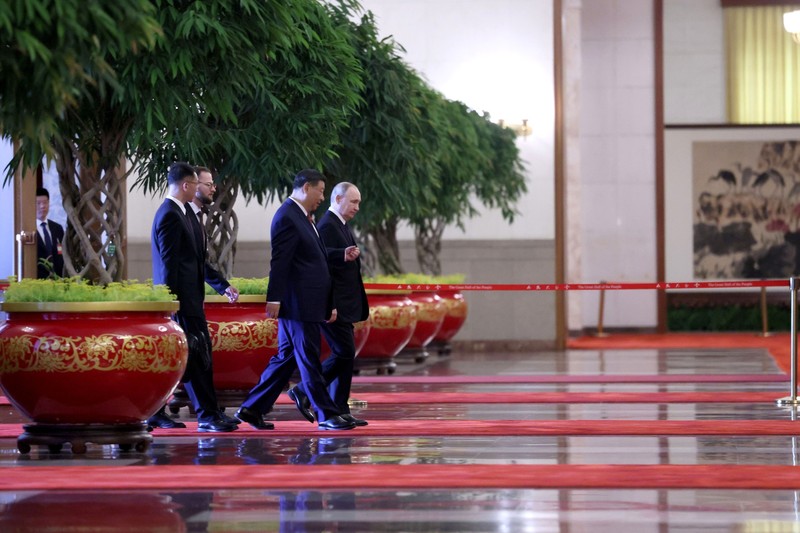
Three days before Xi Jinping sits down with Donald Trump, the Chinese leader hosted Cheng Li-wun at the Great Hall of the People. The optics were deliberate. The timing was not accidental.
Friday’s meeting between Xi and the chair of Taiwan’s Kuomintang was the first official contact between the Chinese Communist Party and the island’s largest opposition party in nearly a decade. Cheng, elected KMT chair last year, had spent months publicly lobbying for precisely this audience. She got it—and with it, a platform that Beijing’s state media amplified across the region and beyond.
A Prop for Unification Rhetoric
Cheng arrived in Beijing calling her trip a “peace mission.” She left having validated Beijing’s core talking points almost verbatim. She praised China’s poverty eradication efforts, invoked shared “Chinese roots” and “Chinese spirit,” and echoed Xi in calling for an end to what both described as “foreign meddling”—meaning American involvement in Taiwan’s affairs.
More pointedly, Cheng suggested she would slow Taiwan’s military build-up. According to Wen-ti Sung, a nonresident fellow at the Atlantic Council’s Global China Hub, Cheng’s talk of a “systemic solution for war prevention” was code for de-emphasizing deterrence. “The message,” Sung told Al Jazeera, “was that Taiwan ought to slow down on defence buildup and buying US arms.”
That posture serves Beijing’s interest directly. Since the DPP took power in 2016, China has refused formal contact with Taipei’s government, which it brands “separatist.” But it has maintained back-channels through parties like the KMT—and now, with this meeting, it has elevated one of them to the level of legitimate counterpart.
Beijing’s Playbook: Divide and Soften
The strategic logic is not subtle. Amanda Hsiao, China director at the Eurasia Group, put it plainly: Beijing “seeks to cast doubt in Taiwan over the Lai administration’s focus on self-defence and to strengthen voices in Taiwan calling for closer cross-strait ties. Beijing seeks to keep Taiwan divided over the question of how best to secure its future.”
That division is already playing out in Taiwan’s legislature. The KMT, which holds a legislative majority alongside a smaller coalition partner, has blocked a proposed $40bn special defence budget for advanced US weapons. The party has offered a $12bn alternative instead—focused on specific, approved items rather than the broader deterrent posture the DPP seeks.
Cheng denied coordinating the budget delay with Beijing. But Xi gave her something arguably more valuable: political cover. By receiving her as a guest of state, he lent legitimacy to her faction’s argument that dialogue with China—rather than deterrence—is the path to peace.
The Trump Variable
The timing, however, tells a story beyond Taiwan’s domestic politics. Xi and Trump are expected to meet in Beijing next month, a summit delayed from April because of the war in Iran. William Yang, a senior analyst at the International Crisis Group, said Beijing likely hopes to use Cheng’s meeting to shape the conversation.
“China hopes to use Cheng’s meeting with Xi to show Trump that its ally in Taiwan is in lockstep with Beijing when it comes to key policies,” Yang told NPR. Beijing could “potentially use this impression to influence Trump’s position on US arms sales to Taiwan, which is one of the major issues Xi will likely put on the table.”
In February, Xi told Trump in a phone call to be “prudent” about such deals. Friday’s meeting reinforces that message: if Beijing can point to elected Taiwanese politicians—ones who hold legislative power—embracing unification rhetoric, American arms sales become harder to justify as supporting a democratic partner.
Taiwan’s Response
President Lai Ching-te of the DPP was blunt. In a Facebook post, he urged the KMT to back the defence spending plans and warned that history shows “compromising with authoritarian powers only sacrifices sovereignty and democracy. It does not bring freedom, and it brings no peace.”
The numbers offer a window into how much has shifted. A 2025 national identity survey by National Chengchi University found 62 percent of respondents identified as “Taiwanese”—up from 17.6 percent in 1992. Those identifying as “Chinese” fell from 25.5 percent to 2.5 percent over the same period. Cheng’s embrace of Chinese identity places her increasingly at odds with her own electorate.
Yet that gap is precisely what Beijing is betting on. As George Yin, a research fellow at National Taiwan University, noted, Cheng’s trip may not produce concrete agreements—but it could produce “concrete political changes, cornering the KMT into positions it would not have been comfortable inhabiting in the past.”
Drew Thompson, a former US defence official and senior fellow at the S. Rajaratnam School of International Studies, offered a counterpoint: Taiwanese people “are clear that the source of military threats is not emanating from the DPP or President Lai. It’s emanating from Beijing.”
For now, the diplomatic theatre is set. Xi gets a receptive audience in Cheng. Trump gets a reminder that Beijing has levers to pull in Taipei. And Taiwan’s opposition walks a line between peacemaker and prop—with its 2028 electoral ambitions hanging in the balance.