 lop News
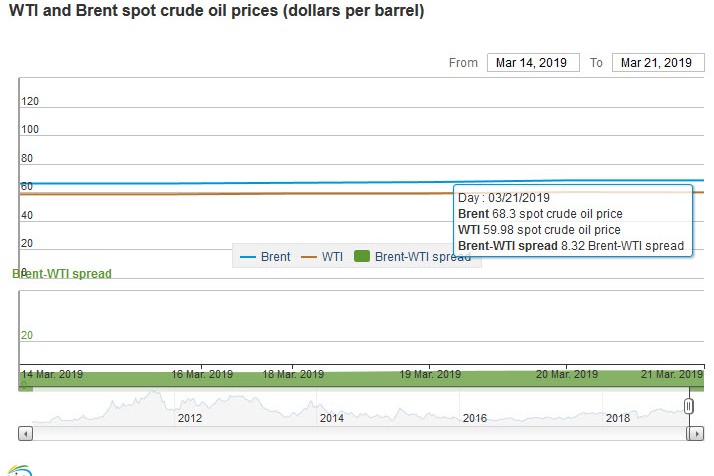
$112.78. That is what a barrel of Brent crude costs as of Monday’s close — up 55% since the start of March, the largest monthly surge in the contract’s 38-year history. The previous record was a 46% jump in September 1990, when Saddam Hussein invaded Kuwait. US West Texas Intermediate settled above $100 for the first time since July 2022.
The numbers are the blunt instrument of a crisis that the International Monetary Fund, in a blog post published Monday by its top economists, described with unusual clarity: “Although the war could shape the global economy in different ways, all roads lead to higher prices and slower growth.”
The war, now in its fifth week after US and Israeli strikes on Iran began on February 28, has produced what the IMF called a “global, but asymmetric shock.” Iran’s closure of the Strait of Hormuz — through which 25% to 30% of the world’s oil and 20% of its liquefied natural gas normally flow, according to the International Energy Agency — constitutes the largest disruption to global oil markets in history.
The IMF’s Three Scenarios
The fund’s blog, authored by its main department heads including chief economist Pierre-Olivier Gourinchas, laid out three possible paths. A short conflict sends prices soaring before markets adjust. A long one keeps energy expensive and strains import-dependent countries. Or the world settles somewhere in between — tensions linger, energy stays costly, and “inflation proves hard to tame.”
Whichever path materializes depends on three variables: the war’s duration, its geographic spread, and the damage inflicted on infrastructure and supply chains. None currently point in a reassuring direction. Yemen’s Houthis announced Saturday they had fired ballistic missiles at Israeli military targets, marking their first direct involvement in the conflict and opening a new front that threatens the Bab el-Mandeb Strait — another critical chokepoint through which 4 to 5 million barrels per day pass.
‘All Necessary Measures’
The Group of Seven finance leaders, meeting as the crisis deepened, declared they were ready to take “all necessary measures” to safeguard energy market stability and limit economic spillovers. It is the kind of language that sounds reassuring in a communiqué and means almost nothing in practice.
The one concrete action taken so far comes from the International Energy Agency, whose 32 members agreed this month to release a record 400 million barrels from strategic stockpiles. That is a bridge, not a solution. Societe Generale analysts warned that prolonged supply disruption could push prices as high as $150 per barrel in April.
Meanwhile, US President Donald Trump spent Monday alternately threatening to obliterate Iran’s energy infrastructure and claiming “great progress” toward a diplomatic resolution. Iran’s foreign ministry spokesperson Esmaeil Baghaei said Tehran had rejected proposals received via mediators, calling them “illogical” and adding that “the American position in diplomacy cannot be trusted.”
Where the Pain Concentrates
The IMF identified clear gradations of exposure. For fuel-importing economies, the shock functions as “a large, sudden tax on income.” In Asia’s large manufacturing economies, higher fuel and power bills are raising production costs while squeezing consumer purchasing power.
In Europe, the crisis revives memories of the 2021–22 gas crisis. The IMF noted that Italy and the UK are especially exposed by their reliance on gas-fired power, while France and Spain are “relatively protected by their greater nuclear and renewables capacity.” UK natural gas prices have more than doubled since December to roughly £140 a therm. In Ireland, energy costs jumped 11% in March alone, pushing overall inflation to 3.6%, up from 2.5% in February.
The poorest countries face the sharpest consequences. Food accounts for roughly 36% of consumption in low-income countries, compared with 20% in emerging markets and 9% in advanced economies. About a third of global fertilizer production passes through the Strait of Hormuz. UN Food and Agriculture Organization projections indicate global food prices could average 15% to 20% higher in the first half of 2026 if the crisis persists — a formula for acute food insecurity in nations that can least afford it, precisely when many advanced economies are scaling back international assistance.
The Supply Chains Beyond Oil
The cascading effects extend well beyond energy. The IMF flagged disruptions to Gulf helium supplies — used in semiconductors and medical imaging — and warned that Indonesia, which provides roughly half the world’s nickel for electric-vehicle batteries, could face a shortage of sulfur needed to process the metal. Air-traffic disruptions around key Gulf hubs are also hitting global tourism.
Ed Yardeni of Yardeni Research told CNBC that the continued Hormuz blockade could deepen equity market pullbacks and raise recession risks, with volatility likely to persist until oil flows normalize. David Roche of Quantum Strategy said markets were increasingly pricing in the possibility of a US move to seize Iran’s Kharg Island export hub — through which roughly 90% of Iranian oil flows — a step that would choke Tehran’s dollar revenues but risk triggering full-scale retaliation against critical Gulf infrastructure.
The IMF will publish its fuller assessment in the World Economic Outlook on April 14, during the spring meetings in Washington. By then, the data will have moved again. The question is whether it moves toward something the global economy can absorb — or toward that $150 barrel.
Sources
- Iran war ‘shock’ is dimming outlook for many economies, IMF says — Reuters
- IMF warns Middle East conflict will lead to higher prices and slower global growth — The Guardian
- Brent oil heads for record monthly surge, WTI settles above $100 for first time since 2022 — CNBC
- Iran War May Stoke Inflation, Dampen Growth, Says IMF; Warns Of Food Price Jolt — NDTV Profit
- IMF warns Iran conflict will lead to higher prices as Trump makes new threat — The Irish Times
Discussion (10)