 lop News
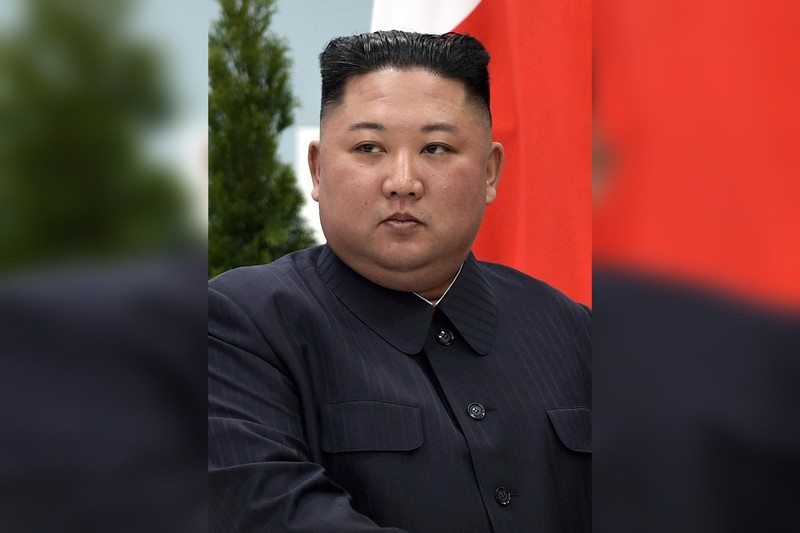
Days after standing before North Korea’s Parliament and accusing the United States of “state terrorism and aggression” — an unmistakable reference to the American role in the Middle East — Kim Jong Un supervised a ground test of the most powerful solid-fuel rocket engine Pyongyang has yet disclosed.
The engine produced a maximum thrust of 2,500 kilonewtons, according to state media reports on Sunday, a 27 percent increase over the 1,971 kilonewtons recorded in a similar test just six months earlier. KCNA, the North’s official news agency, did not disclose when or where the test took place.
Kim said the test had “great significance in putting the country’s strategic military muscle on the highest level,” KCNA reported, adding that it “fully conforms with the national strategy and the military demand for modernizing the strategic forces.” The engine, built with composite carbon fiber materials, is assessed by analysts to be intended for the Hwasong-20 intercontinental ballistic missile currently under development.
Why solid fuel changes the calculus
The distinction between liquid and solid fuel is not merely technical. It is operational.
Liquid-fuel missiles require hours of preparation — fueling on the launch pad, visible to satellite surveillance, vulnerable to pre-emptive strike. Solid-fuel missiles arrive at their launch sites ready to fire. They can be mounted on mobile launchers, hidden in tunnels, and launched with minimal warning. Detection time shrinks from hours to minutes, compressing the decision window for any adversary considering a response.
North Korea’s push toward solid-fuel ICBMs represents a bid to make its nuclear deterrent more credible — and more dangerous — by reducing the vulnerability of its launch infrastructure.
The increased thrust also suggests Pyongyang may be working toward multiple-warhead capability. “Given the increased maximum thrust, this indicates its intention to possess ICBMs with global strike range, as well as the ability to overwhelm missile defence systems,” Dr Hong Min, an analyst at the Korea Institute for National Unification, told AFP.
A five-year plan, advancing on schedule
The test was described as part of North Korea’s new five-year defense development plan, unveiled at a rare ruling party congress in February. The plan reaffirmed the country’s commitment to nuclear weapons while calling for a broad modernization of conventional forces — including new main battle tanks and reorganized special operations units.
Kim also inspected a new tank during the same reporting cycle, with KCNA claiming its active protection system could intercept “almost all existing anti-tank means” with a 100 percent success rate. He separately visited a special forces training base where soldiers demonstrated combat drills with axes and sledgehammers, state media reported.
The combined message: North Korea is building across the board — strategic missiles, armored forces, special operations — and doing so on a timeline it has publicly committed to.
The attention deficit
All of this is unfolding while Washington and its allies are heavily occupied elsewhere. The war in the Middle East has absorbed enormous diplomatic bandwidth, intelligence assets, and military resources. South Korea and the United States have said they are “closely monitoring” North Korea’s weapons development — a standard formulation that underscores the limits of what monitoring alone can achieve when priorities lie elsewhere.
Kim appears to understand this calculus with precision. His parliamentary speech linked his nuclear program directly to American military action in the Gulf, casting the buildup as a defensive response to U.S. aggression. It is propaganda, but propaganda calibrated to a moment when the world’s cameras are pointed at a different theater.
The pattern extends beyond Pyongyang. Authoritarian states have a demonstrated habit of advancing their positions when major powers are stretched thin. Russia’s annexation of Crimea in 2014 coincided with a period of Western preoccupation. China’s island-building in the South China Sea accelerated during years when Washington was consumed by conflicts in Iraq and Syria.
Deterrence, at its core, requires attention — the sustained, credible signal that provocation will be met with consequences. When attention fractures across multiple crises, gaps open. North Korea is methodically exploiting one.
Some foreign experts say Pyongyang still faces significant technological hurdles — particularly around warhead survival during atmospheric reentry — before it fields a fully functional solid-fuel ICBM. Others argue those assessments underestimate the progress of a decade of sustained investment.
The disagreement matters less than the trajectory. Engine thrust increased 27 percent in six months. The five-year plan is six months old. The war in the Middle East shows no sign of ending.
Kim Jong Un has time, and he appears to know it.
Sources
- North Korea’s Kim oversees test of high-thrust engine: KCNA — Channel News Asia
- North Korea conducts engine test for missile capable of targeting US mainland — Associated Press
- N. Korea’s Kim oversees ground test of high-thrust solid-fuel missile engine: KCNA — Yonhap News Agency
Discussion (10)