 lop News
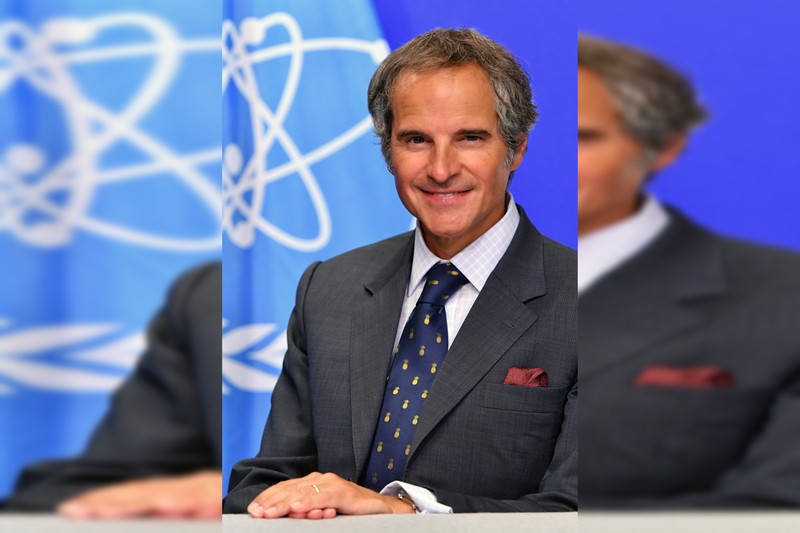
IAEA director general Rafael Grossi delivered a stark assessment in Seoul on Wednesday: North Korea is showing a “very serious increase” in its ability to produce nuclear weapons, with activity at its Yongbyon nuclear complex accelerating across multiple facilities.
The confirmation arrives at a moment when global attention — and American military resources — are trained firmly on Iran. Pyongyang appears to be making the most of the opening.
Satellite imagery analyzed by the International Atomic Energy Agency shows intensified operations at Yongbyon’s 5MW reactor, its reprocessing unit, and a light-water reactor, Grossi told reporters after meeting South Korean foreign minister Cho Hyun. The agency also observed activation of other facilities at the site.
Separately, the Washington-based Center for Strategic and International Studies reported this week that a suspected new uranium enrichment building at Yongbyon is essentially complete, fitted with generators, fuel storage tanks, cooling units, and support infrastructure. The CSIS analysis, published through its Beyond Parallel program, described the facility as measuring roughly 120 by 48 meters — comparable in size to the undeclared Kangson enrichment plant near Pyongyang. Construction began in December 2024, and internal fitting appears to be ongoing.
Neither the new Yongbyon building nor the Kangson facility has been declared to international nuclear authorities.
A Growing Arsenal
North Korea is believed to have assembled at least 50 nuclear warheads, according to the Washington-based Arms Control Association, with enough fissile material for 70 to 90 weapons. Some experts remain skeptical of Pyongyang’s claims that it can miniaturize warheads for long-range ballistic missiles, but the IAEA’s Grossi left little doubt about the direction of travel.
“We consider, looking at external features of the facility, that there will be significant increase in the enrichment capacity of the DPRK,” he said, using North Korea’s official name.
South Korean president Lee Jae Myung offered an even sharper estimate in January, saying the North is producing enough fissile material to build 10 to 20 nuclear weapons per year. In March, South Korean unification minister Chung Dong-young estimated that North Korea may have extracted around 100 kilograms of plutonium over the past three decades — an amount capable of producing roughly 20 nuclear weapons — including 16 kilograms last year alone. Any enriched uranium production would add substantially to that total.
Kim Jong-un vowed last August to pursue a “rapid expansion of nuclearisation,” and the regime appears to be delivering on that promise. North Korea has not conducted a nuclear test since 2017, but it has continued advancing its missile technology, including intercontinental ballistic missiles capable of reaching the US mainland.
The Lesson of Iran
The timing is not coincidental. In a speech to North Korea’s Supreme People’s Assembly last week, Kim pointed to the current conflict with Iran as proof that nuclear weapons are “the true guarantee of a state’s existence.” The lesson, from Pyongyang’s perspective, is straightforward: states with nuclear deterrence do not get attacked. States without it do.
The logic is difficult to argue with. The US and Israel launched strikes against Iran in June 2025 and again in February 2026 — during active negotiations — over concerns about Tehran’s nuclear program. Iran had not assembled a single weapon. North Korea, by contrast, sits on 50 warheads and has faced no military consequences.
“It reinforces their beliefs that they need their nuclear program for regime survival,” former Canadian diplomat James Trottier, who led four official missions to Pyongyang, told CBC News.
The latest US National Security Strategy does not mention North Korea, according to CBC News. Iran, by contrast, is labeled a “chief destabilizing force.” Washington has reportedly redeployed elements of its THAAD missile defense systems from South Korea to the Middle East, according to Chatham House — a signal that allies in East Asia may find American attention divided.
What Options Remain
Grossi called North Korea’s nuclear program a “clear violation” of UN Security Council resolutions. The IAEA has not had inspectors on the ground in North Korea since 2009.
Asked whether Russia was assisting Pyongyang’s nuclear development — a persistent concern given North Korea’s deployment of troops to support Moscow’s war in Ukraine — Grossi said the agency had not seen “anything in particular in that regard,” calling it “too early days to judge.”
Diplomatic efforts have produced nothing. The summits between Kim and Donald Trump during the president’s first term collapsed without agreement, and Rachel Minyoung Lee of the Stimson Center’s Korea Program told CBC News that North Korean denuclearization is now “off the table.” Since the attacks on Iran, Pyongyang has demanded recognition of its “irreversible position” as a nuclear weapons state as a precondition for any future arms talks.
The IAEA says it maintains “enhanced readiness” to verify North Korea’s nuclear program. That readiness has not been tested. Pyongyang shows no interest in letting it be.
Sources
- North Korea rapidly expanding nuclear weapons capability, UN watchdog warns — The Guardian
- Suspected Uranium Enrichment Building at Yongbyon Complete — CSIS Beyond Parallel
- North Korea expands its nuclear arsenal after witnessing Iran’s vulnerability — CBC News
- The Iran war risks triggering a new wave of nuclear proliferation — Chatham House
- North Korea showing ‘serious increase’ in ability to make nuclear weapons, IAEA says — Euronews
Discussion (9)