 lop News
Mohammed Asasa had barely returned home from burying his father when children came running into the house. “The settlers are digging up the grave,” they shouted.
Hussein Asasa was 80 years old, a former livestock trader and father of 10, in the small village of Asasa, near Jenin in the occupied West Bank, from which the family took its name. He had died of natural causes last Friday. In keeping with Islamic custom, his sons laid him to rest quickly — a simple plot on a hillside cemetery across from the family home.
Mohammed had even sought permission from a nearby Israeli military base to hold the funeral. The army confirmed to NPR that the burial had been coordinated in advance. The family was given 30 minutes.
Less than half an hour after the sons left the gravesite, settlers from the hilltop above were hacking at the freshly covered grave with heavy tools. Some carried automatic rifles. By the time Mohammed and his brothers rushed back, the settlers were on the verge of breaking through the slab covering their father’s remains.
“They were on the point of reaching the body,” Mohammed told the BBC. “I’m sure they were about to remove it, so we had to make a decision there and then.”
The settlers gave the family an ultimatum: exhume the body yourselves, or we will do it for you. “Either you take the dead body away right now or we’ll use a bulldozer to remove him from the grave and dump him for you,” Mohammed recalled to NPR.
Mobile phone footage shows the sons digging their father out of his grave — then carrying the shrouded body down the hill, past armed settlers and Israeli soldiers who stood watching.
‘It spares no-one, dead or alive’
The United Nations human rights office condemned the incident as “appalling and emblematic of the dehumanisation of Palestinians” in the occupied territories.
“It spares no-one, dead or alive,” said Ajith Sunghay, the local head of the Office of the High Commissioner for Human Rights. He described the episode as evidence of the “constant failure” of the Israeli military to meet its obligation under international law to protect Palestinian civilians.
The Israel Defense Forces said soldiers confiscated digging tools from the settlers and remained at the site to “prevent further friction.” In a statement, the IDF said it “condemns any attempt to act in a manner that harms public order, the rule of law, and the dignity of the living and the deceased.” The military did not respond to NPR’s specific question about why soldiers did not intervene to stop the settlers, given that the family had obtained the required burial permit.
The family accused the soldiers of standing by while they were forced to empty the grave.
A settlement returns
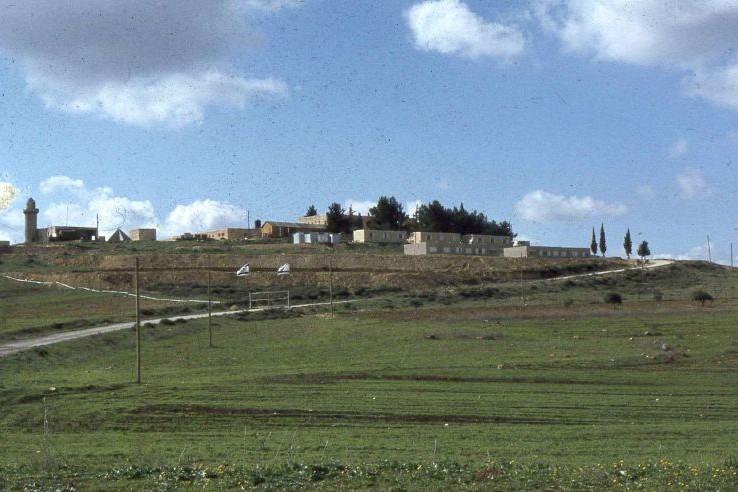
The settlers came from Sa-Nur, a settlement re-established roughly 300 meters from the village cemetery. Sa-Nur was one of four West Bank settlements evacuated in 2005 under Israel’s disengagement plan. Prime Minister Benjamin Netanyahu’s government approved its reoccupation as part of a broader settlement expansion — all illegal under international law.
Finance Minister Bezalel Smotrich, himself a settler, attended the reopening ceremony last month. “We are burying the idea of a Palestinian state,” he said, calling the return a “historic correction.”
Since Sa-Nur’s re-establishment, much of the surrounding area — olive groves, crop fields, and the cemetery — has been designated a “closed military area,” effectively placing them off-limits to their Palestinian owners. Villagers told the BBC that settlers have become more aggressive, many now openly carrying weapons.
A pattern of impunity
The incident fits a broader trend. Since the Hamas-led attack on Israel on October 7, 2023, settler violence in the West Bank has surged. The New York Times reported that between the start of the US-Israeli campaign against Iran and the end of April 2026, 13 Palestinians were killed in settler attacks, with hundreds more injured and driven from their homes. Rights groups say settlers who commit violence are rarely prosecuted.
According to Israeli NGO Peace Now, settlement approvals rose from just three between 2013 and 2022 to 54 in 2025, and already stand at 34 in the first months of 2026 — bringing the total approved under the current government to 104.
Hussein Asasa was eventually reburied in a cemetery in a neighbouring village. His sons had buried him twice in a single day.
Sources
- His father had just been buried. Then West Bank settlers forced him to dig up the body — BBC News
- Israeli settlers force Palestinian family to exhume and rebury their father — NPR
- For Israeli settlers, return to Sa-Nur is a dream realised — RFI / AFP
- Israeli ministers celebrate re-establishment of Sa-Nur West Bank settlement — Al Jazeera
Discussion (10)