 lop News
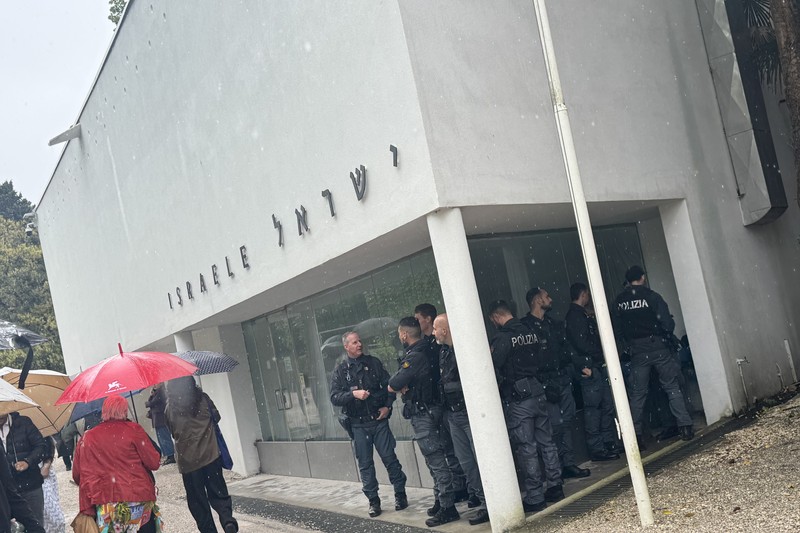
Austria’s pavilion — widely praised as one of this year’s standout entries — stayed dark all day Friday. So did Belgium’s, Japan’s, the Netherlands’, and South Korea’s. The British pavilion locked its doors for hours before finding replacement staff to reopen. A sign on the entrance read: “Due to the Italian cultural workers’ strike today, it is not possible to open the British pavilion.”
Roughly a dozen national pavilions at the Venice Biennale shuttered partially or fully on the final preview day, in a coordinated protest over Israel’s inclusion at the art world’s most prestigious international exhibition. The strike was organized by the Art Not Genocide Alliance (ANGA), which has called for Israel to be barred because of its war in Gaza.
Locked Doors Across the Giardini
The scale of the disruption surprised many attendees. ANGA had initially suggested more than 20 pavilions would participate. The final count was smaller but still remarkable: the Belgian, Dutch, Austrian, Japanese, Macedonian, and Korean pavilions remained closed for the entire day, according to the Guardian. The British, Spanish, French, Egyptian, Finnish, and Luxembourg entries either closed and reopened or planned to shut early — many around 4pm.
For the collectors, curators, and critics who travel to Venice for the preview, the experience was disorienting. Doors locked where major works should have been on view. The Israeli pavilion was also closed Friday morning, though that was attributed to a private event rather than the protest.
A Middle Path: Flags and Posters
Not every artist chose to shut their doors. Several participants in the central exhibition, titled “In Minor Keys,” backed the strike by adding Palestinian references to their installations. Artist Tabita Rezaire hung a Palestinian flag from her work. Posters appeared outside pavilions reading “Palestine is the future of the world” and “We stand with Palestine.”
It was a calibrated gesture — visible and declarative, but one that kept the art accessible. For artists wary of both silence and closure, it offered a middle path.
A Biennale Under Pressure
This year’s Biennale has been fractious from the start. On Wednesday, Pussy Riot staged a protest at the Russian pavilion, forcing its temporary closure. Russia returned this year after a hiatus since 2022. The prize jury resigned en masse in late April after declaring they would not consider entries from countries whose leaders face International Criminal Court charges — a stance that would have excluded both Russia and Israel. According to the Guardian’s Charlotte Higgins, the jury came under pressure to retract the statement and faced legal threats from the artist representing Israel.
Biennale president Pietrangelo Buttafuoco, a rightwing intellectual appointed by Giorgia Meloni’s government, has defended both countries’ inclusion, calling the event “a place of truce in the name of art, culture, and artistic freedom.” The UK government refused to send a minister to open the British pavilion over Russia’s presence.
Protests at the Biennale are not unprecedented. In 1968, students occupied pavilions demanding reforms, leading to the cancellation of that year’s awards. Two years later, demonstrations by the Venice Communist party suspended prizes again. But the coordination of Friday’s action — spanning multiple continents’ worth of national representations — marks a new scale.
The Limits of Neutrality
Buttafuoco has framed his stance as neutrality, calling the Biennale “an institution that can be considered the UN of art, from which no nation can be excluded.” Critics point out the historical weight that framing carries: the Biennale’s national pavilion system was shaped in the 1930s under Mussolini as a vehicle for fascist cultural prestige. As University of Bologna historian Clarissa Ricci told the Guardian, the structure became “a focus for propaganda” under the regime.
The standoff cuts to a question the art world has never resolved: whether cultural boycotts are a legitimate form of political pressure or a betrayal of the dialogue that international exhibitions claim to champion. The artists who closed their doors treated Israel’s participation — and the Biennale’s willingness to host it — as a moral threshold. Those who stayed open but added Palestinian symbols chose solidarity without self-silencing.
Thread and Testimony
Across town, the Gaza Genocide Tapestry opened to the public Saturday at Palazzo Mora — 100 embroidered panels, each bearing 55,000 stitches, created by Palestinian women across the occupied territories and refugee camps in Lebanon and Jordan. The project grew out of the Palestine History Tapestry Project, which began in 2011. Women in Gaza were among the original contributors but became unreachable as bombardment intensified, most displaced multiple times. As Al Jazeera reported, they became “subjects of the story, rather than its narrators.”
The exhibit runs through November.
Discussion (9)