 lop News
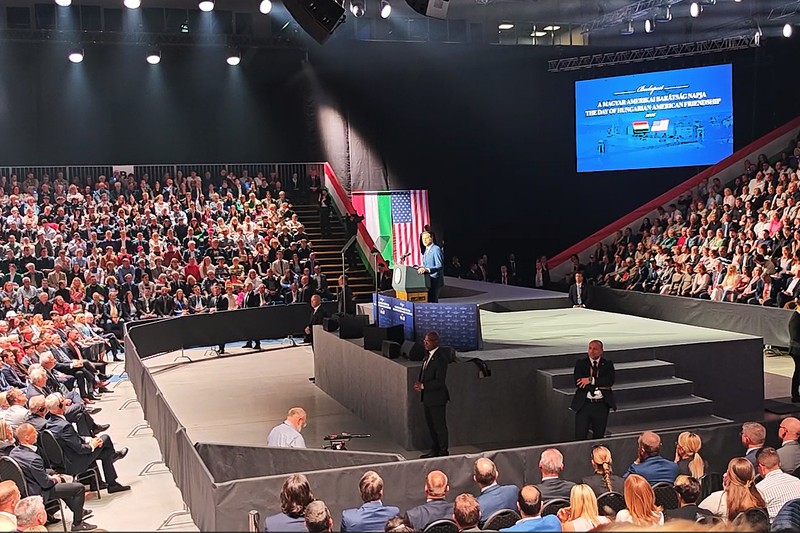
In Budapest, US Vice President JD Vance told a cheering campaign crowd that the war in Ukraine had “stopped making sense.” That same morning, a Russian first-person-view drone slammed into a passenger bus in Nikopol during rush hour, killing four civilians.
The attack was part of a wave of Russian strikes across Ukraine that killed at least nine people and wounded 51 more between Monday night and Tuesday morning, according to the Kyiv Independent. In Dnipropetrovsk Oblast, an 11-year-old boy was killed in a separate strike. In Odesa, three people including a child died when residential buildings and critical infrastructure were hit. In Chernihiv Oblast, administrative buildings caught fire during working hours after strikes hit city centers in Pryluky and Novhorod-Siverskyi.
Deputy Prime Minister Oleksii Kuleba called it “deliberate Russian terror against peaceful cities and civilians.”
A vice president on the campaign trail
Vance’s two-day visit to Hungary this week is extraordinary by any diplomatic standard — and he acknowledged as much. “It’s unprecedented for an American vice-president to come the week before an election,” he told supporters in Budapest. “We had to show that there are actually a lot of people […] who recognise that Viktor and his government are doing a good job.”
Orban, seeking a sixth term as prime minister in Sunday’s election, trails his right-wing rival Peter Magyar in most polls — some by wide margins, though government-aligned institutes give Fidesz the lead. His campaign has leaned heavily on criticism of the EU and Kyiv, fueled by a dispute with Ukraine over halted Russian oil deliveries through a pipeline crossing Ukrainian territory. Ukraine says Russian bombardment damaged the pipeline; Hungary says it doubts that account.
Orban is blocking a major EU loan package for Ukraine in retaliation. Vance called Zelenskyy’s reaction to the blockade “scandalous” — a reference to Zelenskyy’s remark that he could give Ukraine’s military Orban’s address.
He praised Orban as the European leader most helpful to US peace efforts, saying the Hungarian premier had encouraged Washington “to truly understand this, to understand from the perspective of both the Ukrainians and the Russians what is necessary for them to end the conflict.”
The Kremlin was pleased. Spokesman Dmitry Peskov echoed Vance’s claims that “many forces in Brussels” were working against Orban’s reelection, and praised Orban as “a very effective politician […] one who is specifically defending the interests of his own country.”
In Berlin, a German government spokesperson offered a terse rebuttal, saying Vance’s presence in Hungary “speaks for itself” regarding who is interfering in what. The European Commission said it would “convey concerns” to Washington through diplomatic channels, according to The Guardian.
An Easter ceasefire, unanswered
While Vance framed the war as a bargaining session, Zelenskyy was asking for something modest: a pause in the killing for Orthodox Easter, which falls this Sunday.
“We are ready for a ceasefire for the Easter holidays,” Zelenskyy said Monday, according to Ukrainska Pravda. He said Ukraine was open to a complete ceasefire, an energy truce, or both — “so that neither missiles nor drones fly. No strikes on infrastructure.”
The proposal was conveyed to Moscow through Washington. Russia’s answer came in Shahed drones. An overnight attack on Odesa killed three people, including a child. Zelenskyy said Moscow had responded to the ceasefire proposal by deploying Iranian-designed Shahed drones, according to Reuters.
“We have repeatedly proposed to Russia a ceasefire at least for Easter, a special time of the year,” he said in his nightly address. “But for them, all times are the same. Nothing is sacred.”
A history of failed truces hangs over the proposal. A 30-day energy truce announced in March 2025 never took hold, with both sides disagreeing on the terms and start date, according to the Kyiv Post. An Easter ceasefire that year was partly observed. Russia rejected Germany’s Christmas truce proposal in December.
Two wars, two ceasefires
The contrast with Iran is difficult to ignore. Vance “welcomed the sudden temporary ceasefire” in the Persian Gulf, Deutsche Welle reported, touting the administration’s diplomatic success. That ceasefire was brokered with evident urgency and American leverage — the kind of diplomatic muscle conspicuously absent from the Ukraine file.
Peace talks between Kyiv and Moscow have effectively stalled as Washington shifts focus to Iran, the Kyiv Post reports. Zelenskyy recently rejected a US proposal that he said would trade control of the eastern Donbas region for American security guarantees. Secretary of State Marco Rubio claimed Zelenskyy had misunderstood the offer. Either way, the diplomatic energy flowing toward Tehran is not flowing toward Kyiv.
European governments counter that any peace deal must be just — not, in Deutsche Welle’s characterization, an “enforced partial Ukrainian capitulation.” Vance’s framing — “haggling over a few square kilometers of territory” — suggests Washington may see things differently.
Russia launched 110 long-range drones overnight, the Ukrainian Air Force reported. Seventy-seven were shot down. The fate of the remaining 33 was not specified.
Sources
- JD Vance criticizes Zelenskyy and Ukraine in Hungary on visit campaigning for Viktor Orban — Deutsche Welle
- EU to ‘convey concerns’ to US about Vance’s Hungary intervention — The Guardian
- Russian FPV drone hits bus in rush hour attack as strikes kill 9, injure 51 across Ukraine — Kyiv Independent
- Ukraine’s Zelenskiy says he stands by ceasefire proposal to Russia — Reuters
- Zelensky Proposes Easter Ceasefire, Energy Truce — Kyiv Post
Discussion (8)