 lop News
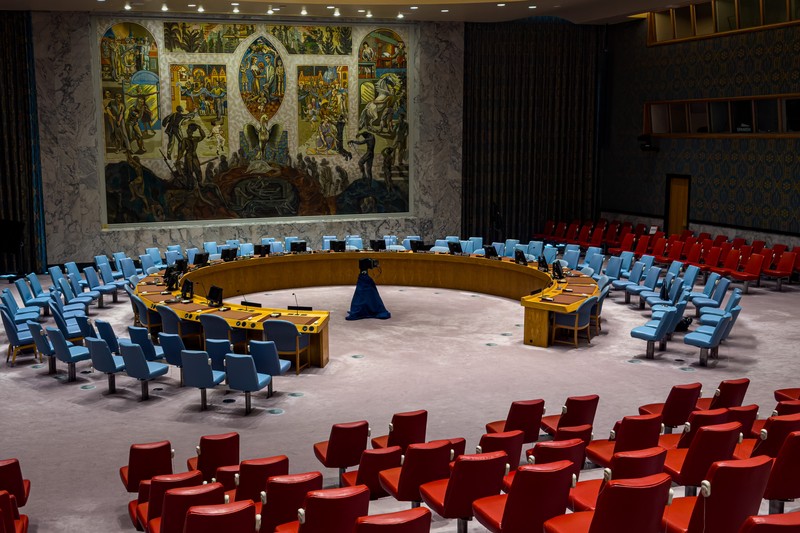
The UN Security Council will vote Saturday on a resolution to reopen the Strait of Hormuz — a proposal already stripped of its sharpest teeth to avoid a veto, even as US President Donald Trump vows to escalate strikes on Iranian civilian infrastructure.
The Bahraini-sponsored measure has been significantly revised since its introduction. An early draft authorized countries to use “all necessary means” — standard UN language that includes military force — to secure the waterway. The final version, obtained by the Associated Press, limits action to “all defensive means necessary and commensurate with the circumstances” for a period of at least six months.
The watering-down was inevitable. China, Russia, and France, all veto-wielding members, had opposed authorizing force. China’s UN envoy Fu Cong warned the council Thursday that military authorization would amount to “legitimising the unlawful and indiscriminate use of force.” Russia’s ambassador Vassily Nebenzia dismissed the proposal altogether, arguing the only solution was ending hostilities.
France signaled the defensive-only draft might be acceptable. “Defensive measures that avoid any broad use of force need to be promoted,” ambassador Jérôme Bonnafont told the council.
A previous Bahrain-sponsored resolution on March 11, condemning Iran’s attacks on Gulf nations, passed 13-0 with Russia and China abstaining. Saturday’s vote will test whether even a defensive mandate can survive.
Bridges, Then Power Plants
While diplomats in New York negotiated language, Trump was writing something considerably less careful.
“Our Military, the greatest and most powerful (by far!) anywhere in the World, hasn’t even started destroying what’s left in Iran,” he posted on Truth Social late Thursday. “Bridges next, then Electric Power Plants.”
The threat followed US strikes on the B1 suspension bridge connecting Tehran and the city of Karaj. Iran’s state media reported eight people killed and 95 wounded, many of them families picnicking nearby during the Nowruz holidays.
Iranian Foreign Minister Abbas Araghchi said striking civilian structures “will not compel Iranians to surrender” and accused the US of “moral collapse.” Even Iranians opposed to their own government expressed alarm. “That bridge could have reduced the traffic in the city,” one Karaj resident told BBC Persian. “This strike has got me worried.”
The Strait Squeeze
The resolution exists because Hormuz is effectively closed. Iran shut the waterway in retaliation for the US-Israeli attacks that began February 28. Roughly one-fifth of the world’s oil normally transits the strait.
The economic fallout is accelerating. US crude surged 11.4 percent to $111.54 a barrel Thursday; Brent climbed 7.8 percent to $109.03. The UN’s Food and Agriculture Organization reported global food prices rose 2.4 percent in March, driven largely by energy costs from the conflict.
Britain chaired a virtual meeting of roughly 40 countries Thursday to discuss restoring navigation. No specific agreement emerged. Trump told allies to “just grab it” — a remark that has not improved the mood among NATO partners already frustrated that the US launched the war without them.
One crack appeared in the blockade: a container ship operated by France’s CMA CGM transited the strait Thursday, the first known passage by a major European carrier since the closure. How the vessel managed the transit remains unclear; neither the company nor the French Foreign Ministry would comment.
Iran has counter-proposed a protocol with Oman requiring ships to obtain permits. EU foreign policy chief Kaja Kallas dismissed the idea: “International law doesn’t recognise pay-to-pass schemes.”
Lawyers Raise the Alarm
More than 100 international law experts published an open letter Thursday expressing “profound concern” about violations by all parties. Published in Just Security at New York University School of Law, the letter cites Trump’s threat to “obliterate” Iran’s power plants and Defense Secretary Pete Hegseth’s comment that “no quarter” be given to enemies — language the signatories note is “especially forbidden” under international humanitarian law and the Pentagon’s own war manual.
The letter highlights the strike on a primary school in Minab on the war’s first day that killed at least 168 people, including 110 children. The Pentagon has said it is investigating. One theory under consideration, according to the BBC, is that outdated intelligence led to the school being hit instead of an adjacent Revolutionary Guards base.
The White House dismissed the signatories as “so-called experts” and said Trump was “making the entire region safer.”
A Conflict Outrunning Its Diplomacy
The war’s toll continues to mount. The US-based Human Rights Activists News Agency reports 1,606 civilians killed in Iran since February 28, including at least 244 children. Missile attacks launched from Iran and Lebanon have killed 19 civilians in Israel. The International Federation of Red Cross and Red Crescent Societies warned Thursday that medical needs were rising exponentially and supplies could run low.
Across the Gulf, the damage is spreading. Kuwait’s Mina al-Ahmadi refinery was struck by drones. Saudi Arabia intercepted seven drones in recent hours. An Abu Dhabi gas plant shut down after air defense debris fell on the facility and ignited a fire.
Iran claimed Friday to have shot down a second US F-35 fighter jet over central Iran, with “low chances of pilot survival.” The US military has not confirmed the claim.
Saturday’s vote will measure whether the Security Council can agree on even modest action. The gap between what the council might authorize and what Trump intends to do is widening by the day.
Sources
- US vows to target more Iranian infrastructure as nations seek to open Hormuz — Reuters (via US News)
- Bahrain waters down UN proposal over opposition to allowing force to open Strait of Hormuz — Associated Press
Discussion (8)