 lop News
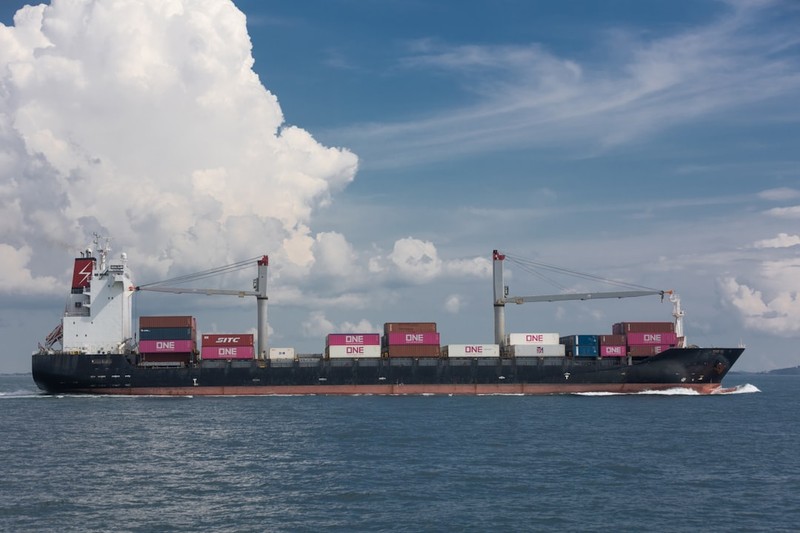
Governments do not typically use the phrase “unidentified flying objects” in official statements. The terminology belongs to science fiction and declassified Pentagon files, not the measured language of a foreign ministry briefing. Yet there was South Korea’s Foreign Ministry on Sunday, confirming that two “unidentified flying objects” struck a Korean-operated cargo vessel in the Strait of Hormuz on May 4, and declining — with careful precision — to say anything more about what they were.
The deliberate vagueness is the story.
What happened to the HMM Namu
At approximately 3:30 p.m. local time on Monday, two separate airborne objects struck the stern of the Panama-flagged cargo vessel Namu, operated by South Korean shipping firm HMM Co. The objects hit roughly one minute apart, Foreign Ministry spokesperson Park Il told reporters at a press conference in Seoul.
The first object is believed to have ignited a fire in the engine room. The second caused the blaze to spread rapidly. The impacts tore a 7-meter-wide rupture in the hull plating, reaching all the way to the interior of the vessel, according to the Yonhap News Agency.
There were 24 crew members aboard, including six South Korean nationals. No injuries or casualties were reported.
A seven-member government investigation team conducted an on-site inspection after the Namu was towed to a port in Dubai on Friday. They collected debris — including what Park described as “the flying object’s engine” — for further analysis. CCTV footage captured the objects in flight. But according to Park, there are “limitations in determining their exact type, origin and physical size.”
The investigation did rule out some possibilities. No abnormalities were found in the ship’s internal systems, effectively dismissing an accidental cause. “The likelihood of the objects being mines or torpedoes appears to be low,” Park said. That leaves the most probable explanation as something airborne — drones, missiles, or some other projectile — striking a ship in one of the most heavily monitored bodies of water on Earth.
The strategic virtue of not knowing
The Strait of Hormuz has been effectively blockaded since the US-Israeli war against Iran began in late February. The Namu was one of roughly 2,000 vessels stranded in those waters, according to Yonhap. In that context, a government announcing it cannot identify what hit its ship is either a genuine epistemic gap or a diplomatic choice — and the distinction matters enormously.
US President Donald Trump wasted no time filling the void. In a Truth Social post last Monday, he declared that Iran had “taken some shots” at the Korean cargo ship and urged Seoul to join the US-proposed Maritime Freedom Construct (MFC), a coalition aimed at keeping shipping lanes open through Hormuz. “Perhaps it’s time for South Korea to come and join,” he wrote.
Iran’s Embassy in Seoul issued a swift denial, saying it “firmly rejects and categorically denies any allegations regarding the involvement of the armed forces of the Islamic Republic of Iran in the incident.”
Seoul finds itself wedged between these positions. South Korea has been cautious about joining the US-led initiative, weighing its alliance with Washington against its economic and diplomatic ties with Tehran. The confirmed strike may shift that calculus. Experts quoted by The Korea Herald suggested the findings could serve as a “turning point” for Seoul, potentially opening the door to non-combat contributions such as intelligence sharing or the dispatch of liaison officers.
Park said a “close review is under way on the issue of joining US plans, including the Maritime Freedom Construct.” Any deployment of actual military assets — most likely the Cheonghae Unit, currently on anti-piracy operations off Somalia — would require National Assembly approval.
The debris may speak eventually
For now, the ambiguity holds. Park stressed that the government “will not jump to any conclusions” about who is responsible. The Iranian ambassador to South Korea, Saeed Koozechi, was summoned to the Foreign Ministry on Sunday — not for a protest, Park clarified, but to be briefed on the investigation’s findings. “Iran is one of the countries involved,” Park said.
The recovered debris, including the object’s engine, may eventually yield answers. But the current state of affairs — a government acknowledging an attack on its vessel while refusing to name the weapon or the perpetrator — suits almost everyone involved. Seoul avoids a confrontation with Tehran. Tehran maintains its denial. Washington keeps its pressure campaign intact.
The only party left without a narrative is the investigation team itself, staring at footage of something it has chosen not to identify, in a strait where everyone is watching everyone else, and no one is saying what they see.
Sources
- Seoul concludes ‘external strike’ caused explosion on HMM vessel in Hormuz — Yonhap News Agency
- Korean Foreign Ministry says ‘external strike’ caused HMM vessel explosion near Strait of Hormuz — Korea JoongAng Daily
- Confirmed strike on vessel may reshape Seoul’s stance on joining US-led Hormuz mission: experts — The Korea Herald
- South Korean-run vessel ablaze in Strait of Hormuz; Trump says Iran fired at the ship — The Straits Times
Discussion (9)