 lop News
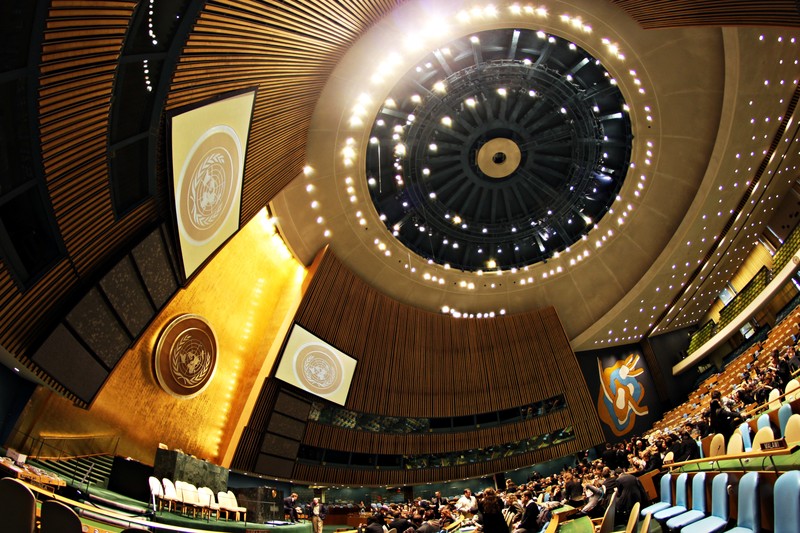
The vote at the United Nations General Assembly was 141 to 8, with 28 abstentions. By any diplomatic standard, a landslide. The resolution, adopted May 20, endorses last year’s landmark advisory opinion by the International Court of Justice, which declared that countries failing to combat climate change are violating international law.
What the resolution does not do is almost as important as what it does.
The original draft, spearheaded by the Pacific island nation of Vanuatu, called for a “rapid, just and quantified phase-out of fossil fuel production and use.” The final text uses softer language — a “transition away” from fossil fuels — mirroring the weakest formulation major emitters have accepted in previous climate negotiations. A provision to establish an “International Register of Damage” to document climate-related losses, a concrete step toward potential reparations, was replaced with a request for a report on the idea.
What the Court Actually Said
The ICJ’s advisory opinion, issued in July 2025, was unequivocal. States have legal duties to combat climate change under customary international law — not merely under the voluntary framework of the Paris Agreement. A state’s failure to act on fossil fuel production, exploration licenses, or subsidies “may constitute an international wrongful act which is attributable to that state,” the court wrote.
Advisory opinions are not legally binding. But they carry authoritative weight, and this one is already being cited in courtrooms. Greenpeace leveraged it in a successful claim against the Dutch government over its treatment of citizens on the Caribbean island of Bonaire. Korean farmers are using it to sue state-owned utility KEPCO for climate damages. A Brazilian judge cited it to order a coal plant shut down — though that ruling is currently on appeal.
The UNGA resolution, also non-binding, reinforces the opinion’s legal standing. Experts describe it as building a foundation for future climate litigation, even if the immediate political effect is limited.
Who Opposed It — and Why
The eight “no” votes came from the United States, Russia, Iran, Saudi Arabia, and four other nations — a roster dominated by major fossil fuel producers.
The Trump administration’s opposition was the most aggressive. According to reporting by the Associated Press, the State Department instructed all US embassies and consulates that the resolution “could pose a major threat to US industry” and urged Vanuatu to withdraw it entirely. Deputy US ambassador Tammy Bruce told the General Assembly the measure was “highly problematic,” adding that “the resolution includes inappropriate political demands relating to fossil fuels and on other climate topics.”
Vanuatu’s climate change minister, Ralph Regenvanu, described the pressure as “beyond what you’d expect a government to do.”
The EU, meanwhile, has “not been as helpful as we expected,” Regenvanu added.
What Was Lost
The most significant concession was the removal of the International Register of Damage — a mechanism that would have created a formal record of climate-related losses, potentially feeding into future reparations claims. Vanuatu’s climate justice envoy, Lee-Ann Sackett, called it a “really significant compromise.”
The stakes are not abstract. In Tuvalu, where the average elevation is two meters above sea level, more than a third of the population has applied for climate migration visas to Australia. By 2100, much of the country is projected to be underwater at high tide. In Nauru, the government has begun selling passports to wealthy foreigners to fund possible relocation. A single cyclone in 2015 wiped out 64 percent of Vanuatu’s GDP.
A Foundation, Not a Finish Line
Noah Gordon, a climate politics expert at the Carnegie Endowment for International Peace, described the resolution as “the beginning of the world building up a body of law for when the politics are different and the world takes more serious action on climate.”
“Judges and lawyers will look back at this as the foundation of international climate law that has teeth,” Gordon said.
The vote affirms a legal consensus. The text reflects how much of that consensus major polluters were willing to accept. The distance between those two things is where the next fight will be.
Discussion (10)