 lop News
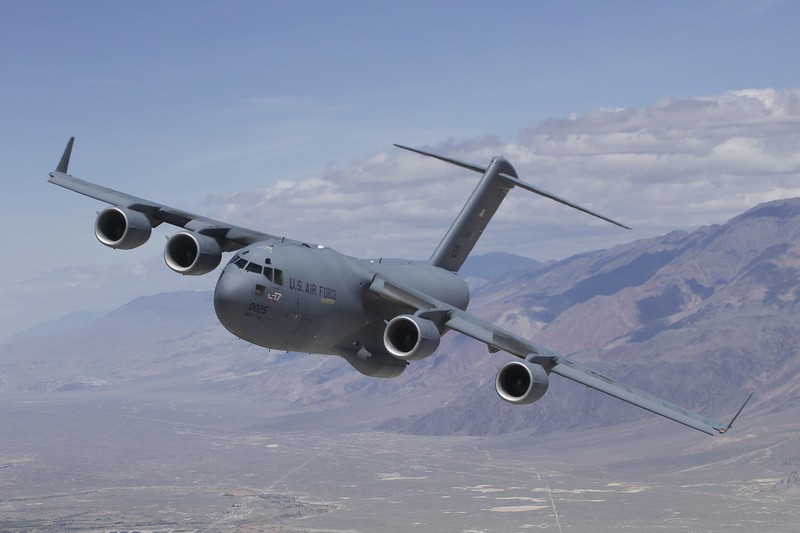
Two US Air Force C-17 Globemaster IIIs landed at Beijing Capital International Airport on consecutive days this week, their tail numbers — 088204 and 055140 — captured by aviation photographers and circulated on Chinese social media. By Saturday, the Britain-based flight tracking channel Armchair Admiral confirmed the arrivals and reported two additional C-17s apparently en route.
If the deployment was meant to be discreet, it failed.
The aircraft are the logistical backbone of presidential travel. C-17s routinely transport the full presidential motorcade — including the armoured limousine known as “The Beast” — along with secure communications gear, medical facilities, and security apparatus. Their presence in Beijing is the most concrete public indication yet that President Donald Trump’s anticipated visit to China this month is proceeding as planned.
What the Logistics Reveal
The scale of these operations is considerable. When Vice-President JD Vance travelled to Islamabad last month for peace talks with Iran, US forces reportedly deployed at least four C-17s carrying dozens of vehicles, according to the South China Morning Post. Trump’s Beijing visit, higher in profile and heavier in security requirements, will likely demand comparable or greater resources.
The arrivals carry diplomatic significance beyond their cargo. China granted permission for American military aircraft to land at its busiest commercial airport — a decision requiring senior-level approval in Beijing. That both governments permitted the imagery to circulate through open-source channels suggests neither wishes to minimise the visibility of the visit. For two capitals that calibrate every signal, that choice is deliberate.
A Summit at a Crowded Moment
The visit, anticipated within approximately two weeks per the SCMP, would intersect with an already dense foreign policy calendar. The Vance peace talks in Islamabad last month signal active Iran-related diplomacy, raising the question of whether Washington will use the Beijing summit to seek Chinese cooperation — or at minimum acquiescence — on sanctions enforcement or regional security arrangements tied to Iran.
China is Iran’s largest oil customer and has consistently resisted participating in Western sanctions on Tehran. If Trump raises the issue, he will be testing whether personal diplomacy with Xi can achieve what institutional pressure has not.
The bilateral trade file remains unresolved. American tariffs on Chinese goods, some dating to Trump’s first term and others imposed more recently under a broader economic decoupling strategy, continue to define the relationship. Beijing seeks tariff relief; Washington wants concessions on market access, technology transfer, and intellectual property protections. A direct Trump-Xi meeting could shift dynamics, though the first-term record offers caution: the two leaders have a history of producing striking optics alongside underwhelming policy outcomes.
The broader strategic competition has only deepened in recent years — over semiconductor export restrictions, Taiwan, and competing visions for technological supremacy. A summit does not resolve structural tensions, but it can establish channels for managing them. Or, if mishandled, widen them.
For Xi, the visit provides a stage to project diplomatic weight while China’s economy faces persistent headwinds and its European partnerships remain strained. For Trump, a productive summit could yield progress on tariffs or technology controls and offer a political counterweight to pressures elsewhere.
Regional allies will be watching. Any shift in the Washington-Beijing dynamic carries implications for Japan, South Korea, and Southeast Asian states navigating their own relationships with China. A summit that produces trade progress but raises questions about American commitment to regional security would not go unnoticed in Tokyo or Seoul.
The Calculus of Visibility
The C-17s on a Beijing runway are, in one sense, routine. Advance teams have pre-positioned equipment for presidential visits for decades. But routine logistics can double as deliberate diplomacy. The decision to fly military aircraft into Chinese airspace — and to allow the deployment to be photographed and shared — required coordination between governments that have spent years erecting barriers to engagement.
Neither Washington nor Beijing has formally confirmed summit dates. The planes are the strongest public evidence that the visit is imminent.
Whether the meeting produces agreements or remains largely performative is uncertain. The preparations, however, are visible. The tail numbers are documented. The cargo is on the ground.
Discussion (8)