 lop News
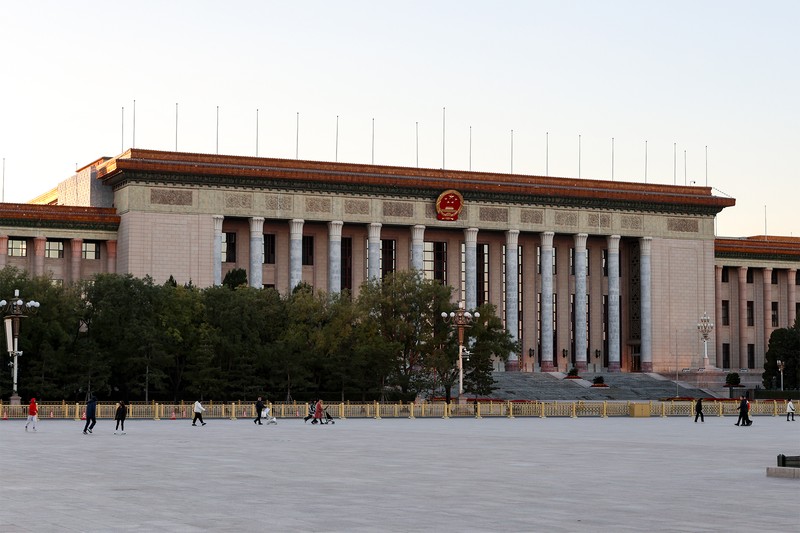
The Strait of Hormuz is shut. Global energy markets are reeling. And on Wednesday evening, Donald Trump will touch down in Beijing to sit across from Xi Jinping and try to keep the world’s most consequential bilateral relationship from fraying under the weight of crises neither leader fully controls.
The US president arrives with Boeing executives and agricultural representatives in tow, according to Al Jazeera, and an agenda that runs from Iran to rare earth minerals to Taiwan. The trip was supposed to happen earlier this year but was postponed in March when the US-Israel military campaign against Iran made the timing impossible. The war has only escalated since.
By the time the two leaders meet for Thursday’s opening ceremony, the stakes will have compounded well beyond the usual diplomatic choreography. According to Al Jazeera, the talks are expected to cover Iran, trade, rare earth minerals, and China’s support for Russia — an agenda so broad it functions as a register of everything that has gone wrong since Trump and Xi last sat down together.
The Busan Truce Holds — Barely
Last October, at a summit in Busan, the two leaders agreed to a one-year trade truce that has proved more durable than most observers predicted. Patricia M Kim, a fellow at the Brookings Institution’s China Center and Center for Asia Policy Studies, notes that the relative steadiness in US-China relations is “striking” given the turmoil elsewhere.
The explanation is structural. Despite years of talk about decoupling, Washington and Beijing remain locked in mutual dependency. China dominates the rare earth supply chains essential to electric vehicles and advanced defence systems. The US, in turn, controls access to high-end semiconductors capable of crippling key Chinese firms if export restrictions are tightened.
“Until both sides reduce these dependencies, a managed truce may be the least risky path forward,” Kim writes.
The question hovering over Beijing this week is whether that truce can absorb the shock of the Iran war.
The Iran Problem
The conflict has put both leaders in uncomfortable positions. Iran closed the Strait of Hormuz in response to US-Israeli strikes, choking off a passage that handles roughly a fifth of global oil consumption. Asian economies — dependent on Middle Eastern imports — have been hit hardest.
China has hosted Iranian Foreign Minister Abbas Araghchi and called for an end to the war. But Beijing has also refused to recognise Washington’s unilateral sanctions on Iran’s oil sector, and US Treasury Secretary Scott Bessent last week accused China of effectively “funding” Tehran.
“Iran is the largest state sponsor of terrorism, and China has been buying 90 percent of their energy, so they are funding the largest state sponsor of terrorism,” Bessent told Fox News.
A senior administration official, briefing reporters anonymously, said Trump could “apply pressure” on China over its purchases of Iranian oil and Tehran’s acquisition of potential dual-role military-civilian goods. According to Channel News Asia, the US has also accused China of possibly having shipped shoulder-fired missiles to Iran.
China’s calculus is different. It has sharpened its legal tools to counter what it calls US “long-arm jurisdiction” over Chinese entities facilitating the oil trade. Beijing wants the war to end — but on terms that don’t surrender its energy relationships or its resistance to American sanctions regimes.
Both sides, Kim argues, appear to have reached a tacit understanding: for now, stability serves their interests better than escalation. Whether that understanding survives a sustained American pressure campaign on Iranian oil is another matter.
Rare Earths and the Trump Card
Rare earth minerals give Xi something tangible to bargain with — or withhold. In recent months, Beijing has signalled it is willing to use its dominance of these supply chains as leverage, including against Japan following a diplomatic spat over Taiwan.
That posture has rattled Asian governments already squeezed between the two powers. In Southeast Asia, countries like Vietnam and Malaysia have become key manufacturing hubs, importing Chinese raw materials and exporting finished goods to the US. A renewed trade confrontation could force them to choose between limiting Chinese inputs or facing higher American tariffs.
Kim warns that if Washington secures its own rare earth supply while leaving partners exposed, it would send “a troubling signal about the reliability of US economic leadership” — and risk further erosion of American alliances in the region.
For Trump, the leverage runs in the opposite direction. The US military escalation in the Gulf, whatever its domestic controversies, gives Washington weight in any conversation about Middle Eastern stability — a priority for Beijing, which needs the flow of energy to resume.
Taiwan: The Unresolved Core
No US-China summit avoids Taiwan for long. The administration official briefing reporters said no change was expected in the US stance on the island, which China considers part of its territory but which maintains deep security and economic ties with Washington.
China has long sought an explicit US statement opposing Taiwanese independence, going beyond the longstanding American position of simply not supporting it. The risk, as Kim frames it, is not a formal policy shift but something less predictable — an off-the-cuff remark by Trump that seems to align Washington more closely with Beijing’s position, at Taipei’s expense.
Such a moment would shake confidence not only in Taiwan but across a region already uncertain about the durability of American commitments.
The Most Likely Outcome: Nothing Dramatic
Like the Busan summit before it, the Beijing meeting is likely to be less about breakthroughs than about trajectory. The most probable outcome, according to Kim’s analysis, is a continuation of the status quo: an extension of the trade truce, a mutual effort to avoid escalation, and a shared recognition that neither side is ready for a more ambitious agenda.
For many Asian governments, that may be sufficient. Stability, even uneasy stability, has value when the alternative is a chain reaction of crises no one controls.
But as Kim notes, that stability is not guaranteed. If either side concludes the other is violating their understanding — or if new disruptions knock the balance loose — the détente could come apart fast.
“The question is not whether the United States and China will compete, but whether they can do so without destabilising the region — and at what cost if they cannot,” she writes.
Two leaders. One table. Cascading crises. The math doesn’t need to be complicated to be consequential.
Sources
- Trump to discuss Iran with Xi Jinping during China visit: Officials — Al Jazeera
- Commentary: What the Trump-Xi meeting in Beijing means for Asia — Channel News Asia
Discussion (14)