 lop News
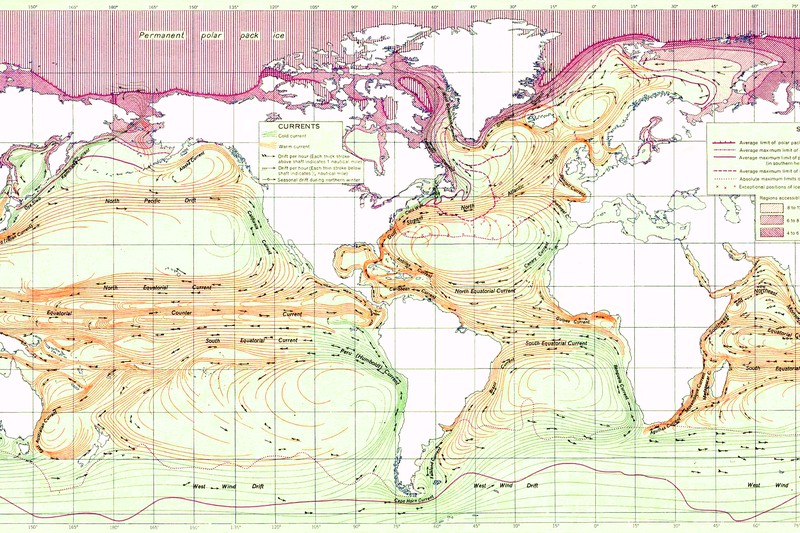
Four sensors, anchored to the deep ocean floor along the western edge of the North Atlantic, have been quietly recording water temperature, salinity, and current velocity since 2004. Twenty years of continuous measurements from all four sites now point in the same direction: the Atlantic Meridional Overturning Circulation — the vast current system that carries warm tropical water northward and keeps Europe’s winters livable — is getting weaker.
This is not a computer projection. It is the ocean, measured directly.
The findings come from a University of Miami study analyzing data from four moorings at different latitudes along the Atlantic’s western boundary. Weakening was detected at every site. Shane Elipot, a physical oceanographer at the University of Miami and co-author of the study, told CNN that the western boundary is “the canary in a coal mine” for the AMOC as a whole.
What the AMOC Actually Does
The AMOC functions as a planet-scale conveyor belt. Warm surface water flows north from the tropics, releases heat into the atmosphere over the North Atlantic — warming Western Europe — then cools, becomes denser, and sinks to the ocean floor, where it flows back south. Beneath it, a deeper cell carries Antarctic Bottom Water, the coldest, densest water mass on Earth, northward along the seafloor. Together, these cells transport up to 25 percent of the planet’s net ocean and atmosphere heat, according to NOAA.
When the circulation slows, the consequences cascade. Europe faces harsher winters and prolonged summer droughts. The tropical rainfall belt that millions depend on for agriculture shifts unpredictably. Sea levels along the US East Coast rise faster than the global average. A full AMOC collapse — which last occurred roughly 12,000 years ago — would be, in the words of Potsdam oceanographer Stefan Rahmstorf, who has studied the system for 35 years, something to avoid “at all costs.”
The Numbers
A second study, published this month in Science Advances, combined real-world observations with climate models to project the AMOC’s future. Led by Valentin Portmann of the Inria Centre de recherche Bordeaux Sud-Ouest in France, the research used a statistical method called ridge regression to identify which climate models best matched observed conditions — particularly surface salinity in the South Atlantic, a known key variable.
The results narrowed years of uncertainty into a sobering band: an estimated slowdown of 42 to 58 percent by 2100 under a mid-range emissions scenario, with a midpoint around 51 percent. That is roughly 60 percent more severe than the average across all climate models, according to CNN. Portmann told AFP the estimate was “more severe than we expected.”
The UN’s Intergovernmental Panel on Climate Change said in 2021 that an AMOC collapse before 2100 was unlikely. The new research challenges that confidence. Rahmstorf, who was not involved in either study, said the findings show that “pessimistic” models — those projecting the steepest decline — “are unfortunately the realistic ones.” He warned the AMOC could pass a tipping point, beyond which shutdown becomes unstoppable, as early as mid-century. Greenland ice-sheet melt, which further freshens surface waters and is not included in current models, could make the reality even worse.
Why the Observational Record Matters
Climate model projections for 2100 range from a modest 3 percent slowdown to a 72 percent collapse, depending on the model and emissions scenario. That wide spread has fed legitimate scientific disagreement about how urgent the problem is.
The observational record narrows it. “The worrying part is that the same models are predicting that the AMOC is likely going towards a tipping point where it eventually shuts down,” Elipot said. The real-world data validates the models showing the steepest decline.
Not everyone is ready to close the case. Florian Sevellec, a research director at France’s CNRS, cautioned that “one paper does not settle a scientific debate.” Fabien Roquet, a physical oceanography professor at the University of Gothenburg, noted that another team using similar methods reached different conclusions last year.
Still, a separate NOAA-led study found that the AMOC’s deep abyssal limb weakened by roughly 12 percent between 2000 and 2020 at 16°N latitude, contributing to deep-ocean warming and 2.8 millimeters of sea-level rise in the region. Even the planet’s most remote depths are responding to what is happening at the surface.
The moorings are still down there, recording. The question is whether anyone is listening.
Sources
- A vital system of Atlantic Ocean currents is weakening and closer to collapse than previously thought — CNN
- Critical Atlantic current significantly more likely to collapse than thought — The Guardian
- Key Atlantic current could weaken more than expected: study — AFP / France24
- The Atlantic Meridional Overturning Circulation is weakening in the deep sea of North Atlantic — NOAA Atlantic Oceanographic and Meteorological Laboratory
Discussion (8)