 lop News
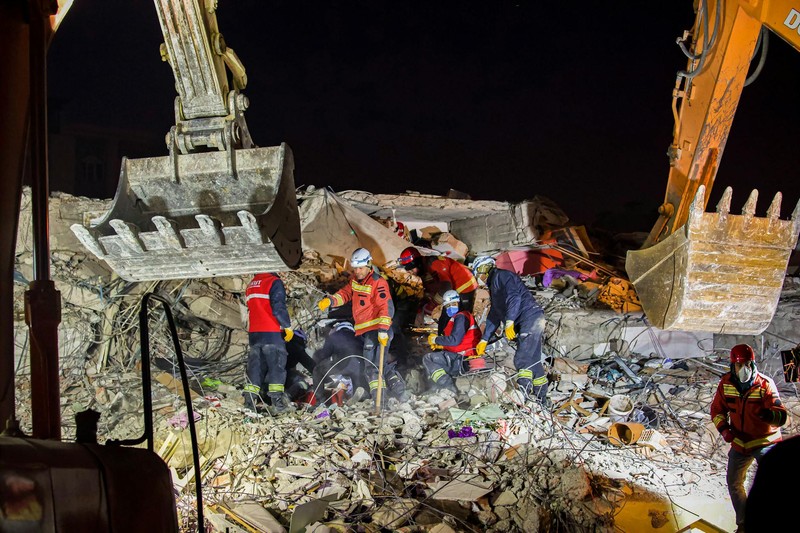
The earthquake struck at 12:21 a.m., while most of Liuzhou’s four million residents were asleep. By dawn, thirteen buildings had been reduced to rubble, a married couple was dead, and more than 7,000 people had been forced from their homes in southwestern China.
The magnitude-5.2 temblor centered on Taiyangcun town in the Liunan district of Liuzhou, a city in China’s Guangxi Zhuang autonomous region roughly 190 kilometers northeast of the regional capital, Nanning. According to the Guangxi Earthquake Administration, the quake originated at a depth of just 8 kilometers — shallow enough to amplify surface destruction significantly. Both the US Geological Survey and China’s seismological agency measured the event at 5.2 magnitude.
State broadcaster CCTV identified the two confirmed fatalities as a married couple, a 63-year-old man and a 53-year-old woman. One person remains unaccounted for, according to the local earthquake relief headquarters. Four others were hospitalized with injuries that were not life-threatening.
A predawn scramble
Tremors rippled across a wide swath of southern China. Residents in Guigang, Wuzhou, Hechi, and Nanning — cities spread across hundreds of kilometers of Guangxi — reported feeling the ground move. The shaking traveled far enough to register in Hong Kong, roughly 550 kilometers to the southeast, where the Hong Kong Observatory received more than ten calls from residents who felt the tremor. The Observatory estimated local intensity at II on the Modified Mercalli scale — perceptible mainly to people at rest on upper floors of tall buildings.
It was Liuzhou, a major industrial and transport hub in Guangxi, that bore the brunt. Video footage released by CCTV showed residents pouring out of high-rise apartment blocks into the pre-dawn darkness, some still in nightclothes. Other clips revealed piles of concrete rubble where homes had stood, rescue workers in orange vests clambering over debris alongside sniffer dogs, and heavy earthmovers clearing wreckage under portable floodlights. The footage captured the disorienting aftermath of a shallow quake: structures pancaked flat, personal belongings scattered across roads, neighbors helping neighbors navigate debris-choked streets in the dark.
The rescue response was swift. By 2 a.m. — less than two hours after the initial shock — 51 fire and rescue vehicles and 315 personnel were operating in the affected zone, according to emergency services cited by multiple news outlets. Rescue teams comprising emergency management staff, police, firefighters, and specialized crews conducted searches through the night, with a particular focus on locating the one person still missing.
Not China’s earthquake country
Here is what makes the structural damage notable: Guangxi is not earthquake country. The region sits along fault systems that thread through southern China, but it ranks far below Sichuan, Yunnan, and the Tibetan plateau in seismic risk. The catastrophic earthquakes that have defined China’s modern disaster history — the 2008 Wenchuan earthquake that killed nearly 70,000 people, the 2010 Yushu quake that claimed over 2,000 lives, the 2014 Ludian tremor that devastated parts of Yunnan — all struck hundreds of kilometers to the west, along the collision zone where the Indian tectonic plate grinds into the Eurasian plate.
A magnitude-5.2 event is, by global standards, modest. The USGS records dozens of earthquakes of this magnitude worldwide every year; most cause limited damage.
Two factors compounded the impact in Liuzhou. The first was depth. Earthquakes originating within 10 kilometers of the surface transmit a disproportionate share of their energy directly into structures above, rather than dissipating it through intervening rock layers. A shallow 5.2 can inflict damage comparable to a significantly deeper quake of larger magnitude.
The second factor was preparedness — or the lack of it. Guangxi’s buildings were not designed with frequent seismic activity in mind. The collapse of more than a dozen structures in a region unaccustomed to significant shaking raises immediate questions about local construction standards and retrofitting practices. China overhauled its building codes after the 2008 Wenchuan disaster, which exposed the catastrophic failure of thousands of structures, including schools full of children. The revised standards mandated stricter seismic requirements for new construction in designated high-risk zones. How rigorously those standards have been applied in a lower-risk region like Guangxi is a question that engineers and local officials will now have to confront.
The response cascade
China’s emergency apparatus activated through multiple tiers in the hours after the quake. Guangxi’s regional earthquake relief headquarters declared a Level-III emergency response at 2 a.m. The China Earthquake Administration matched it with its own Level-III activation. The State Council’s earthquake relief headquarters and the Ministry of Emergency Management then escalated to a Level-IV national response — the lowest tier of China’s formal earthquake emergency framework, but still a coordinated deployment that brought a central government working group directly to the affected area to guide rescue and relief operations.
The tiered system was reformed after 2008, when coordination failures between local and national authorities hampered the early response to the Wenchuan disaster. Level IV commits central resources — specialists, equipment, assessment teams — to supplement local efforts on the ground.
Local authorities were instructed to verify casualties and damage as quickly as possible, push forward search and rescue operations, evacuate affected residents, and maintain close monitoring for aftershocks. Railway authorities warned of possible disruptions as engineers inspected the integrity of rail lines running through the corridor — a significant transport artery connecting southern China’s industrial cities.
As of early Monday, basic infrastructure in the quake zone remained functional. Communications networks, power lines, water and gas supply, and road transportation were all operating normally, according to state media. That represents a significant contrast with many previous Chinese earthquake disasters, where destroyed infrastructure has historically compounded rescue efforts for days.
What comes next
The immediate priority remains the search for the missing person. Beyond that, the full scope of structural damage across Liuzhou’s districts is still being catalogued. Thirteen buildings are confirmed collapsed. The number of structures suffering serious damage that will require demolition or extensive reinforcement is almost certainly higher and will take days to assess fully.
No international aid appeals had been issued as of Monday morning. The Level-IV national response classification signals that Chinese authorities consider the disaster manageable within existing domestic resources — consistent with an event that, while devastating for those directly affected, falls well below the threshold of China’s catastrophic seismic disasters.
For the thousands of Liuzhou residents who spent the night in emergency shelters, the return home will bring its own reckoning. Some will find cracked walls and broken windows. Others will find nothing left standing to return to. The earthquake that shook them awake in the dark has already taken two lives and left one person unaccounted for. What it has done to the rest of their community is still being measured.
Sources
- Earthquake hits southwest China; thousands evacuate, buildings collapse — Channel News Asia
- 2 dead, 1 missing after 5.2-magnitude quake hits China’s Guangxi — China Daily Asia
- Several Buildings Collapse After 5.2 Earthquake Hits China — Times Now News
- 5.2-magnitude earthquake strikes Guangxi, tremor felt in HK — The Standard (Hong Kong)
Discussion (12)