 lop News
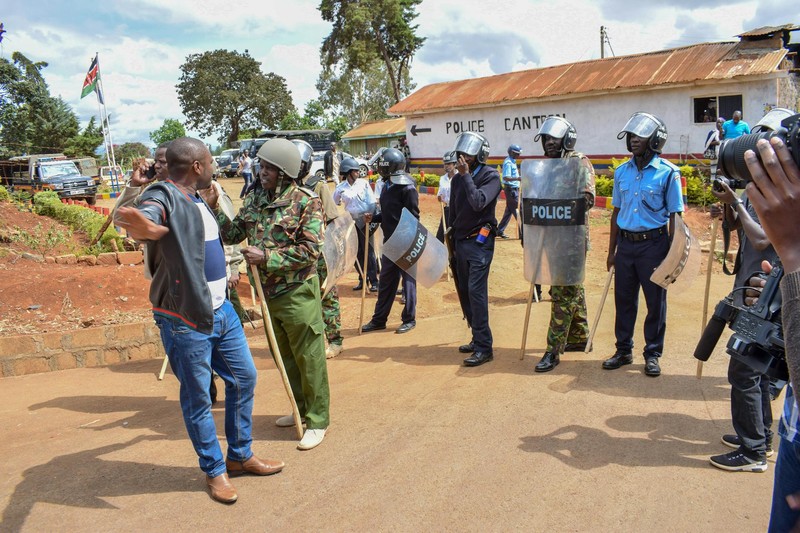
Two people are dead in central Kenya after police opened fire on protesters demonstrating against a US-backed Ebola quarantine facility — a project a High Court judge has now blocked for a second time while demanding the government come clean about its deal with Washington.
Protest organizer Patrick Wahome said both victims died of gunshot wounds after police confronted hundreds of demonstrators Monday in Nanyuki, the town nearest to Laikipia Air Base, where the 50-bed isolation unit was being built. A security source confirmed the deaths to Reuters. Police spokesperson Michael Muchiri said he was not aware of them.
On Tuesday, Justice Patricia Nyaundi extended her court’s suspension of the facility and ordered Kenya’s cabinet secretary for health to publicly disclose the full agreement with the US — including health and biosafety assessments, regulatory approvals, and operational protocols. The court also barred authorities from admitting anyone exposed to or infected with Ebola under the arrangement.
That the court had to order disclosure at all tells you something about the transparency of the deal.
A facility for Americans, on Kenyan military soil
The quarantine unit was designed to house American citizens exposed to the Bundibugyo strain of Ebola in the Democratic Republic of Congo or Uganda — more than 1,500 miles away. Kenya has recorded zero Ebola cases.
Trump administration officials described the planned facility as “state-of-the-art” and said it would provide “high-quality care for Americans who would need to quickly get out of DRC and quarantine without the risks of a lengthy transport back to the US.” A US Public Health Service team including physicians, nurses, and laboratory technologists had already begun deploying to the base, according to CNN.
The reasoning has a certain logic: the outbreak in eastern DRC has produced more than 1,000 suspected cases and over 220 deaths since it was declared on May 15, and it is outpacing the global response. The Bundibugyo strain has no approved vaccine or treatment. Seven cases have been confirmed in neighboring Uganda, with one death.
But the optics are difficult to ignore. Secretary of State Marco Rubio declared the US “cannot and will not allow any cases of Ebola to enter the United States.” An American doctor who contracted Ebola in DRC was evacuated to Germany last month. Another exposed US national was sent to the Czech Republic. The message, whether intended or not, reads plainly: Ebola is too dangerous to bring home, but manageable enough in Kenya.
“A containment colony”
Kenya’s doctors have been unsparing. The Kenya Medical Practitioners, Pharmacists and Dentists Union (KMPDU), representing more than 10,000 doctors, accused the government of “backdoor negotiations” and warned it would not “sit back and watch Kenya be treated as a containment colony for a lethal pathogen that we did not generate.”
“If it is too dangerous for America, it is too dangerous for Kenya,” the union stated.
KMPDU also objected to reports that the facility would be staffed entirely by US personnel, calling it “an apartheid healthcare model on Kenyan soil,” and gave the government 48 hours to disclose details or face nationwide industrial action.
President William Ruto, addressing the controversy for the first time on Monday, said he approved the facility after Trump asked Kenya to support it, citing decades of cooperation on HIV/AIDS, Ebola, and COVID-19. He said the base unit was no different from other preparedness facilities across 23 Kenyan counties and would serve Kenyans as well as foreign nationals.
“We are a responsible government. We know what we are doing,” Ruto told reporters.
US officials have not confirmed that the facility would treat non-Americans. RFI reported that Nairobi and Washington disagreed on precisely this point — Kenya favored opening it to all nationalities; the White House wanted access restricted to US citizens.
The court demands answers
Despite the court’s original suspension order, issued last Thursday, US military aircraft continued flying in staff and equipment over the weekend, according to a US official and diplomatic sources cited by Reuters. Satellite imagery obtained by the BBC showed an area just over the size of three football pitches had been cleared at the base between Monday and Friday.
The Katiba Institute, the rights group that brought the lawsuit, argued that the “secretive, unilateral establishment” of the facility raised “grave constitutional concerns regarding the rights to life, health, fair administrative action, public participation and parliamentary oversight.”
What exactly the US-Kenya agreement contains remains unknown. The court’s order gives the government a deadline to fix that.
Washington has pledged $13.5 million for Kenya’s Ebola preparedness, part of a broader $112 million regional commitment. Meanwhile, funding pledged to fight the outbreak across Africa has nearly halved in recent days, according to Africa CDC director general Jean Kaseya, dropping from roughly $500 million to $290 million after unnamed donors backed out.
“People are dying,” Kaseya told reporters. “How can we come and say: we commit X million dollars, and the next day they are calling me to say no, it was a mistake?”
Two people are dead. A court is demanding answers. And the question at the center of all of it — why the United States would park its medical risk in an African country with no cases of the disease — is the one nobody in Washington or Nairobi has answered.
Sources
- Two Killed in Kenya Protest Against US Ebola Quarantine Facility, Protest Organizer Says — Asharq Al-Awsat (Reuters)
- High Court orders Kenya government to release details of Ebola facility — Al Jazeera
- Kenya court halts opening of US Ebola quarantine facility in the country — BBC
- Kenya pushes ahead with Ebola quarantine facility in partnership with US despite court order — CNN
- Kenya high court suspends plan to open US Ebola quarantine centre — RFI
Discussion (10)