 lop News
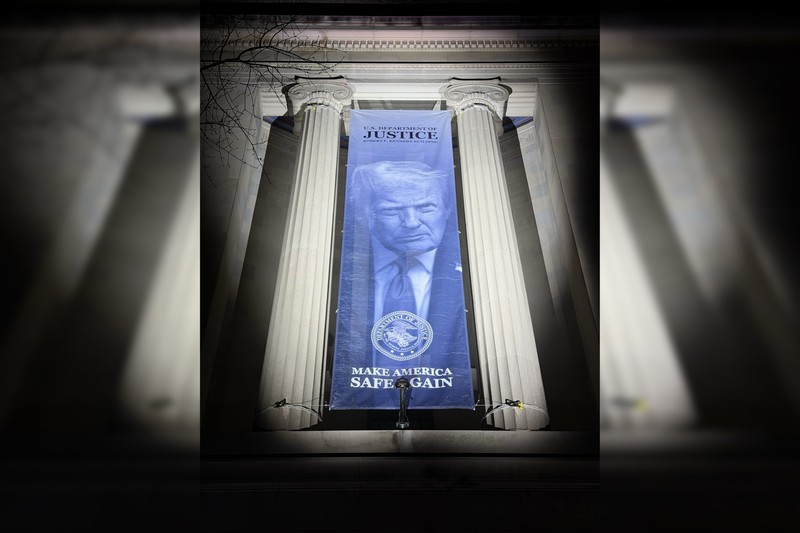
The president sued his own government. His own government settled. And $1.776 billion in taxpayer money will now flow through a fund controlled by the president’s Justice Department, earmarked for his political allies.
On Monday, President Donald Trump voluntarily dismissed his $10 billion lawsuit against the Internal Revenue Service over the leak of his tax returns. The Justice Department, on the same day, announced the creation of the “Anti-Weaponization Fund” — a pool to compensate individuals who claim they were mistreated by the Biden-era Justice Department. Acting Attorney General Todd Blanche described it as “a lawful process for victims of lawfare and weaponization to be heard and seek redress.”
The transaction took five months from filing to resolution. In that time, a sitting president turned a personal grievance into public expenditure, and the institutional guardrails designed to prevent exactly this were never engaged.
A Case Where the Plaintiff Controlled Both Sides
The legal tension was structural from the start. As president, Trump oversees both the IRS and the Justice Department. He sued an agency run by his own appointees, and those same appointees negotiated the settlement. Court-appointed attorneys flagged this in a May 14 brief, writing that “the circumstances raise the specter that Defendants and their attorneys may instead be operating at the President’s direction” rather than exercising independent judgment.
US District Judge Kathleen Williams had appointed the advisors to examine whether a genuine legal controversy existed — a threshold requirement for any lawsuit. Trump’s attorneys argued in their Monday filing that the resolution was not reviewable by any judge. Ninety-three members of Congress have filed a brief challenging that assertion.
The core problem was stated plainly by Andrew Warren, deputy legal director at the Democracy Defenders Fund: “Anyone who got through their first day of law school knows you can’t sue yourself.”
Who Gets the Money
The precise beneficiaries have not been disclosed. But the likely recipients map neatly onto the president’s political orbit.
More than 1,500 January 6 rioters — pardoned or given commuted sentences by Trump on his first day back in office — would be eligible for compensation, according to ABC News. Also potentially eligible: associates investigated during the Trump-Russia inquiry and individuals charged in connection with efforts to overturn the 2020 election.
The fund would be drawn from the Treasury Department’s Judgment Fund, a pool of taxpayer money reserved for court judgments and settlements against the government. At $1.776 billion, it would be five times larger than any single payout from that fund between January 2020 and September 2025, according to a February amicus brief cited by The Guardian.
A Lawsuit With Weak Foundations
The underlying lawsuit had genuine origins. Former IRS contractor Charles Littlejohn was sentenced to five years in prison in January 2024 after pleading guilty to leaking Trump’s tax information to The New York Times and ProPublica. The resulting reporting revealed that Trump paid $750 in federal income tax his first year in the White House and nothing in several other years.
But the case had substantial legal weaknesses. Civil damage claims under the IRS tax code must be filed within two years of discovering an unauthorized disclosure. Trump’s returns were leaked in 2019 and widely reported by 2020; his lawsuit was filed in January 2026. Additionally, Littlejohn was a private contractor, not a government employee — a distinction the relevant statutes require. The Justice Department could have raised either defense. It raised neither.
Unsettled Terms
The full settlement terms have not been made public. The New York Times reported that Trump was also seeking to have the IRS drop audits of himself, his family, and his businesses. A 2024 Times investigation found Trump could owe more than $100 million if the IRS revised its position on a single Chicago property.
Whether the audit issue is part of the agreement has not been confirmed.
A Global Signal
For democracies that have looked to the United States as a reference point for institutional independence — however imperfect — the mechanics of this episode are the message.
A president filed a personal lawsuit against an agency he controls. His Justice Department declined to mount available legal defenses. The case was resolved through a fund that routes public money to his political supporters. The entire sequence, from filing to dismissal, took less than five months.
Donald Sherman of Citizens for Responsibility and Ethics in Washington called Trump “the most stunningly corrupt chief executive this country has ever had.” Rep. Jamie Raskin, the top Democrat on the House Judiciary Committee, described the arrangement as a scheme to direct taxpayer dollars into what he called “a huge slush fund.” Skye Perryman of Democracy Forward called the case “a sham” and pledged to keep fighting.
The outrage is documented. The institutional capacity to reverse what has been done is less clear.
Sources
- Justice Department announces a $1.7B fund to compensate Trump allies in a deal to drop IRS suit — AP News
- Trump may settle his lawsuit against IRS for $1.7bn fund to compensate allies — The Guardian
- Trump Drops $10 Billion Lawsuit Against IRS—But He Could Be Looking For Billion-Dollar Payday — Forbes
Discussion (10)