 lop News
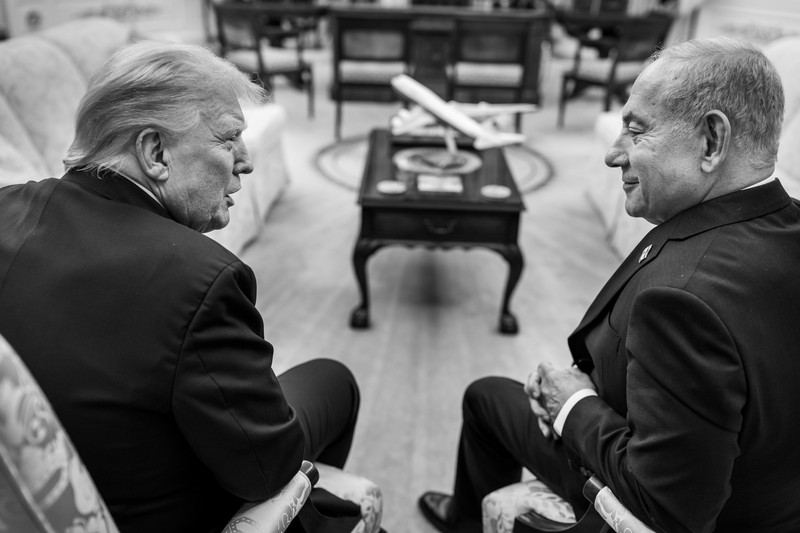
“Within two weeks, maybe two weeks, maybe three.”
With that deliberately casual phrase, delivered in the Oval Office on Tuesday, President Donald Trump attached the most specific deadline yet to a month-long war that has reordered the Middle East, killed thousands, and sent global energy prices spiraling.
The declaration marks a sharp shift. For weeks, the administration has offered only vague signals about an exit from the military campaign against Iran. Now Trump has put a number on it — and said no deal with Tehran is required.
“Iran doesn’t have to make a deal, no,” he told reporters. “No, they don’t have to make a deal with me.” The sole condition for withdrawal, he said, was that Iran be “put into the stone ages” — rendered incapable of building a nuclear weapon. “Then we’ll leave.”
The White House announced that Trump will address the nation Wednesday at 9 pm ET with what press secretary Karoline Leavitt called “an important update on Iran.”
The Public Wants Out
The timeline lands in a political environment that has turned sharply against the war. A Reuters/Ipsos poll conducted Friday through Sunday found that 66 percent of Americans believe the US should end its involvement quickly, even if the administration’s stated goals go unmet. Only 27 percent favored continuing until all objectives are achieved.
The numbers reach into Trump’s own coalition. Forty percent of Republicans said they favored a quick exit regardless of goals met. Overall, 60 percent of respondents said they disapproved of the military strikes on Iran in the first place.
The pressure is overwhelmingly economic. Average US gas prices surpassed $4 a gallon on Monday, the highest since 2022, according to price-tracking service GasBuddy. Two in three poll respondents said they expect fuel costs to keep rising, including 40 percent of Republicans. More than half said the conflict would have a mostly negative impact on their personal finances.
Republicans face midterm elections in November holding slim congressional majorities. The incumbent president’s party typically loses ground in midterms — and a war dragging into summer with pump prices to match is the kind of backdrop that costs seats.
A War That Keeps Expanding
On the same day Trump declared the end was weeks away, the fighting showed no sign of ebbing.
US and Israeli forces launched a new wave of strikes on Iran Monday, hitting targets across Tehran and damaging a petrochemicals plant in Tabriz, according to Iranian state media. Israeli Prime Minister Benjamin Netanyahu declared the campaign had “changed the face of the Middle East” and vowed to “continue to crush the terror regime.” He described the war as “definitely beyond the halfway point” in terms of missions — but pointedly declined to put a timetable on it.
Iran’s retaliation has spread across the region. Missiles struck a power and desalination plant in Kuwait, killing one worker and wounding ten soldiers, according to Kuwait’s state news agency. Saudi Arabia intercepted five missiles over its oil-rich Eastern Province. A fireball erupted over Dubai during a missile interception. A Haifa oil refinery caught fire for the second time in the war. NATO air defenses shot down a ballistic missile over Turkey — the fourth such interception since the conflict began.
In southern Lebanon, where Israel is fighting Iran-backed Hezbollah, three Indonesian UN peacekeepers were killed in less than 24 hours, prompting France to request an emergency Security Council session. Israel’s military said it was reviewing whether the deaths resulted from Hezbollah activity or Israeli fire. Netanyahu announced over the weekend that Israel would expand its ground invasion.
Iranian photojournalist Yalda Moaiery, speaking to CNN from inside the country, described conditions at odds with any talk of a clean conclusion. “We do not know if we have water or electricity,” she said. “The sounds of the bombs, the smokes are everywhere. People are really tired of this.”
The death toll continues to mount. Iranian authorities report more than 1,900 killed. Lebanon has counted over 1,200 dead and more than a million displaced. Nineteen people have been killed in Israel, 13 US service members have died, and two dozen have been killed in Gulf states and the occupied West Bank.
A Negotiation That Both Sides Deny
The diplomacy that might underpin Trump’s timeline is, by both sides’ accounts, barely occurring.
Trump told the New York Post that the US is negotiating with Iranian parliament speaker Mohammad Bagher Qalibaf. Qalibaf dismissed the Pakistan-facilitated talks as cover for American troop deployments and warned that Iranian forces were “waiting for the arrival of American troops on the ground to set them on fire and punish their regional partners forever.”
Iranian Foreign Minister Abbas Araghchi told Al Jazeera that while he still receives messages from US envoy Steve Witkoff, “this does not mean that we are in negotiations.” Iran’s foreign ministry spokesman, Esmail Baghaei, called the administration’s 15-point proposal “excessive, unrealistic and irrational.”
Iranian President Masoud Pezeshkian told European Council President António Costa that Tehran has the “necessary will” to end the war — but only with guarantees that Israel and the US would not attack again. An EU official confirmed to CNN that Pezeshkian’s position was consistent in his private remarks. Trump has shown no interest in offering such guarantees.
The IRGC, meanwhile, threatened to attack 17 American technology companies — including Apple, Microsoft, Google, Tesla, and Boeing — if more Iranian leaders are killed, according to the semi-official outlet Fars. The statement called on employees of those firms in the region to evacuate.
The Strait Nobody Wants to Clear
Perhaps the largest gap between Trump’s timeline and reality is the Strait of Hormuz, the narrow waterway through which a fifth of the world’s oil passes in peacetime. Iran’s blockade has effectively closed it. Brent crude trades around $115 a barrel, up nearly 60 percent since the war began.
Trump has decided the strait is no longer America’s problem. “If France or some other country wants to get oil or gas, they’ll go up through the Hormuz Strait,” he told reporters. On Truth Social, he was blunter: “The USA won’t be there to help you anymore, just like you weren’t there for us. Iran has been, essentially, decimated. The hard part is done. Go get your own oil!”
Even if the shooting stops, shipping will not resume quickly. Insurance premiums remain sky-high. The waters are exposed to mines and explosive drones. At least seven seafarers have died and more than a dozen vessels have been attacked. Angad Banga, CEO of the Hong Kong-based Caravel Group, which oversees the world’s second-largest ship management company, said persuading maritime workers to return will “continue to cause challenges for the supply chain.”
The Third Timeline
Trita Parsi, a foreign policy expert at the Quincy Institute, noted a pattern. “Remember, at first they said that this war would be over in four days. Then, three weeks ago, they said it would take three weeks. Three weeks have passed, and now we hear that it’s two to three weeks.”
“The timeline just keeps on being extended because, at the end of the day, the United States is no longer in control of this war,” Parsi told Al Jazeera. He described the “Stone Age” standard as “essentially the Israelisation of America’s war aims” — a strategy of periodic devastation with no achievable political endpoint, what he called a “mowing the lawn” approach.
Two to three weeks is the most specific deadline Trump has named. It is also the third such deadline he has offered. The question is whether the fourth is already being drafted.
Sources
- Trump says U.S. could end Iran war in two to three weeks — Reuters
- Two-thirds of Americans want quick end to Iran war even if goals unachieved — Reuters
- Trump again threatens widespread destruction in Iran if a deal is not reached ‘shortly’ — AP News
- Trump tells allies ‘get your own oil’, says Iran war could end in 2-3 weeks — Al Jazeera
- Trump says US to leave Iran ‘very soon,’ deal or not: ‘We’re finishing the job’ — Le Monde
- Trump says US could be done with Iran war within 2 or 3 weeks — CNN
Discussion (15)