 lop News
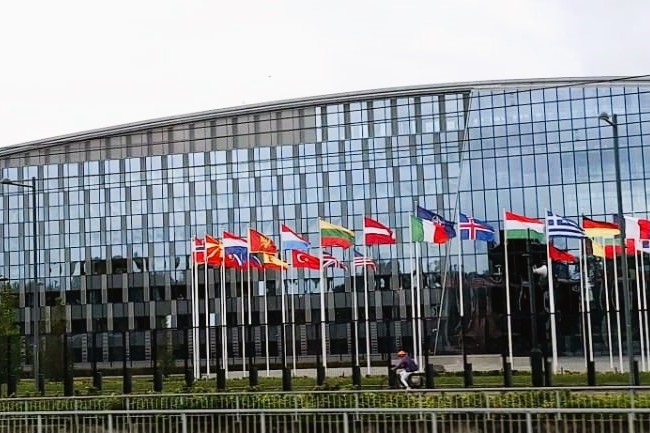
“They were tested and they failed.” Those were President Trump’s words, relayed by White House press secretary Karoline Leavitt on Wednesday, delivered hours before President Donald Trump sat down with alliance secretary general Mark Rutte to discuss, by the White House’s own admission, the possibility of withdrawing the United States from NATO.
The encounter marks the gravest crisis in the 77-year history of the transatlantic alliance. A sitting US president is publicly weighing departure from the cornerstone of Western security, enraged that European allies refused to join a war he launched without consulting them.
A War NATO Never Signed Up For
Trump’s fury centers on Operation Epic Fury, the six-week US-Israeli bombing campaign against Iran that began on February 28. European NATO members declined to contribute forces, limiting themselves to defensive maneuvers. Trump branded the alliance a “paper tiger” and called its members “cowards” for restricting US access to bases on their territory and refusing to lead efforts to reopen the Strait of Hormuz.
What Trump has not acknowledged is that nothing in NATO’s charter obliges members to participate in a war of choice. The alliance is founded on collective defense — Article 5 defines an attack on one member as an attack on all. The United States was not attacked. Its allies were not consulted before the bombs fell.
Asked earlier this month whether he was considering withdrawing, Trump told a Reuters reporter: “Wouldn’t you if you were me?” White House spokesperson Anna Kelly said the president had been “disappointed by NATO and other allies’ unwillingness to be helpful throughout Operation Epic Fury, even though his effort to destroy the threat posed by Iran is to their benefit.” She added: “As he said, the United States will remember.”
The Legal Firewall — and Its Limits
Legislation passed in 2024 requires a two-thirds Senate majority or an act of Congress before a president can withdraw from NATO. But Trump has already demonstrated willingness to bypass congressional authority — the Iran war itself was launched without the approval the 1973 War Powers Act demands.
Ivo Daalder, the Obama administration’s ambassador to NATO, has outlined a scenario in which Trump could hollow out US participation without formally leaving: withdrawing American troops and officers from the command structure while claiming the US remains nominally bound by Article 5.
The Wall Street Journal reported on Wednesday that the administration is already weighing whether to close bases or move troops out of Spain and Germany as punishment for their stance on the war.
Rutte’s High-Wire Act
Rutte, a former Dutch prime minister dubbed the “Trump whisperer,” has cultivated a warm rapport with the president through flattery and personal chemistry. He once referred to Trump as the “daddy” of the alliance. He has voiced support for the Iran campaign — putting himself at odds with the very European allies he represents.
Ahead of the White House meeting, Rutte sat down with Secretary of State Marco Rubio to discuss Iran, Ukraine, and alliance responsibilities. A NATO official said Rutte would push for increased defense-industry cooperation and seek to build on last year’s Hague summit, where members agreed to raise defense spending to 5 percent of GDP by 2035 — a striking shift from a decade ago, when some allies struggled to reach 2 percent.
But Rutte was not tasked with committing to any Strait of Hormuz operation, according to European diplomats. His leverage, for now, consists mainly of spending commitments and personal rapport with a president who has shown little regard for either.
An Alliance Redrawn
The Iran ceasefire, agreed Tuesday just before Trump’s deadline expired, may give both men room to de-escalate. But the rupture runs deeper than a single conflict. Trump has threatened to seize Greenland from Denmark, a NATO member. He has pulled support from Ukraine and engaged directly with Russia. Rubio warned last week that the US was “going to have to reexamine” the NATO relationship over the Iran rift.
“This is a dangerous point for the transatlantic alliance,” said Oana Lungescu, a former NATO spokesperson now at the Royal United Services Institute.
If Trump follows through — by formal withdrawal or the quieter erosion of bases, troops, and command roles — the security architecture that has governed the West since 1949 does not simply weaken. It restructures entirely. And the principal beneficiary of that restructuring sits in the Kremlin.
Sources
- White House rebukes NATO over Iran as Trump meets alliance chief — Reuters
- White House says Trump will discuss possibility of leaving NATO with Mark Rutte — Le Monde
- Can Trump pull the US out of Nato – and why is he considering it? — The Guardian
- Trump administration signals it is mulling NATO withdrawal after Iran war — Al Jazeera
Discussion (8)