 lop News
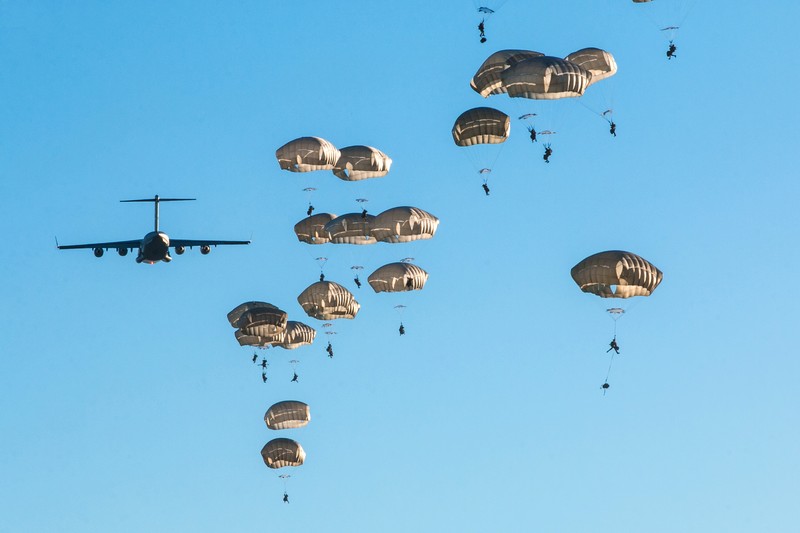
Thousands of American paratroopers began arriving in the Middle East on Monday. The White House wants Arab states to pay for the war they may soon fight.
The twin developments — military escalation and a search for outside funding — capture the political and economic strains of a conflict now in its second month. Thirteen American service members have been killed and over 300 injured since US and Israeli strikes on Iran began on February 28. The US has hit more than 11,000 targets. Iran’s retaliatory campaign has struck infrastructure in Kuwait, Saudi Arabia, and the United Arab Emirates, and largely shut down commercial shipping through the Strait of Hormuz.
What the New Forces Bring
Elements of the Army’s 82nd Airborne Division are built for rapid insertion into hostile environments — seizure of key terrain, emergency response, and early-stage combat. Their arrival follows roughly 2,500 Marines who came ashore over the weekend aboard the USS Tripoli. The combined forces are not configured for occupation, but give Washington the ability to transition from air and naval strikes to ground operations with limited notice.
Reuters first reported on March 18 that the administration was considering sending thousands of additional troops to expand options to include ground operations inside Iranian territory. Internal discussions have included seizing Kharg Island — the terminal for 90 percent of Iran’s oil exports — extracting highly enriched uranium from fortified underground sites, or securing the Iranian coastline for tanker passage. No decision to send troops into Iran has been made, one of the officials told Reuters. But the infrastructure for that decision is now in theatre.
The total American military presence in and around the Middle East stands at roughly 50,000 personnel, according to a Congressional Research Service report published March 26.
The Cost and the Ask
The New York Times reported on March 12 that Pentagon officials briefed Congress the estimated cost of Operation Epic Fury exceeded $11.3 billion in its first six days — a figure that did not include many associated expenses. Media accounts cite a Pentagon request for White House approval of a $200 billion supplemental spending package.
“I think it’s something the President would be quite interested in calling them to do,” White House press secretary Karoline Leavitt said at a briefing on Monday, when asked whether Arab countries would help pay for the war. “It’s an idea that I know that he has and something that I think you’ll hear more from him on.”
The Gulf States in the Crossfire
The proposal has historical precedent. Saudi Arabia, Kuwait, and other Gulf states contributed tens of billions to offset the cost of the 1991 Gulf War. But that conflict followed an invasion — Iraq’s assault on Kuwait — that unified regional governments behind the response. This war was initiated by the United States and Israel, and the Arab states now absorbing Iranian retaliation did not start it.
They are paying regardless. More than 40 percent of Iranian missiles and drones have targeted the UAE alone, according to the Congressional Research Service. Over the weekend, Saudi Arabia intercepted five missiles aimed at its oil-rich Eastern Province. An Iranian strike on a Kuwaiti power and desalination plant killed one worker and wounded 10 soldiers, according to Kuwait’s state news agency. A fireball erupted over Dubai during a missile interception. NATO air defenses shot down a ballistic missile over Turkey — the fourth such interception since the war began.
Iran has explicitly threatened to invade Gulf Arab countries if American troops enter Iranian territory. Parliament speaker Mohammad Bagher Qalibaf said Iranian forces were “waiting for the arrival of American troops on the ground to set them on fire and punish their regional partners forever,” according to state media.
The calculus for Gulf leaders is punishing. They host the American bases from which the war is waged. They suffer the retaliation. And now they may be asked to fund the campaign responsible for both.
Who Might Comply — and Who Might Balk
The UAE has staked out the most hawkish position among Gulf states. Minister of State Noura Al Kaabi wrote that “an Iranian regime that launches ballistic missiles at homes, weaponizes global trade and supports proxies is no longer an acceptable feature of the regional landscape.” She added: “We want a guarantee that this will never happen again.” That language suggests Abu Dhabi may be open to financial contributions in exchange for durable security commitments.
Saudi Arabia’s posture is harder to read. The kingdom spent years pursuing détente with Tehran before the war upended it. Public financial contributions could be cast domestically as complicity in a campaign Riyadh did not choose. Qatar, which hosts the massive Al Udeid Air Base, maintains complex ties with both Washington and Tehran. Kuwait, its infrastructure newly scarred, may feel pressure to support the coalition but wariness about inviting further escalation.
A War in Search of a Coalition
The funding question is not merely transactional. If Arab states publicly underwrite the campaign, the conflict’s character shifts from a US-Israeli operation to a broader regional coalition — lending weight to Tehran’s framing of a Western-Arab alliance arrayed against it. That narrative carries potency far beyond the battlefield.
In Washington, the troop buildup is generating friction inside Trump’s own party. Republican Representative Nancy Mace said Sunday that Congress must authorize any ground operation. “If we’re going to do a conventional ground operation with Marines and 82nd Airborne, that is a ground war that I believe Congress should have a say and we should be briefed,” she told CNN. Former Trump ally Matt Gaetz warned that a ground invasion would raise gas and food prices and said he was “not sure we would end up killing more terrorists than we would create.”
The administration insists diplomacy moves in parallel. Leavitt said talks with Tehran are “continuing and going well” and that Iran has privately agreed to some US demands, while acknowledging that public statements from Iranian officials diverge from what Washington hears behind closed doors. Iran’s Foreign Ministry spokesman described the American proposals as “excessive, unrealistic and irrational.”
Trump on Monday repeated his threat to “completely obliterate” Iran’s power plants, oil wells, and Kharg Island if the Strait of Hormuz is not reopened and a deal is not reached “shortly.” The deadline, already extended once, now stands at April 6. Brent crude was trading near $115 on Monday — up roughly 60 percent since the war began.
A fifth of the world’s oil transits Hormuz in peacetime. Who pays to reopen it, and what it costs the governments caught between Washington and Tehran, has become a question as strategically significant as any order given on the battlefield.
Sources
- Thousands of US Army paratroopers arrive in Middle East as buildup intensifies — Reuters
- Trump interested in calling on Arab states to help pay for Iran war, White House says — Reuters
- Trump threatens to destroy Iran’s civilian infrastructure if a deal is not reached ‘shortly’ — Associated Press
- Republican Mace says Congress must approve any US troop deployment to Iran — Al Jazeera
- US Ground Forces Arrive in Middle East as Iran Conflict Escalates — Military.com
- U.S. Conflict with Iran (CRS Report R48887) — Congressional Research Service
Discussion (12)