 lop News
The US government’s official energy forecast now assumes the Strait of Hormuz will remain effectively closed through late May, with shipping traffic only beginning to recover in June. What began as an acute shock in February is entering its third month, and the language coming out of Washington has quietly shifted from crisis management to something closer to grim accommodation.
The Energy Information Administration’s May Short-Term Energy Outlook, released Tuesday, marks a significant revision from just one month ago. In April, the agency expected global oil inventories to decline by 0.3 million barrels per day this year. The new forecast: a drawdown of 2.6 million barrels per day — nearly nine times steeper. The assumption that Hormuz might reopen quickly has been replaced by an expectation that oil shipments won’t reach pre-conflict levels until later this year, and that some Middle Eastern production will remain disrupted throughout that period.
The numbers tell the story of a world draining its buffers. Some 10.5 million barrels per day of crude production across Iraq, Saudi Arabia, Kuwait, the UAE, Qatar, and Bahrain were shut in during April. Brent crude peaked at $138 a barrel on April 7 and averaged $117 for the month. The EIA now expects Brent to hover around $106 through May and June — lower than the April spike, but far above pre-crisis levels, sustained by inventory draws that will limit any downward pressure even after flows resume.
Britain Bets on Drones and Deterrence
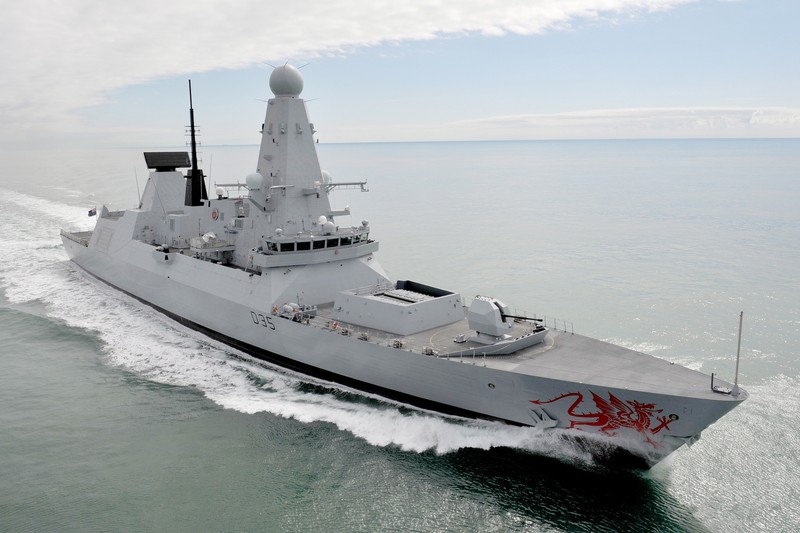
The same day the EIA published its revised outlook, the UK announced a substantial military contribution to a multinational mission to secure the strait. Defense Secretary John Healey told a virtual summit of more than 40 nations that Britain would deploy Typhoon jets, the destroyer HMS Dragon, autonomous mine-hunting equipment, and counter-drone systems backed by £115 million in new funding.
Healey called the commitments “strong and clear” and said the mission would “strengthen the confidence of commercial shipping and reduce the burden of the conflict on people at home.”
But the mission’s own framing reveals the scale of the challenge. The UK government described the force as becoming “operational when conditions allow” — a notable caveat that underscores the difference between announcing a naval presence and actually escorting tankers through a mined, contested waterway where satellite navigation is being jammed and armed drones circle overhead.
HMS Dragon is already en route to the Middle East. Whether it will be escorting merchant vessels through Hormuz anytime soon is another question entirely.
The Convoy Problem
The idea of armed convoys through the strait has surfaced repeatedly since the crisis began. The US launched Operation Project Freedom on May 4 to escort merchant ships out of the Persian Gulf, then paused it two days later, with President Trump citing “great progress” toward a possible agreement. The start-and-stop illustrates the core difficulty: even the world’s most powerful navy cannot guarantee safe passage through a waterway where Iran has deployed mines, missile-armed small boats, drones, and GPS spoofing — all at once.
Real-time maritime data confirms the gap between official claims and actual traffic. Even during periods when Iran and the US both declared the strait open, vessel traffic has sometimes fallen to as few as three ships per day, compared with 120 to 140 in normal conditions, according to OilPrice.com. Major shipping operators simply refuse to transit. Insurance markets have effectively priced the route out of existence, with war-risk premiums surging as much as ninefold.
A Crisis That Outlasts the Closure
The longer the strait stays shut, the more the global economy adapts around it — and the less any eventual reopening will matter. The precedent is already visible in the Red Sea, where Suez Canal traffic remains structurally depressed years after the Houthi campaign began, despite transit fee discounts and periodic ceasefires. Shipping lines rerouted around the Cape of Good Hope, rewrote contracts, and recalibrated schedules. They have not come back.
Hormuz is now following the same trajectory at far greater scale. Container freight rates are up 21 percent since the start of the year, and urea — a critical fertilizer component — has risen roughly 50 percent, according to the United Nations Economic Commission for Africa. Twenty-nine African currencies have depreciated over the same period, tightening financing conditions for the economies least equipped to absorb the blow.
As the EIA’s own forecast revision demonstrates, the assumption behind earlier recovery models — that this was a temporary disruption followed by a return to normal — is being steadily abandoned. Global oil inventories are being drawn down at a pace that will take months to reverse. OPEC’s spare capacity has been cut nearly in half by the UAE’s departure from the cartel on May 1. The $106 Brent forecast for May and June assumes partial recovery; the actual price will depend on whether that recovery materializes on schedule, or slips again.
The strait’s closure is now in its eleventh week. The world is no longer absorbing a shock. It is settling into a new equilibrium — more expensive, more fragmented, and far more fragile than the one that existed before February 28.
Sources
- Short-Term Energy Outlook - EIA (May 2026) — US Energy Information Administration
- UK to contribute drones, jets and warship to Multinational Mission to secure the Strait of Hormuz — UK Government
- The Strait of Hormuz May Reopen, But the System Has Already Broken — OilPrice.com
- Is the global financial system making the Hormuz shock worse? — Ahram Online / Project Syndicate
- 2026 Strait of Hormuz crisis — Wikipedia
Discussion (8)