 lop News
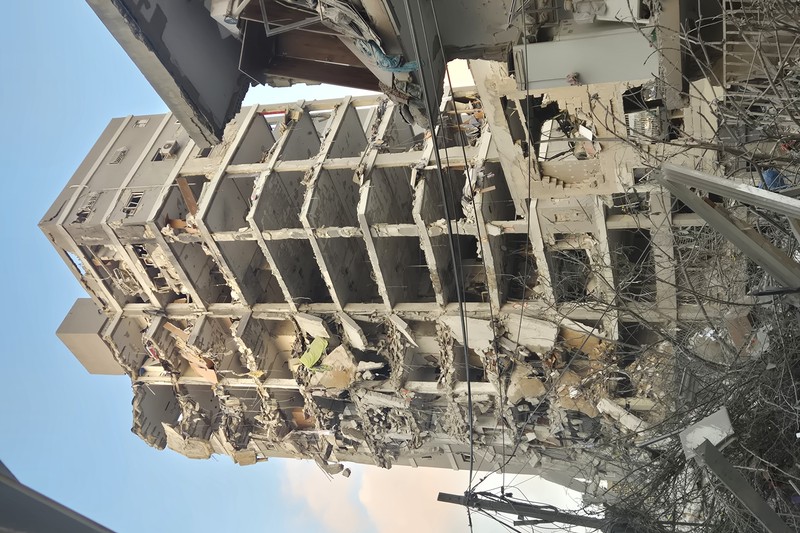
Three actors, three borders, one coordinated assault. On Monday, Yemen’s Houthi rebels confirmed what incoming fire had already suggested: they had struck Israel alongside Iran and Lebanon’s Hezbollah in a synchronized military operation.
Houthi military spokesman Yahya Saree said the three allies “launched a barrage of cruise missiles and drones targeting several vital and military sites belonging to the Israeli enemy.” The Houthis, who control most of northern Yemen, formally joined the war on Iran’s side on March 28. Their participation in Monday’s strike marks a shift from solo operations to operational integration with Iran and Hezbollah.
Israel is now fighting on three active fronts, with violence spreading through Gaza, the UAE, and Kuwait. What began as a bilateral confrontation between the US-Israel alliance and Iran has become, in five weeks, a regional war.
What Each Front Contributed
Iran’s contribution was the most destructive. A ballistic missile struck a residential building in Haifa’s Vardiya neighborhood on Mount Carmel on Sunday evening, killing four residents — an older couple, their son, and his partner. Rescue workers needed 18 hours to recover the bodies. Erez Geller, Haifa area director for Israel’s Magen David Adom ambulance service, said the scene looked like “there had been an earthquake.” The warhead did not detonate, he said, preventing a far larger death toll.
Iran’s Revolutionary Guards claimed they had targeted an oil refinery, not the residential building. Haifa’s port and petrochemical facilities have been a recurring target throughout the conflict. Israel’s air defenses attempted to intercept the missile but failed, according to the Israeli military. The Haifa strike was the second deadliest single attack in Israel since the war began on February 28, after nine people were killed in Beit Shemesh near Jerusalem early in the conflict. At least 23 people have been killed in Israel by missile and rocket fire since late February. All those killed by Iranian ballistic missiles or debris from interceptions have been civilians, according to Israeli authorities.
Hezbollah’s participation in the coordinated strike came as Israel intensified its Lebanon campaign. The Israeli military said it was “striking Hezbollah terror targets in Beirut” on Monday, with attacks also reported across the south. On Sunday, Israel struck two petrol stations it said served as “significant financial infrastructure” for Hezbollah.
Lebanon’s toll continues to mount. Four people were killed in a strike on a car in Kfar Rumman, near Nabatieh. A paramedic from the Hezbollah-allied Risala Scout Association was killed on Monday, and two paramedics from the Islamic Health Committee were killed a day earlier. WHO Director-General Tedros Adhanom Ghebreyesus said the agency had verified 92 attacks on health facilities, medical vehicles, personnel, and warehouses. A Sunday strike near Beirut’s largest public medical facility killed five people, including a 15-year-old girl. Another strike in Ain Saadeh, east of Beirut, killed a local official from the Lebanese Forces — a Christian party opposed to Hezbollah — and his wife, deepening internal Lebanese divisions as Israeli strikes reach beyond traditional Hezbollah strongholds.
Lebanon says 1,497 people have been killed since the war began.
From Yemen, the Houthis contributed cruise missiles and drones as part of the coordinated operation. The group had previously targeted Israel and Red Sea shipping during the Gaza war. Monday’s strike was different — not a solo gesture of solidarity, but a synchronized military action planned in concert with Iran and Hezbollah.
Ceasefire Prospects Buried Under Rubble
The assault landed as diplomatic efforts were still flickering. Iran had transmitted a 10-point peace proposal through Pakistani mediators, according to Iranian state media. The proposal reportedly included a protocol for safe passage through the Strait of Hormuz and demands to lift sanctions and provide reconstruction guarantees. A regional Arab security official confirmed that Iran was demanding a complete end to hostilities with guarantees the war would not restart, full sanctions relief, and compensation for war damage.
The US had not accepted the terms. Pakistan and other regional allies proposed a 45-day ceasefire. Iran rejected any temporary pause, and the White House said Trump had not signed off.
Trump oscillated between threats and diplomatic overtures at a Monday press conference. He threatened to destroy “every bridge” and “every power plant” in Iran by Tuesday night if Tehran did not agree to open the Strait of Hormuz. “It will take them 100 years to rebuild,” he said. Moments later, he insisted the US had “an active, willing participant on the other side” in negotiations.
Iran’s response was defiant. Military spokesman Ebrahim Zolfaghari warned that if attacks on civilian targets continued, “the subsequent phases of our offensive and retaliatory operations will be carried out much more crushingly and extensively.”
Democrats in Congress condemned Trump’s threats. Congresswoman Yassamin Ansari called for invoking the 25th Amendment, calling the president “a deranged lunatic and a national security threat.” Senator Bernie Sanders urged Congress to “end this war.” Republican allies held firm — Senator Lindsey Graham said Trump was “right to blow up their crucial infrastructure” if Iran refused a deal.
A War Reaching Beyond Its Borders
Israel’s military is stretched thin. In Gaza, separate from the Iran-Lebanon-Yemen theater, clashes between Hamas and an Israel-backed Palestinian militia near the Maghazi refugee camp killed at least 10 Palestinians on Monday, according to local sources cited by BBC News. Witnesses said Israeli drones intervened to support the militia after it clashed with Hamas security personnel at a checkpoint. Hamas military spokesman Abu Ubaida praised the coordinated strikes by Iran, Hezbollah, and the Houthis as “an extension” of what Hamas began on October 7, 2023, explicitly connecting Gaza to the wider regional war.
The conflict has already drawn in other states. Iran said it used drones and missiles to target a joint Emirati-Israeli drone production facility in the UAE. The Emirati defense ministry said it intercepted 12 ballistic missiles, two cruise missiles, and 19 drones on Monday. Six people were injured in Kuwait when projectiles fell in a residential area.
Israel continued pressing its advantages. The military said it struck dozens of Iranian military aircraft and helicopters at three airports in Tehran. An Israeli airstrike in the capital killed IRGC intelligence chief Majid Khademi — a significant decapitation strike against Iran’s security apparatus. Overnight strikes hit Sharif University of Technology, Iran’s premier science and engineering institute, which is under Western sanctions for ties to Iran’s military. The attack on a university generated outrage even among regime opponents.
Iran has paid heavily. The Human Rights Activists News Agency reported at least 49 civilians killed and 58 injured across 20 provinces in 24 hours, with 573 attacks recorded on Monday alone. Iranian officials say more than 2,000 people, mostly civilians, have been killed since the war began.
The Risk Ahead
The geometry of this conflict has shifted fundamentally. Three armed groups have demonstrated they can plan and execute strikes from three countries in a single operation — a level of coordination that raises the question of how much wider this could become. The UAE and Kuwait have already been caught in the crossfire. Trump’s Tuesday deadline adds a ticking clock to a situation with no functional de-escalation mechanism and no ceasefire that either side has agreed to.
No diplomatic track has gained traction. No frontier of the conflict is contracting. And the map of this war keeps growing.
Sources
- Lebanon’s Hezbollah and Yemen’s Houthis join Iran in strike on Israel — Al Jazeera
- At Least 4 Killed in Strike in Northern Israel — The New York Times
- Iran War Live Updates: Trump Renews Threat of Attacks on Bridges and Power Plants — The New York Times
- Ten killed in Israeli strikes and clashes between Hamas and militia in Gaza, local sources say — BBC News
- Democrats blast Trump for Iran ‘war crimes’ threat; Republicans supportive — Al Jazeera
Discussion (13)