 lop News
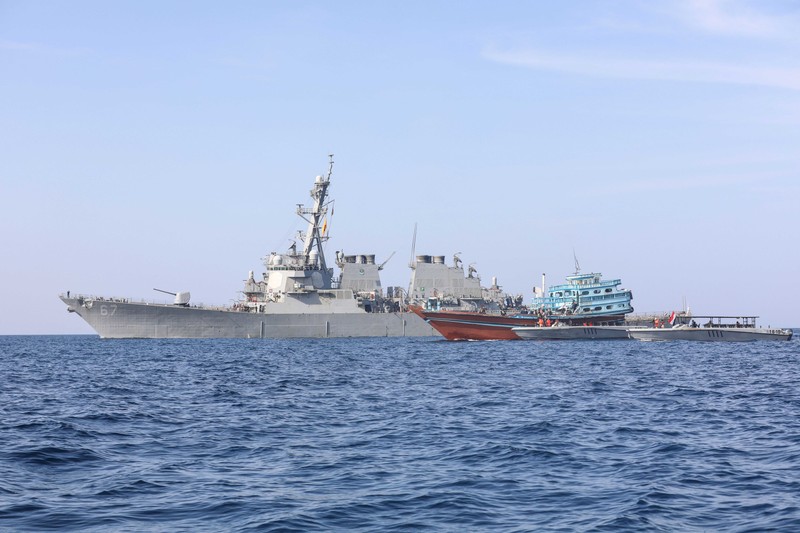
More than twenty warnings went unanswered. Then a US missile struck the engine room of the Lian Star, and three people died.
The Gambia-flagged cargo ship was attempting to reach an Iranian port overnight when American forces fired on it, according to US Central Command. The vessel had ignored more than 20 successive warnings before the strike, Reuters reported. According to Reuters, three crew members were killed. The Lian Star remains adrift in the Gulf of Oman. US forces have not boarded it.
This appears to be the first reported use of lethal force since the US imposed its naval blockade of Iranian ports on April 17. The crossing of that threshold — from warning and redirecting to killing — raises urgent questions about the rules of engagement governing one of the world’s most volatile waterways, and about the status of neutral commercial vessels caught between two powers’ competing claims to control it.
A Ship With No Stake in the War
The Lian Star flew the flag of Gambia, a small West African nation with no evident stake in the US-Iran confrontation. Its crew were merchant mariners delivering cargo. By all available accounts, the ship was not carrying military supplies. It was a commercial vessel, flagged to a third-party state, attempting to conduct commerce — the kind of activity that, in peacetime, would be entirely unremarkable.
It became a casualty of a war it was not part of.
The rules governing the blockade’s enforcement have not been publicly disclosed by the Pentagon. What threshold of warning is required before lethal force is authorized, how the status of neutral-flagged vessels is assessed in real time, and what recourse the crews of such ships have — all remain opaque.
Twenty warnings suggests extraordinary restraint on the part of the enforcing vessels. It also raises the question of what happened on the Lian Star’s bridge — what information, what pressure, what miscalculation — that made its crew willing to sail past every one of them.
The Blockade by Numbers
Since April 17, the US military has stopped six ships attempting to breach the blockade, including the Lian Star. One was allowed to proceed. Another 116 were redirected without the use of force.
The Lian Star is the sixth — and, based on available reports, the first to be struck by a missile.
The blockade was imposed in direct response to Iran’s effective closure of the Strait of Hormuz after the war began on February 28. Washington’s stated aim is to restrict Iran’s own maritime trade, limit shipments, and deepen economic pressure on Tehran by cutting off access to the cash flow that sustains its long-weakened economy.
It is a strategy with two fronts: squeeze Iran economically, and assert control over the waterway Iran claims as its own.
A Fragile Ceasefire, Now Fractured
The Lian Star strike landed in the middle of a week in which hostilities resumed, despite a fragile ceasefire that had held since April 7.
The war — launched by the United States and Israel on February 28 over Tehran’s disputed nuclear programme — has killed an unknown number of people across three months of strikes, counterstrikes, and naval confrontation. The ceasefire had offered a pause. It did not hold.
Behind the military escalation, diplomacy continues to flicker. President Donald Trump met with advisers on Friday to discuss a tentative agreement framework that, according to US officials, would extend the ceasefire by 60 days, reopen the Strait of Hormuz to commercial traffic, and require Iran to surrender a large share of its uranium deposits.
Trump has not yet decided whether to proceed. Iran has said no deal has been finalised.
The dissonance is stark: a missile hitting a civilian cargo ship’s engine room in the same week diplomats are attempting to end the confrontation that put that ship in the crosshairs.
Two Powers, One Waterway
Iran maintains its own enforcement regime in the strait. Tehran insists it must approve all transits and has charged tolls as high as $2 million for passage — a practice analysts have described as a violation of freedom of peaceful navigation, one of the foundational principles of international maritime law.
On Saturday, Iran’s joint military command issued a fresh warning. “Any violation of these regulations will place the security of their passage at serious risk,” the statement, carried by state TV, said. Military vessels attempting to interfere with Iran’s regulations would be targeted, the command added.
The result is a waterway claimed by two adversaries, each enforcing its own rules, with commercial vessels caught in the gap between them.
Qatar, positioning itself as a mediator, offered a calibrated response. Deputy Prime Minister Sheikh Saoud bin Abdulrahman bin Hassan bin Ali Al Thani said Qatar opposes charging transit fees, but acknowledged that temporary charges for purposes such as mine clearing “is something that is negotiable, and it could be something that will help the transit of the Strait of Hormuz to be back to a normal stage.”
The Widening Toll
Roughly 20 percent of global shipping passes through the Strait of Hormuz. The blockade and Iran’s counter-restrictions have left shipments of oil, natural gas, and fertilizer largely stranded. Consumers and food producers worldwide are feeling the strain — and the missile strike on the Lian Star will not ease it.
The ship was not a military target. It was not carrying contraband. It was a merchant vessel flagged to a neutral state, crewed by civilians, sailing through waters that two adversaries have turned into a contest of wills.
The three deaths aboard the Lian Star are, so far, the only confirmed fatalities from the enforcement of the blockade. Whether they will be the last depends on decisions being made in Washington, Tehran, and on the bridges of every cargo ship still willing to test the waters.
Discussion (14)