 lop News
Three dead. Eight infected. A body still on board. And 140 people trapped somewhere in the Atlantic, steaming toward a small island that hasn’t forgotten what it felt like when a virus arrived on its shores.
The MV Hondius, a Dutch-flagged expedition vessel, is expected to reach Tenerife early Sunday. Its passengers — ornithologists, botanists, lovers of remote places — signed up for a month-long Atlantic crossing from Argentina to Cape Verde. They got a floating quarantine and an international health response spanning nine countries.
The pathogen is hantavirus, specifically the Andes strain — the only hantavirus known to spread between humans. Most hantaviruses are caught from rodent droppings or urine in rural settings. The chain of infection ends with you. Andes virus breaks that rule — and appears to have done so aboard the Hondius. In rare cases of close, prolonged contact, it can jump from person to person.
A Deadly Cascade
The first patient was a 70-year-old Dutch man who boarded on April 1 after more than three months traveling through Argentina, Chile, and Uruguay. He developed fever, headache, and diarrhea on April 6 and died five days later. No tests were performed. Nobody knew what killed him.
His wife disembarked at St. Helena on April 24, collapsed at a Johannesburg airport the next day, and died April 26. Posthumous testing confirmed Andes virus. A British man evacuated to South Africa was the outbreak’s first confirmed positive. A German woman died May 2. The ship’s doctor and a tour guide both fell ill. A passenger already home in Switzerland tested positive.
As of May 8, the World Health Organization had logged eight cases — six confirmed and two probable — including three deaths. Case fatality rate: 38 percent.
A Narrow Window in Tenerife
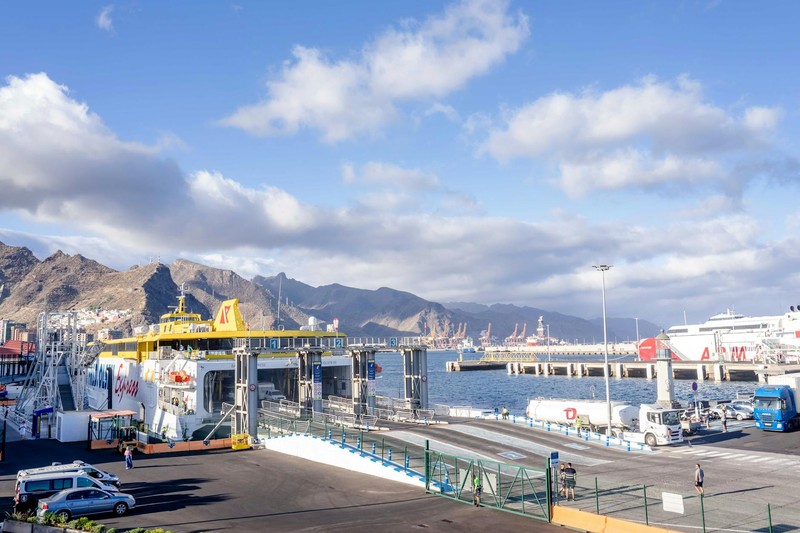
The logistics are intricate and the deadline unforgiving. The Hondius will anchor offshore at Granadilla, in southeastern Tenerife, away from residential areas. Passengers will be ferried to port by smaller boats, then bused to the airport for repatriation flights organized by the US, UK, France, Germany, Belgium, Ireland, and the Netherlands.
The US Centers for Disease Control and Prevention plans to fly 17 American passengers to Offutt Air Force Base in Nebraska, where they will be transported to the nearby National Quarantine Center at the University of Nebraska, Omaha. CDC epidemiologists deployed to the Canary Islands will assess each American passenger’s exposure risk before departure.
Weather gives authorities roughly 24 hours. “The only window of opportunity we have,” said Canary Islands government spokesman Alfonso Cabello, runs from midday Sunday until conditions change Monday. After that, the ship may have to leave.
WHO Director-General Tedros Adhanom Ghebreyesus is traveling to Tenerife to coordinate the response — a measure of the operation’s complexity, even as officials insist the public risk remains low.
A Virus Far From Home
What makes this outbreak epidemiologically striking is the setting. Hantavirus is overwhelmingly a rural disease — forests, farms, barns where rodents nest. A cruise ship is not the expected terrain.
The WHO’s working hypothesis is that the first patient acquired the virus before boarding, during travels in Argentina and Chile, both endemic for Andes virus. Argentine health officials say the timeline makes infection in Ushuaia “practically nil,” but investigations into the couple’s full itinerary continue.
Once aboard, the virus moved through close contact. Some passengers who shared cabins with infected individuals remained healthy — a sign that Andes virus does not transmit efficiently between humans. “It’s not spreading anything close to how Covid was spreading,” WHO spokesman Christian Lindmeier told reporters.
Calm at Sea, Anger on Land
Aboard the ship, passengers describe a calm atmosphere. French couple Julia and Roland Seitre called the journey an “unlikely adventure.” “To call this an epidemic is wrong,” they said. “To imply it’s a pandemic is dishonest.” Passengers wear masks indoors and practice distancing but move freely on outdoor decks. WHO and European CDC experts are aboard.
In Tenerife, the reception is less composed. Dock workers protested Friday outside the Canary Islands parliament, demanding safety guarantees and threatening to block the ship. For islanders, the Hondius revives memories of early 2020, when a Tenerife hotel was locked down over one of Spain’s first COVID cases.
There are no licensed treatments or vaccines for hantavirus. Supportive ICU care improves survival, but options are limited once severe symptoms develop. The WHO rates the ship-level risk as moderate — the average passenger age is 65 — and the global risk as low.
By Monday, the passengers should be scattered across a dozen countries to quarantine centers and homes. The ship will sail to the Netherlands for disinfection. And health authorities face weeks of contact tracing, chasing every link to a vessel that demonstrated what happens when a lethal pathogen turns up in a sealed environment at sea.
Sources
- Hantavirus cluster linked to cruise ship travel, Multi-country — World Health Organization
- French couple on hantavirus cruise ship says ‘no panic onboard’ — France 24
- Anger and resignation in Tenerife as hantavirus ship approaches — BBC
- CDC Provides Update on Hantavirus Outbreak Linked to M/V Hondius Cruise Ship — US Centers for Disease Control and Prevention
- A timeline of the cruise ship hantavirus outbreak and when passengers fell sick — Associated Press
Discussion (9)