 lop News
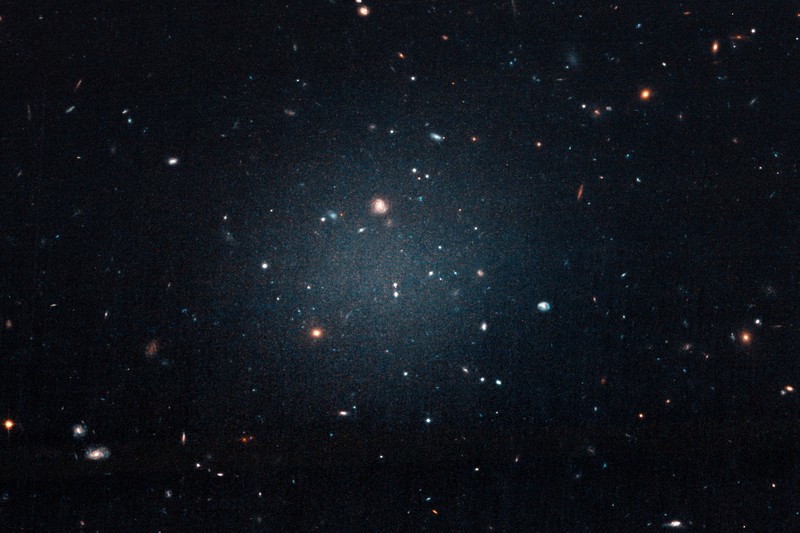
Three galaxies. Zero dark matter. What was once a cosmic anomaly is starting to look like a pattern — and that pattern has physicists rethinking some fundamentals.
According to reports, astronomers may have identified a third galaxy apparently devoid of dark matter. The finding has not yet been independently confirmed. Dark matter is the invisible gravitational scaffolding that, by conventional models, holds galaxies together. Without it, the rotational velocity of stars should fling galaxies apart like an unraveled merry-go-round. Yet DF9 persists, calm and intact.
Two earlier galaxies in the same group — NGC 1052-DF2 and NGC 1052-DF4 — were dismissed by some as possible measurement errors or statistical flukes. Three is harder to hand-wave. The repeated discovery has led some researchers to propose a so-called “violent collision” theory, which posits that these galaxies were stripped of their dark matter halos during ancient, high-speed collisions with larger neighbors. The ordinary matter survived. The invisible scaffolding did not.
This matters because dark matter has never been directly detected — its existence is inferred entirely from gravitational effects on visible matter. Galaxies that behave normally without it force an uncomfortable question: is dark matter a universal ingredient, or merely a placeholder for physics we don’t yet understand?
The collision theory offers a tidy answer — dark matter was there, then it was violently removed. But three data points, however suggestive, are still just three. More surveys are underway, and the list of dark-matter-free galaxies may grow.
If it does, textbooks will need revisions. If it doesn’t, physicists will have to explain why the universe produced exactly three rule-breaking galaxies — and how they hold together at all.
Discussion (5)