 lop News
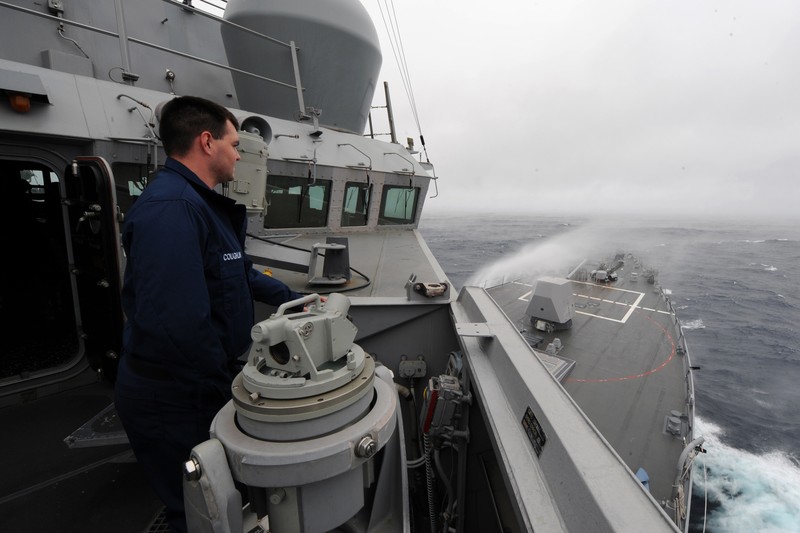
Three American destroyers sailed through the Strait of Hormuz on Thursday. Iran sent swarms of fast-attack boats, cruise missiles, and drones to stop them. The US Navy shot everything down, then bombed two Iranian ports. President Donald Trump called the whole thing a “love tap” and insisted the ceasefire was still in effect.
It was the most intense military exchange between the two countries since they agreed to a conditional ceasefire roughly one month ago — and the clearest sign yet that the truce exists in name only.
What happened on the water
The sequence began early Thursday when the USS Truxtun, USS Rafael Peralta, and USS Mason transited the international waterway toward the Gulf of Oman. According to US Central Command, Iranian forces launched “multiple missiles, drones and small boats” at the warships over several hours.
American commanders described the assault as fiercer and more sustained than a similar barrage the Truxtun and Mason faced on Monday. Small-caliber gun teams on deck engaged fast-attack boats that maneuvered dangerously close. Apache helicopters fired Hellfire missiles. The destroyers emptied their five-inch naval guns and close-in weapon systems. Supporting aircraft circled overhead.
CENTCOM reported no damage to any US vessel.
The American response was immediate. US forces struck Iranian military facilities at Bandar Abbas and Qeshm Island — both ports directly abutting the strait. CENTCOM said the targets included missile and drone launch sites, command and control locations, and intelligence, surveillance, and reconnaissance nodes.
An Iranian military spokesperson, speaking on state media, said US airstrikes also hit civilian areas along the coasts of Qeshm Island, Bandar Khamir, and Sirik. The spokesperson accused the US of carrying out the strikes “with the cooperation of some regional countries,” though no nations were named.
Dueling narratives of violation
The two sides could not even agree on who broke the ceasefire first.
Iran’s Khatam al-Anbiya Central Headquarters — its top joint military command — said the US violated the truce by targeting an Iranian oil tanker and another ship entering the Strait of Hormuz. “The American aggressor, terrorist and bandit army, violating the ceasefire, targeted an Iranian oil tanker,” the command said in a statement.
The tanker incident appears to refer to a separate event on Wednesday, when US forces disabled the Iranian-flagged M/T Hasna in the Gulf of Oman. CENTCOM said a fighter jet fired “several rounds” into the ship’s rudder after it attempted to sail toward an Iranian port in violation of the ongoing US blockade.
Iran’s Islamic Revolutionary Guard Corps Navy said it responded with “various types of ballistic and antiship cruise missiles and destructive drones with high-explosive warheads.” A senior source cited by the semiofficial Tasnim news agency claimed three US destroyers came under fire and “fled” toward the Gulf of Oman — an account contradicted by CENTCOM’s statement that no US assets were struck.
Iranian state media also claimed that the strikes caused “significant damage” to US ships. The Pentagon has flatly denied this.
The ceasefire that everyone insists is fine
Despite the exchange of live fire across one of the world’s most critical shipping lanes, the Trump administration’s position is that nothing has fundamentally changed.
“The ceasefire is going. It’s in effect,” Trump told ABC News by phone. He described the American strikes on Iranian military infrastructure as “just a love tap.” Earlier, on Truth Social, he was more colorful: missiles were “easily knocked down,” drones were “incinerated while in the air” and fell “ever so beautifully down to the Ocean, very much like a butterfly dropping to its grave.”
Trump also issued a warning: “We’ll knock them out a lot harder, and a lot more violently, in the future, if they don’t get their Deal signed, FAST!”
The gap between the administration’s rhetoric and the reality on the water is widening. Chairman of the Joint Chiefs of Staff Gen. Dan Caine told reporters on Tuesday that Iran had attacked US forces more than 10 times since the ceasefire began. None of those incidents, Caine said, had crossed the threshold for a return to full combat operations. Defense Secretary Pete Hegseth has maintained that US forces are in a “defensive posture.”
The strait that stopped the world
The strategic stakes extend well beyond the immediate exchange of fire.
The Strait of Hormuz normally carries roughly one-fifth of the world’s oil. Since the US and Israel first launched strikes on Iran in late February, commercial shipping traffic has ground to a virtual halt — hundreds of tankers trapped in the Persian Gulf, global oil prices surging.
Most ships have continued to avoid the strait even during the ceasefire. Iran has warned vessels not to sail through without permission. The US has enforced a blockade on Iranian ports to pressure Tehran economically.
On Monday, Trump launched what he called “Project Freedom” — an initiative to guide commercial ships through the waterway. Two American vessels sailed through. By Tuesday, the project was suspended. Trump said the pause was to allow negotiations to progress.
Thursday’s escalation makes a resumption unlikely in the near term.
The deal that keeps almost happening
Just hours before the strikes, officials in Pakistan claimed the two sides were close to a temporary agreement to halt the war. Islamabad, which brokered the initial ceasefire last month, said a very basic “interim” deal could be reached this weekend and that Tehran was reviewing a US proposal.
Pakistan and Trump have repeatedly suggested a breakthrough is imminent. Weeks of negotiations have produced little concrete progress. No in-person talks have been announced. Trump has not given a timeline.
The breakthrough that appeared close days ago now looks increasingly remote. Both sides are dug in — literally, in the case of the missile batteries ringing the strait — and neither has an incentive to de-escalate first.
Iran frames every American action as aggression. The US frames every Iranian response as unprovoked. The blockade tightens. The missiles fly. The ceasefire — technically still in place, according to both parties — functions as a diplomatic fiction that allows each side to keep shooting while claiming the moral high ground.
The strait remains empty. Oil markets remain stressed. And the distance between a “love tap” and a full-scale war is measured in the payload of a cruise missile.
Sources
- US military strikes sites in Iran as countries exchange fire — CNN
- U.S. strikes 2 Iranian ports as American warships come under fire — CBS News
- US-Iran ceasefire under threat after exchange of strikes in strait of Hormuz — The Guardian
- Iran says it attacked US Navy ships after they targeted Iranian tanker — Al Jazeera
Discussion (12)