 lop News
Brent crude at $108. Gold down nearly 17 per cent this month. The Nasdaq in correction. Six weeks into the Iran war, the financial data tells the story of a global economy absorbing body blows — and the International Monetary Fund says the damage will not heal even if peace holds.
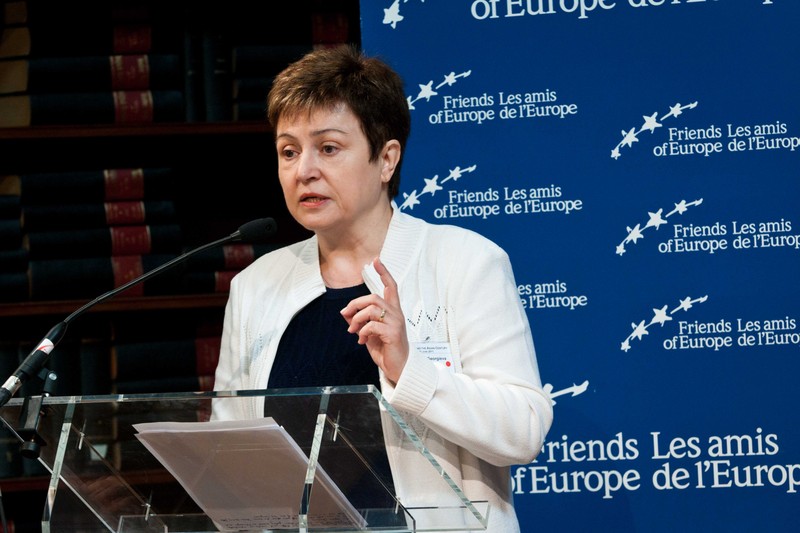
IMF managing director Kristalina Georgieva delivered that assessment in Washington on Thursday, ahead of the fund’s spring meetings next week. Every scenario the IMF has modelled for its World Economic Outlook shows a permanent hit to living standards. The fund’s previous 2026 forecast of 3.1 per cent growth is coming down. The global economy entered the conflict with considerable momentum from a tech-driven investment boom, Georgieva said, but infrastructure damage, supply disruptions, and lost confidence had changed the outlook entirely.
“Even in a best case, there will be no neat and clean return to the status quo ante,” Georgieva said.
Following the Money Out of Hormuz
The rupture starts at the Strait of Hormuz, where Tehran has virtually blocked oil tanker traffic since the conflict began on 28 February. Brent crude settled at $108.01 on Thursday, up 5.7 per cent on the day. It had peaked above $121 in March before a partial retreat. US crude closed at $94.48.
The squeeze ripples outward. The IMF, World Bank, and World Food Programme warned jointly that rising oil, gas, and fertiliser prices would “inevitably lead to rising food prices and food insecurity” for at least 45 million people. Georgieva singled out low-income energy importers and Pacific Island nations at the end of long supply chains as bearing the heaviest burden. The World Bank now projects the Middle East — excluding Iran — will grow just 1.8 per cent in 2026, a 2.4 percentage point downgrade from pre-war forecasts.
Nowhere to Hide
For investors, the usual shelters are failing. Gold futures fell 4 per cent on Thursday and are down nearly 17 per cent in April — on track for the worst monthly decline since October 2008. Higher-for-longer interest rate expectations are punishing an asset that pays no income.
Treasury yields climbed as investors sold bonds. John Canavan, lead analyst at Oxford Economics, said the global bond selloff had continued through European trading hours as markets weighed potential central bank responses to rising oil prices. The Trump administration’s request for $200 billion to fund the war has compounded deficit concerns.
US equities are reeling. The Dow fell 469 points on Thursday. The S&P 500 dropped 1.74 per cent, its worst day in two months. The Nasdaq sank 2.38 per cent into correction territory. All three indices are on track for their worst month in a year.
“It all boils down to oil markets and the implications on inflation,” said Adam Turnquist, chief technical strategist at LPL Financial. “There’s really no clarity on when this war will end, despite a lot of confusing commentary.”
Capital Finds Unlikely Refuges
With traditional havens failing, money is flowing into unexpected corners. China’s healthcare sector has emerged as a surprising destination. The Hang Seng Healthcare Index has outpaced the broader Hang Seng Index in recent weeks, as investors chase companies insulated from commodity swings.
Yang Huang, head of China healthcare research at JPMorgan Chase, said investor interest had improved because healthcare is generally less exposed to energy-driven volatility. The fundamentals help: China’s biotech subsector posted revenue growth of 36 per cent and net profit growth of 103 per cent in 2025, driven by commercialisation and licensing deals.
The Sovereign Balance Sheet
The IMF is preparing between $20 billion and $50 billion in emergency balance-of-payments support for war-affected countries, with the lower figure contingent on the fragile ceasefire holding. World Bank President Ajay Banga said his institution could mobilise $25 billion “very quickly,” with up to $60 billion available longer-term.
Georgieva urged governments to avoid blanket subsidies or tax cuts that could stoke inflation while straining already-stretched public finances. “Don’t pour gasoline on the fire,” she said.
Bank of England Governor Andrew Bailey, who also chairs the Financial Stability Board, told the EU parliament’s economic committee that the global economy had absorbed a “very big shock.” His description of conditions was candid: “We all have to get up in the morning and find out what’s gone on overnight.”
Ceasefire talks between Washington and Tehran are scheduled for Saturday, with both sides accusing each other of violations. Oil prices swung 5 per cent in a single session on Thursday — a market pricing in prolonged disruption, not a resolution.
The IMF’s warning is an opening argument, not a final judgment. But the money has already voted. It is fleeing gold, dumping bonds, and parking in Chinese biotech — a vote of no confidence in the global economy that would be almost comical if the underlying data were not so grim.
Sources
- Head of IMF says Iran war will permanently scar global economy even if peace is reached — The Guardian
- ‘No return to normal’: IMF warns of lasting economic damage from Iran war — Euronews
- The war in Iran is scrambling Wall Street’s playbook for safe investing — Yahoo Finance
- China healthcare stocks outgain Hong Kong market as Middle East roils global investments — South China Morning Post
Discussion (8)