 lop News
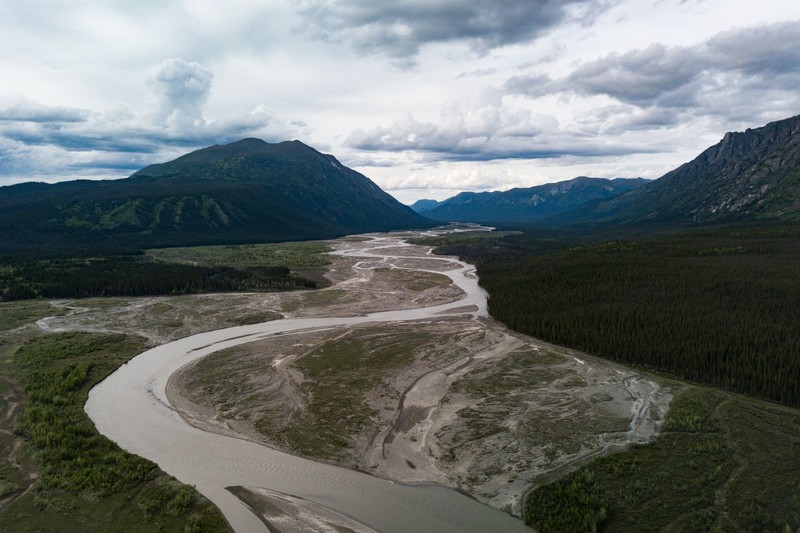
Zinc, nickel, cadmium, aluminum — at concentrations hundreds, if not thousands, of times above safe limits. Water with a pH of roughly 3, uninhabitable for most aquatic life. Sulphur levels on par with mining tailings ponds.
Not from a mine. The permafrost is doing the digging.
A study published Thursday in Science documents what one co-author calls an “unfolding environmental disaster” across the subarctic: thawing permafrost is exposing sulfide minerals to air and water for the first time in millennia, triggering chemical reactions that acidify hundreds of streams and release toxic metals at concentrations matching some of the world’s most contaminated mine sites.
Rivers that ‘look like butter chicken’
Using satellite imagery, researchers pinpointed 146 visibly degraded headwater streams across the Yukon and Mackenzie river basins — North America’s two largest subarctic rivers. On-the-ground monitoring confirmed what the orange-brown discoloration suggested: water chemistry had shifted catastrophically, particularly since 2024.
The worst case documented by the team feeds the Ogilvie River north of Dawson City. Its water quality, pristine at the start of the millennium, had by July 2025 become so acidic that sulphur concentrations matched a mining tailings pond. Metals were detected at hundreds to thousands of times above safe thresholds for humans and wildlife. A contamination plume stretched three kilometres downstream.
“These streams look like butter chicken,” said co-author Sean Carey, a hydrology professor at McMaster University who has studied the region since the mid-1990s.
The mining comparison lands with particular force here. In 2017, First Nations won a landmark legal victory to protect the Peel watershed from mining and industrial development. The permafrost is now doing the industry’s work without permits, without environmental review, without a tailings dam to contain the damage.
A feedback loop with no off switch
The chemistry is straightforward. As permafrost thaws, ancient sulfide-rich bedrock meets oxygen and water for the first time in thousands of years. Oxidation generates sulfuric acid, which leaches metals from surrounding rock and flushes them into streams. The acid also dissolves carbonate minerals, releasing CO2 — a feedback loop that further warms the planet and thaws more permafrost.
The region has warmed roughly 2.6°C since the 1960s, well above the global average. Permafrost is disappearing faster than at any point since the last ice age.
Lead author Elliott Skierszkan, an assistant professor at Carleton University, said the team documented a “precipitous drop in pH, metals concentrations thousands of times above water quality guidelines — all happening within a two-to-three-year period.”
“We were really shocked when we started seeing the data coming in year over year, particularly in the last two or three years, where we captured an abrupt transition,” he said.
What’s at stake downstream
These headwater streams are culturally significant to the Tr’ondëk Hwëch’in and other Indigenous communities, used as drinking water sources and critical spawning grounds for dolly varden and Arctic grayling.
In Alaska’s Kobuk Valley National Park, the phenomenon has already produced casualties. The Salmon River — which author John McPhee once described as having the “clearest, purest water I have ever seen flowing over rocks” — turned reddish-orange around 2019. Two resident fish species, dolly varden and slimy sculpin, disappeared entirely from affected stretches. A separate study published in the Proceedings of the National Academy of Sciences found metal concentrations exceeded US Environmental Protection Agency standards for aquatic life.
The timing raises uncomfortable questions. In 2024, Alaska and Canada imposed a seven-year moratorium on Yukon River Chinook salmon fishing after populations collapsed to less than 10 per cent of historical averages. Whether acid-rock drainage from thawing permafrost is contributing remains unproven. But the mechanism — toxic metals pouring into spawning habitat — is now documented across hundreds of streams.
For now, a thin buffer remains. Larger downstream rivers have not yet shown dangerous water quality declines, as dilution and natural chemical processes bring pH back up and cause dissolved metals to precipitate into particles. How long that protection lasts is unknown.
The research team, funded by the Canada Water Agency, is working with the Tr’ondëk Hwëch’in government to track ecological impacts. Backcountry hikers are being enlisted to report rust-colored streams.
Carey, for his part, sees little reason for optimism. “We don’t know the end point, but there’s nothing about this that gives me any feeling of like, ‘oh, we’re going to be OK.’ I’m not even a gloomy person. This looks pretty gloomy.”
Sources
- As permafrost thaws, some headwaters in Canada’s North turn orange and toxic: study — CBC News
- Abrupt stream acidification and metal mobilization linked to permafrost degradation — EarthArXiv / Science
- When permafrost thaw turns Arctic Alaska river red, toxicity levels rise, scientists find — Alaska Beacon
Discussion (8)