 lop News
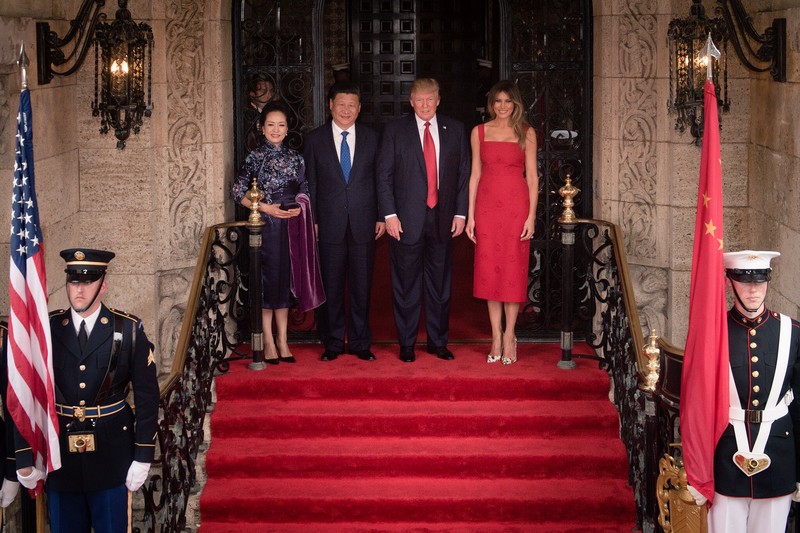
Twenty-one guns fired in salute on the steps of the Great Hall of the People. Schoolchildren in white and robin’s egg blue — matching Air Force One’s paint job — waved flags and chanted “Welcome, welcome!” Donald Trump, visibly pleased, told Xi Jinping the children were “amazing.”
Then the doors closed, and Xi delivered a different message: mishandle Taiwan, and the two countries risk “clashes and even conflicts, putting the entire relationship in great jeopardy.”
The contrast between the lavish ceremony and the blunt closed-door warning captured the essential dynamic of Thursday’s summit — the first visit by a sitting US president to China in nearly a decade. Beijing rolled out genuine pageantry. It also drew a red line.
The Carrot: Markets Open Wider
Xi came bearing gifts for the American business contingent — 17 CEOs with a combined personal net worth exceeding $1 trillion, according to Forbes and SEC filings compiled by Quiver Quantitative.
“China’s door of opening to American business will only open wider and wider,” Xi told the executives, according to the official Xinhua news agency. He called US-China economic ties “mutually beneficial and win-win in nature” and said trade teams had produced “generally balanced and positive outcomes” in preliminary meetings.
The specifics are still taking shape. According to Reuters, citing four unnamed sources familiar with the administration’s objectives, Washington and Beijing are weighing a framework that would see each country identify roughly $30 billion in goods for tariff reductions — a modest down payment on repairing a trade relationship scarred by two tariff wars in two years. Treasury Secretary Scott Bessent and Chinese Vice Premier He Lifeng met Wednesday in Incheon, South Korea, to lay the groundwork.
Trump arrived with a clear commercial ask: more Chinese purchases of American soybeans, beef, and aircraft. He posted on social media that his “first request” would be asking Xi to “open up” China to US firms. The business leaders — including Nvidia’s Jensen Huang, Apple’s Tim Cook, Tesla’s Elon Musk, and Boeing’s Kelly Ortberg — were introduced to Xi one by one.
The Stick: Taiwan and the Red Line
If Xi was generous on trade, he was unequivocal on Taiwan.
In the closed-door session, Xi told Trump that if Taiwan is “handled well,” bilateral relations “will enjoy overall stability,” according to Xinhua. If not, the two countries risk confrontation. The language was notably sharper than his public remarks, where he called for the two powers to be “partners rather than rivals” and invoked the “Thucydides Trap” — the ancient idea that rising powers and established ones tend toward war.
Trump authorized an $11 billion arms package for Taiwan in December, the largest ever approved for the island, but has not begun fulfilling it. When a reporter asked how the talks went, Trump offered only: “Great.” He declined to say whether Taiwan had come up in the discussions.
The Communist Party’s People’s Daily had underscored the point before the summit, calling Taiwan “the first red line that cannot be crossed in China-US relations.”
The Shadow: Iran and Energy
The two-month US-Israeli war with Iran hovered over every discussion without dominating the room. Trump, who once insisted he had Iran “very much under control,” faces growing domestic pressure as energy prices spike and the Strait of Hormuz remains effectively closed to oil and gas tankers.
Secretary of State Marco Rubio said the administration would push China to “play a more active role in getting Iran to walk away from what they’re doing now,” arguing the economic fallout would hurt Chinese exports as global consumers buy less.
But Beijing has its own calculus. Iran’s foreign minister was in Beijing last week, and China has shown little appetite for doing Washington’s bidding on a conflict it did not start.
What Actually Changed
Xi hailed a “new positioning” of bilateral ties, and both leaders agreed to pursue a “constructive, strategically stable relationship” guiding the next three years, according to state broadcaster CCTV.
Scott Kennedy, a senior adviser at the Center for Strategic and International Studies, assessed that China enters the meeting from “a much stronger place” and benefits simply by avoiding a blow-up. “As long as there’s not a blow-up in the meeting and President Trump doesn’t go away and look to re-escalate, China basically comes out stronger,” Kennedy said.
The renminbi rose to a three-year high against the dollar. Markets were mixed — Shanghai fell 1.3 percent, Hong Kong gained slightly — suggesting investors treated the optics as positive but the substance as unresolved.
The leaders meet again Friday before Trump departs. Whether the ceremony or the closed-door warnings define the trip’s legacy is a question the pageantry itself was designed to obscure.
Sources
- Trump arrives in Beijing for talks with China’s Xi on Iran war, trade and US arms sales to Taiwan — AP News
- Live updates: Xi and Trump wrap up bilateral meeting after 2 hours of talks — AP News
- US-China summit: Trump signals ‘positive outcome’ on trade, Xi issues warning on Taiwan — Business Times (Singapore)
Discussion (10)