 lop News
Bunker-buster bombs shattered a large ammunition depot in Isfahan overnight. A fully loaded Kuwaiti oil tanker caught fire off the coast of Dubai. Brent crude surged past $116 a barrel — on track for the largest monthly gain in the history of oil markets.
And the US president said peace talks were making “great progress.”
Day 32 of the US-Israeli war on Iran arrived with the full contradiction on display: military escalation and diplomatic off-ramps being offered simultaneously, by the same government, in the same news cycle. The gap between what is being bombed and what is being negotiated has never been wider.
Bunker Busters in Isfahan
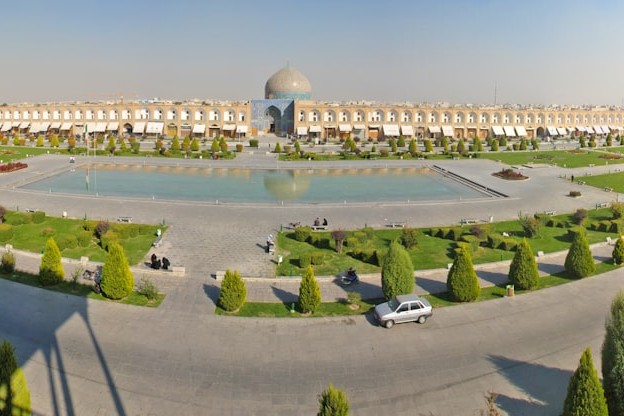
The Wall Street Journal reported that US forces struck the ammunition depot in Isfahan using 2,000-pound bunker-buster bombs, according to a US official. CNN geolocated video showing a series of large explosions in the city, with the minarets of Isfahan’s Grand Mosalla mosque visible in the foreground.
Explosions were also reported in Tehran and Zanjan, according to Turkey’s Anadolu Agency. State-affiliated Iranian media reported power outages in parts of the capital after shrapnel struck an electrical substation. Israel’s military issued a warning to Tehran residents — in Farsi, on X — that it would strike the Vard Avar area “in the coming minutes,” though the message was unlikely to reach many civilians given an internet blackout in effect since the war began.
The Isfahan strike marks a significant escalation beyond weeks of rhetoric about Kharg Island, Iran’s principal oil export terminal. Until now, threats against Iranian energy infrastructure were exactly that — threats, held in reserve as bargaining chips. Hitting a major ammunition depot with penetrator munitions signals a shift from pressure to punishment.
A Tanker on Fire
The same night brought a reminder that Iran is hitting back. A fully loaded Kuwaiti crude carrier, the Al Salmi, was struck by an Iranian drone while anchored at Dubai Port, according to Kuwait Petroleum Corporation. The vessel was carrying 2 million barrels of oil from Kuwait and Saudi Arabia, destined for Qingdao, China.
Dubai authorities said maritime firefighting teams extinguished the blaze. All 24 crew members were reported safe, though Kuwaiti officials warned of a possible oil spill in surrounding waters. No group has claimed responsibility for the strike.
The Al Salmi is one of at least 16 vessels attacked in and around the Arabian Gulf, Strait of Hormuz, and Gulf of Oman since February 28, according to the UK’s maritime authority. Earlier this month, a Thai-flagged vessel was struck by an Iranian drone in the Strait of Hormuz; three Thai crew members remain missing, according to Thailand’s foreign ministry. The attacks have made the world’s most critical oil chokepoint effectively impassable. About 25 to 30 percent of global oil supply would normally transit the strait, according to the International Monetary Fund.
The Price of Everything
The economic consequences are cascading outward. Brent crude hit $116.89 a barrel in early trading on Monday before settling slightly lower, according to The Guardian — a 54% surge for March, beating the previous record of 46% set after Saddam Hussein invaded Kuwait in September 1990. Other reporting puts the monthly gain as high as 59%. Before the war, Brent sat at roughly $72.
The pain is distributed unevenly. US gasoline prices reached a national average of $3.99 per gallon, according to AAA. In the UK, the RAC reported average petrol at 152p per litre and diesel at 181.2p — levels not seen in over two years, with industry figures warning of possible pump shortages.
Asian markets absorbed the heaviest blows. Japan’s Nikkei fell 2.8%, South Korea’s Kospi dropped 3%, and Hong Kong’s Hang Seng shed 0.8%, according to The Guardian. The IMF noted that large energy importers in Asia and Europe are bearing the brunt, while poorer countries in Africa and Asia struggle to secure supplies “even at inflated prices.” Beyond oil, the disruption to fertilizer shipments — one-third of which normally pass through Hormuz — threatens crop yields just as the Northern Hemisphere planting season begins.
Ipek Ozkardeskaya, a senior analyst at Swissquote, warned that crude could reach $150 or even $200 if the war drags on, though she cautioned that above $120-130 per barrel, global recession odds would suppress demand. The IMF was similarly blunt: “All roads lead to higher prices and slower growth.”
The Contradiction
Then came the counter-signal. The Wall Street Journal reported that President Trump has expressed willingness to end the war even if the Strait of Hormuz remains closed — a striking concession that briefly pulled oil prices back from their session highs. White House press secretary said talks were “going well” and that Iranian officials at the negotiating table appeared more reasonable than the previous leadership.
An Iranian official offered a starkly different read. The US list of demands was “largely excessive, unrealistic, and unreasonable,” the official said, according to CNN.
Trump’s public posture has oscillated between these poles for weeks. In a Financial Times interview published Sunday, he mused about seizing Kharg Island — “maybe we take Kharg Island, maybe we don’t” — and called taking Iran’s oil his “favourite thing,” dismissing critics as “stupid people.” On Truth Social Monday, he threatened to “blow up and completely obliterate” Iran’s electric plants, oil wells, and Kharg Island if a deal was not reached. Yet the same post opened by claiming “great progress.”
The gap matters. Every threat of further destruction raises the price of oil, which raises the cost of the war for everyone. Every leaked signal about off-ramps pulls it back. Markets are not pricing in either outcome — they are pricing in the uncertainty between them.
Where This Heads
The Isfahan strike and the Dubai tanker attack represent the military reality: both sides are still escalating, still inflicting damage, still widening the conflict’s footprint. The arrival of 3,500 additional US troops in the region, Houthi ballistic missile fire at Israeli targets, and escalating Israeli operations in southern Lebanon — where the Health Ministry reports at least 1,247 killed since March 2 — all point to a war that is growing, not shrinking.
The diplomatic signals are real enough to move markets but not yet concrete enough to stop the fighting. Iran has approved plans to impose tolls on ships passing through Hormuz — a gesture that suggests Tehran is thinking about revenue, not surrender. The Pentagon, which has not held a press briefing in nearly two weeks, is scheduled to address reporters on Tuesday.
The contradiction between escalation and negotiation is not confusion. It is the strategy. The Trump administration is trying to bomb and bargain simultaneously — maximum pressure as a path to maximum leverage. Iran is doing its own version: hit tankers, strike aluminum plants in Bahrain and the UAE, keep Hormuz closed, all while keeping the diplomatic door open.
Whether either side can find an off-ramp before the economic damage becomes irreversible is the question that now hangs over everything. The IMF’s assessment is clear: the duration, spread, and destructiveness of the conflict will determine how much of the global economy survives it intact. On the evidence of the past 24 hours, the gap between the battlefield and the negotiating table is still widening.
Sources
- Brent crude hits $116 a barrel as Trump threatens to ‘blow up’ Iran’s oilwells and export hub — The Guardian
- Fire extinguished on Kuwaiti tanker hit by Iranian attack in Dubai waters — Reuters
- Explosions reported in Tehran, Isfahan and Zanjan amid US-Israeli strikes — Anadolu Agency
- Trump threatens to ‘obliterate’ Iran’s energy sources, as Tehran calls US demands ‘unrealistic’ — CNN
- How the War in the Middle East Is Affecting Energy, Trade, and Finance — International Monetary Fund
- Here’s What Trump Has Said About Seizing Iran’s Key Oil Hub Kharg Island — Time
Discussion (13)