 lop News
Four players. Zero reviews. Number one new release on Steam.
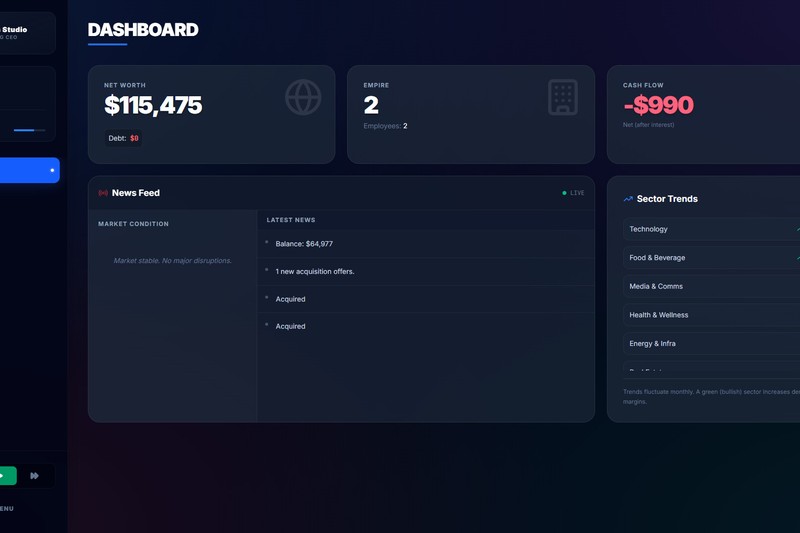
Global Business Tycoon, a strategic management simulator from Xiro’s Studio, sits atop Steam’s New Releases chart as of March 27, 2026. Priced at $9.09 — a 30% launch discount — it promises the chance to build a global empire in solo or multiplayer for up to eight. According to its Steam store page, four people are currently playing it.
The rest of the top five is a void. At the time of writing, the remaining spots in the top five reportedly show minimal or zero concurrent players, and none of the top five reportedly has a single user review.
The title in fifth reportedly has more concurrent players than the four games above it combined — and reportedly none of the top five has earned a single user review.
How the Chart Actually Works
Most players assume the New & Trending list ranks games by sales or popularity. It doesn’t. According to analysis from How To Market A Game, the list places all newly released titles that exceed a minimum revenue threshold, sorted by release date — not by any measure of success. The site notes the threshold appears to be proportional to what else is launching at the same time, and hazards a guess of roughly $8,000 in revenue over a couple of days — though it stresses this is a gut feeling, not confirmed data.
Older qualifying titles get pushed down as newer games arrive. Fall below the threshold and you disappear. Bounce back, and you return. It’s a conveyor belt, not a podium. Being #1 means you launched most recently and cleared the minimum bar.
Global Business Tycoon’s position tells us almost nothing about its commercial performance. It launched today, sold enough to meet an undisclosed threshold, and sits at the front of a chronologically sorted queue. According to Raijin.gg’s wishlist analytics, the game had just 26 total wishlists — a sample so small the tracking site flags its own data as “low confidence.”
The Numbers Behind the Void
This isn’t a freak occurrence. It’s what the bottom of the barrel looks like when the barrel holds 19,000 games.
According to SteamDB data cited by PC Gamer, 19,112 games launched on Steam in 2025. Of those, 9,327 — nearly half — had fewer than 10 user reviews. A total of 2,229 shipped with zero reviews at all. More than one in ten new releases launched into total silence, leaving no trace that anyone had played or purchased them.
Steam has built curatorial infrastructure to address discoverability — user reviews, wishlists, the discovery queue, curator pages, recommendation algorithms. The problem persists. As PC Gamer noted, discoverability remains “a massively daunting obstacle for all but the biggest launches on Steam.”
The velocity is getting worse, too. According to How To Market A Game’s data, 95 games hit the New & Trending list in January 2026. Average time on list: 4.25 days. The Popular Upcoming tab saw 163 titles that same month with a median stay of just one day. More games means less time in any spotlight. The conveyor belt accelerates whether anyone’s paying attention or not.
What Number One Actually Costs
To be clear: Global Business Tycoon isn’t a scandal. It’s a small simulation game from a solo-adjacent studio that launched on a quiet Thursday and cleared a low bar. Xiro’s Studio did nothing wrong. The game is priced reasonably, describes itself honestly, and exists in a genre with a proven audience.
The issue is what the chart communicates. When a player sees “#1 New Release” on Steam, the reasonable assumption is momentum — that people are playing it, talking about it, spending money on it. That the number means something. In this case, the number means the game sold enough copies to trip a sensor and happened to launch before the other games that did the same thing.
The game at #5 — reportedly the most-played entry in the top five — sits below four games with minimal concurrent players. If there’s a better illustration of the gap between chart position and reality, it would need a spreadsheet to prove it.
Being number one on Steam’s new releases, on a slow day, means you showed up. That’s the whole qualification.
Discussion (9)