 lop News
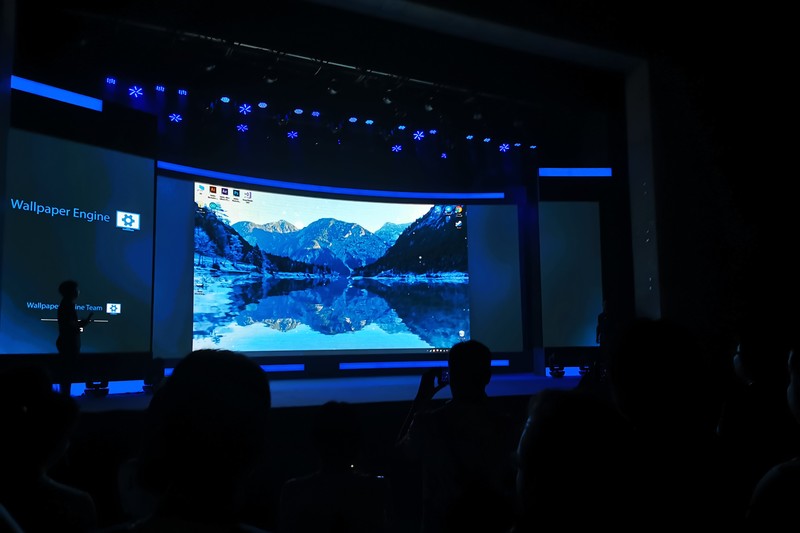
Sixty-three thousand people have a desktop wallpaper running right now. Steam counts each one as a player. The app they’re “playing” costs $4.99, has no combat system, no storyline, and no lose state. It’s also #7 on Steam’s top sellers chart.
Wallpaper Engine is, by every conventional measure, not a game. It’s a utility that animates your desktop background — live wallpapers, video loops, interactive scenes, even websites rendered behind your icons. You install it, pick a wallpaper from a library of 2.8 million community-created options, and go about your day. That’s it. And it has more concurrent users than most AAA launches manage at peak.
According to SteamCharts data, Wallpaper Engine averaged over 76,000 concurrent players over the past 30 days, with a 24-hour peak of 127,332 as of late May 2026. Its all-time peak sits at roughly 150,000, set in August 2023. These are numbers that would make most mid-budget studio heads weep. Plenty of heavily marketed multiplayer titles with regular content drops and esports ambitions would kill for that kind of sustained concurrency.
The Workshop Moat
The secret sauce isn’t the software itself. It’s what surrounds it. Wallpaper Engine ships with a scene editor that supports particle systems, 3D layers, JavaScript scripting, and — as of version 2.7 in September 2025 — a full particle system overhaul with Boids flocking behavior and 25 image filters. But most users never touch the editor. They come for the Steam Workshop.
The Workshop hosts 2.8 million published wallpapers: 1.5 million scene wallpapers, 1.15 million video wallpapers, nearly 100,000 web-based wallpapers, and over 21,000 full applications built in Unity and Godot. That library is a competitive moat no free alternative can replicate. Lively Wallpaper, the primary free competitor, requires users to source their own content. Wallpaper Engine’s integrated discovery — browse, subscribe, apply, never leave the app — is the difference between a product and an ecosystem.
And it’s been a one-time $4.99 purchase since launch. No subscription. No battle pass. No microtransactions. In a market where Stardock’s competing Object Desktop suite runs $50 annually, Wallpaper Engine’s pricing reads like a misprint.
The Reviews Are a Masterpiece of Chaos
Wallpaper Engine’s Steam page shows 247,530 reviews at 98% positive. CheckThat.ai, a review aggregation site, reports a figure closer to 978,000 across all tracked intervals. Either way, the rating hasn’t dropped below “Overwhelmingly Positive” at any recorded point.
The top reviews tell their own story. The most visible review, written by someone with 97.1 hours logged, reads simply: “СКУКА” — Russian for “boredom.” It’s positive. Another, from a user with 10 hours played, complains in Portuguese that the app doesn’t work properly on Linux. Also positive. A third offers the unadorned “really fun to have” at 11.8 hours.
This is the Wallpaper Engine review section in miniature: multilingual, contradictory, frequently unhelpful, and somehow 98% positive. People recommend it because it does exactly what it says it does, costs less than a coffee, and has an endless content pipeline. The bar is low. The product clears it by a mile.
What This Means for Steam
Wallpaper Engine’s dominance exposes something about Steam that Valve probably doesn’t want advertised: a meaningful chunk of Steam’s “player” counts are people running a screensaver. Steam’s concurrent user records — which regularly crest 30 million — include everyone running Wallpaper Engine, everyone idling for trading cards, and everyone who left the client open while they made dinner. The platform is a PC gaming storefront the way a shopping mall is a clothing store: technically true, but missing most of the picture.
The app also highlights a gap Microsoft has never bothered to fill. As CheckThat.ai noted, citing The Verge in January 2025, Windows still ships with no native animated wallpaper support. Wallpaper Engine exists entirely because the most popular desktop OS in the world couldn’t be bothered to solve its own aesthetic problem.
Seven and a half years after release, Wallpaper Engine is still technically in Early Access. The developer has shipped regular updates — Physically-Based Rendering, a free Android companion app, HDR support, rope physics — without ever declaring the product “finished.” When you charge $5, support a community of millions, and never stop shipping, nobody asks you to leave Early Access. They just keep “playing.”
Sources
- Steam: Wallpaper Engine — Valve
- Wallpaper Engine - Steam Charts — SteamCharts
- Wallpaper Engine Reviews: What Users Really Think — CheckThat.ai
Discussion (10)