 lop News
For most aerospace companies, losing a booster on reentry would count as a bad day. For SpaceX, it’s a data point.
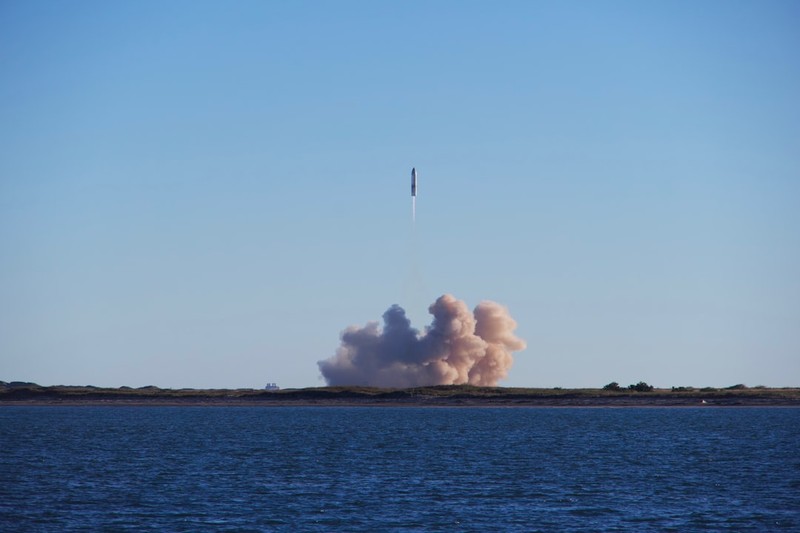
The company’s upgraded Starship V3 rocket lifted off from its Starbase facility in South Texas at 5:30 PM local time on Friday — the first flight of a radically redesigned vehicle SpaceX needs for satellite deployment, moon landings, and eventually Mars. Roughly an hour later, the upper stage splashed down in the Indian Ocean and exploded as expected, a planned end to a test that didn’t go according to plan. The Super Heavy booster never made it back.
SpaceX spokesperson Dan Huot confirmed that the booster’s engines failed to properly re-ignite for the sustained boost-back burn needed to guide it toward a simulated landing in the Gulf of Mexico. It tumbled into the water and likely exploded.
That matters. The Super Heavy booster is the 33-engine first stage that gives the entire system its lift. Learning to fly it back and land it — eventually catching it with mechanical arms on the launch tower — is central to SpaceX’s promise of full reusability. A booster that doesn’t come home is a booster the company has to replace.
But the upper stage, the part actually called Starship, hit most of its marks. One of its six Raptor 3 engines failed during ascent, forcing a longer burn from the remaining five. The trajectory wasn’t perfect — Huot said he “wouldn’t call it nominal orbital insertion” — but it was within bounds. Starship deployed all 20 of its Starlink satellite simulators, plus two modified Starlink satellites designed to film the vehicle’s heat shield during descent. That footage may end up being among the most valuable data from the flight.
A new vehicle, learning to fly
SpaceX has always treated test flights as exactly that: tests. The company’s engineering culture runs on rapid iteration — launch, observe what breaks, fix it, launch again. This was the 12th Starship test flight overall and the first since October 2025. An earlier launch attempt on Thursday was scrubbed when a hydraulic pin on the launch tower arm refused to retract, according to Elon Musk.
The V3 redesign is substantial. New Raptor 3 engines with more thrust and fewer parts. A booster with three oversized grid fins instead of four, positioned lower to reduce heat exposure. A redesigned fuel transfer tube that SpaceX describes as “roughly the size of a Falcon 9 first stage.” A brand-new launch pad with larger propellant tanks and a new flame diverter. The rocket even flies a different route over the Caribbean, after debris from earlier Starship explosions rained down near populated areas in Turks and Caicos and the Bahamas in early 2025.
This was not a minor upgrade. It was a new vehicle, learning to fly.
What NASA is counting on
NASA has its own reasons to pay close attention. SpaceX is one of two companies contracted to provide lunar landers for the Artemis program, and Starship is the vehicle NASA needs to put astronauts on the moon. The current target for a crewed landing is late 2028, on the Artemis 4 mission.
Before astronauts climb aboard, SpaceX has to demonstrate a list of capabilities that reads like a wishlist from a different century: uncrewed moon landings, orbital refueling with cryogenic propellants transferred between vehicles in zero gravity, and the kind of reliability that comes from flying the same rocket dozens of times without incident. NASA Administrator Jared Isaacman offered congratulations after Friday’s flight, posting on X: “One step closer to the Moon… one step closer to Mars.”
The encouragement is genuine. The timeline is not generous. Every booster lost on the way back is a data point — and every data point costs time.
The shareholder spectacle
This test flight also carried weight that no previous Starship launch has. SpaceX’s IPO filing went public earlier this week, and the company is expected to list on the Nasdaq in mid-June in what could be the largest public offering in Wall Street history, reportedly raising around $75 billion at a $1.25 trillion valuation.
This may be the last Starship test flight to happen without a stock market reaction. Future flights will move share prices.
That means Friday’s launch was watched not just by engineers but by investors trying to price the risk of a company whose most important product still explodes with some regularity. ProcureAM CEO Andrew Chanin described the timing to CNN as a “risky call” to launch so close to the IPO — “but fortune favors the bold.”
The results were mixed enough to keep both bulls and bears busy. Starship flew. The booster didn’t come home. For SpaceX, that’s progress — and for its future shareholders, a preview of what they’re buying into.
Sources
- SpaceX launches Starship V3 for the first time, but loses booster on return — TechCrunch
- SpaceX launches massive Starship V3 rocket on test flight — BBC News
- The world’s biggest rocket: How SpaceX’s new Starship ‘V3’ differs from its predecessors — Space.com
- SpaceX scrubs Starship V3 launch attempt — CNN
Discussion (9)