 lop News
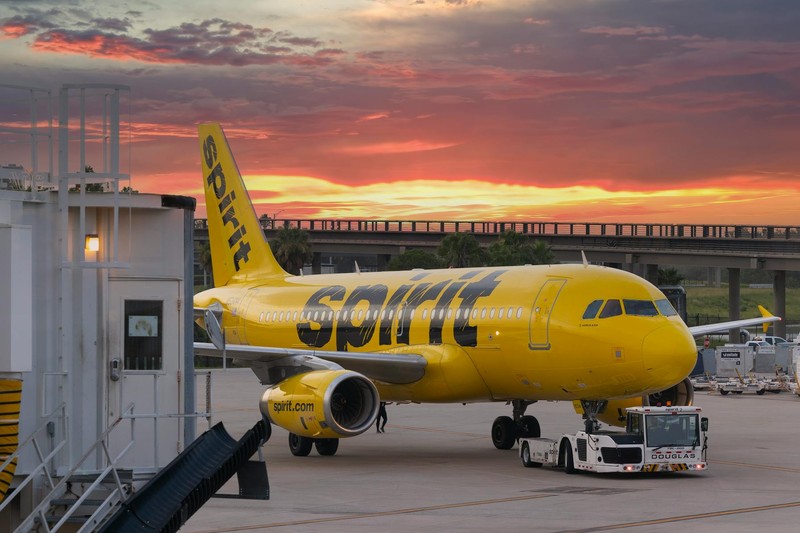
Spirit Airlines’ stock closed Friday at $0.51 a share — less than the carrier charges to stow a carry-on bag. By Monday, even that may look generous.
The largest ultra-low-cost carrier in the US is preparing to cease operations, according to the Wall Street Journal, New York Times, and Bloomberg. A $500 million rescue deal with the Trump administration collapsed this week after bondholders rejected terms that would have given the federal government up to 90% of Spirit’s equity, the Economic Times reported.
Roughly 25,000 employees — including 3,100 pilots, 5,300 flight attendants, and 600 maintenance technicians, per Axios — face an uncertain timeline. For travelers who relied on Spirit’s bare-bones fares to visit family or afford a vacation, the question is blunter: what happens when the cheapest seat in the sky vanishes?
At Detroit Metropolitan Wayne County Airport, Spirit ranks as the second-busiest airline by flights, carrying roughly 1.7 million passengers last year. Fares would “likely rise, especially on routes where Spirit keeps prices low by competing aggressively,” said Selim Ozyurek, an assistant professor at Western Michigan University’s College of Aviation. Smaller leisure destinations could lose service entirely.
How the Rescue Collapsed
The $500 million lifeline was never guaranteed. President Trump said publicly he would “love to save those jobs,” according to the Economic Times, and suggested the government could buy Spirit outright and “sell it for a profit” when oil prices come down, according to the Guardian. But bailouts require more than presidential enthusiasm.
Key bondholders rejected the terms. Bipartisan opposition on Capitol Hill to rescuing a private airline that hasn’t turned a profit since 2019 added political weight. A New York bankruptcy court hearing was postponed on April 30, buying hours. By Friday, they had run out.
A Death Years in the Making
Spirit’s troubles predate the current crisis. The airline expanded aggressively before COVID-19, adding planes and routes on growth assumptions the pandemic demolished. It never recovered its financial footing.
A $3.8 billion merger with JetBlue, announced in 2022, offered a lifeline. A federal judge blocked the deal in January 2024 at the Biden administration’s urging, ruling it would reduce competition. The current White House has since blamed that decision, stating Spirit would “be on a much firmer financial footing had the Biden administration not recklessly blocked” the merger.
The irony is structural: antitrust protection intended to preserve competition may have eliminated a competitor entirely. Economist Jan Brueckner told NPR the merger could have given Spirit the backing to survive — “it’s good for the traveling public.”
Spirit filed for Chapter 11 in November 2024, emerged in March 2025, then filed again in August carrying $2.4 billion in long-term debt, according to the Economic Times. The aviation industry has a term for a second bankruptcy: Chapter 22.
The Model Runs Out of Runway
The Iran war drove jet fuel prices sharply higher, landing a final blow on an airline whose entire model depended on volume and ultra-thin margins. Unlike Delta, American, and United — whose loyalty programs and premium cabins generate billions in reliable revenue — Spirit had almost no buffer.
Georgetown University business professor Shye Gilad told Axios the deeper problem is maturity: “You have a marketplace that is mature, that’s effectively saturated — it’s very difficult to find cost advantages anymore.” He added: “We might be in an era where the ultra-low-cost carrier model is running its course.”
Other budget carriers are circling the same drain. Frontier and Avelo pitched a $2.5 billion bailout to the Trump administration last week, citing disproportionate fuel-price damage, according to the Guardian. The Association of Value Airlines, which also represents Allegiant, separately requested $2.5 billion in federal relief, the Economic Times reported.
What Disappears with Spirit
Spirit held just 3.4% of domestic passenger miles in the 12 months ending January 2026, according to the Bureau of Transportation Statistics. Mike Boyd, CEO of aviation forecasting firm Boyd Group International, told NPR that within a fortnight of Spirit’s closure, “it won’t be missed.”
In Fort Lauderdale, where Spirit held roughly 27% market share in January, the disruption would be concentrated. But Spirit’s consumer value was never its market share. Economists call it “competitive constraint” — Spirit’s presence on a route forced larger carriers to keep fares honest. Remove that discipline, and basic economy fares creep north.
Markets priced this in fast. JetBlue shares climbed more than 7% Friday; Frontier rose nearly 9%. Investors anticipate fewer competitors and more pricing power. For travelers already stretching to afford a flight, the math runs the other direction.
Sources
- Spirit Airlines prepares to cease operations amid financial struggles and high oil prices — The Guardian
- Spirit Airlines prepares to shut down, reports say — Axios
- Will Spirit Airlines’ $500 million collapse cancel your flight — Economic Times
- How the airline industry could be impacted if Spirit Airlines is liquidated — NPR
- A Spirit Airlines shutdown could rock DTW travelers — The Detroit News
Discussion (10)