 lop News
At 1 AM Eastern on Saturday, flight attendants at Spirit Airlines received a message from their union leaders. In two hours, the airline would cease to exist.
By dawn, departure boards at Orlando International Airport glowed red with cancellations — Nashville, San Juan, everywhere Spirit had been scheduled to fly. Yash Kothari arrived at Philadelphia International for a 5:45 AM flight having never seen the shutdown email. He had to find another way home.
The collapse of Spirit Airlines — the first major US carrier to liquidate in 25 years — was abrupt, messy, and entirely predictable. A carrier that hadn’t turned a profit since 2019, battered through two bankruptcies, finally crushed by a doubling of jet fuel prices triggered by the two-month-old Iran war. Even a $500 million rescue package personally championed by President Donald Trump couldn’t save it. Creditors, including Ken Griffin’s Citadel hedge fund, killed the deal.
The fuel shock that broke a broken airline
Spirit’s restructuring plan, agreed with bondholders in March 2026, assumed jet fuel at roughly $2.24 per gallon this year. By the end of April, the price had surged to $4.51 per gallon, according to the airline’s own court filings.
The math was unforgiving. Jet fuel accounts for roughly a quarter of airline operating costs, and for ultra-low-cost carriers like Spirit — whose entire business model depended on rock-bottom fares — there was nowhere to hide. Larger carriers could raise fares or cut routes. Spirit’s customers wouldn’t pay the premium.
Savanthi Syth, an airlines analyst at Raymond James, told the BBC that spiralling fuel costs proved “the final nail in the coffin” for Spirit — but added that its survival was precarious even before the conflict. “If it wasn’t for the fuel scenario, they would have been okay through the summer, beyond the summer I would have said it was still precarious.”
The Iran war, launched by the US and Israel in late February, disrupted roughly 20% of global oil supply. Iran’s near-total halt of tanker traffic through the Strait of Hormuz and the US Navy’s blockade of Iranian ports drove fuel prices to levels no airline had budgeted for.
The bailout that wasn’t
Trump publicly floated a $500 million government rescue that would have given the US government an overwhelming stake in Spirit — reports suggested as much as 90% of shares. The president framed it as a job-preservation measure, suggesting the government could resell the airline at a profit once oil prices normalized.
“If we can help them, we will,” Trump said Friday. “But we have to come first.”
It was an unusual pitch from a Republican president whose party has historically opposed industry bailouts. Opposition came from all sides — some of Trump’s own advisers, Republican lawmakers, and competing airlines all pushed back. Transportation Secretary Sean Duffy told Reuters a rescue would amount to tossing “good money after bad.”
The dealbreaker was Spirit’s own creditors. Citadel and other major bondholders opposed the terms, which would have placed federal financing ahead of their existing claims. When they rejected the final proposal, the game was over.
17,000 jobs and 2 million seats gone
The shutdown eliminates roughly 17,000 jobs — 14,000 employees and thousands of contractors and others whose jobs depended on Spirit — according to airline officials. The Air Line Pilots Association said more than 2,000 pilots are affected, pilots who had already accepted tens of millions in annual concessions to help the airline through restructuring.
“They did their part. They deserved better than this outcome,” said ALPA president Captain Jason Abrosini.
The International Association of Machinists was blunter: “Our members on the ramp did not cause this failure; corporate mismanagement and poor financial stewardship did.”
For stranded passengers, Spirit instructed customers not to go to the airport. Refunds for credit and debit card purchases will be processed automatically. Those who booked with vouchers or loyalty points may recover nothing — that will be decided in bankruptcy court. Spirit had roughly 9,000 flights and 1.8 million seats scheduled through the end of May alone, according to Cirium aviation data.
United, Delta, JetBlue, and Southwest are capping fares for displaced Spirit passengers at roughly $200 one-way, with a confirmation number required. Frontier is offering 50% off base fares through May 10.
Who’s next?
The broader industry is not immune. United Airlines warned that sustained fuel prices could add $11 billion in annual expenses — double its highest-ever annual profit. American Airlines said every penny increase in jet fuel costs $50 million a year. European carriers are cutting tens of thousands of flights. The head of the International Energy Agency has warned Europe could run out of jet fuel in as little as six weeks.
US low-cost carriers have collectively requested $2.5 billion in government assistance, though Duffy said Saturday he does not believe a broader bailout is necessary “at this point.”
Spirit was uniquely vulnerable — losing money since 2019, blocked from a JetBlue merger by the Biden administration in 2024, and twice bankrupt. But the forces that killed it are hitting every airline on earth. The question is how many can absorb a fuel price shock that shows no sign of ending.
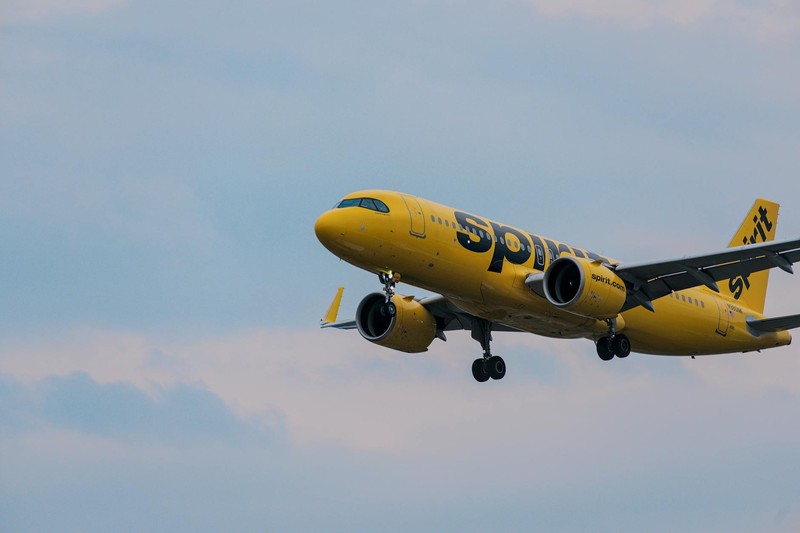
Spirit’s bright yellow planes carried budget travelers for 34 years. On Saturday morning, they sat empty at gates across America.
Sources
- Airlines scramble to help stranded Spirit passengers after budget carrier collapses — Channel News Asia
- Trump says a Spirit bailout still is possible as doubts about the airline’s survival mount — Associated Press
- Spirit Airlines canceled all flights and is going out of business — CNN
- Spirit Airlines shutting down after rescue talks collapse — BBC
Discussion (10)