 lop News
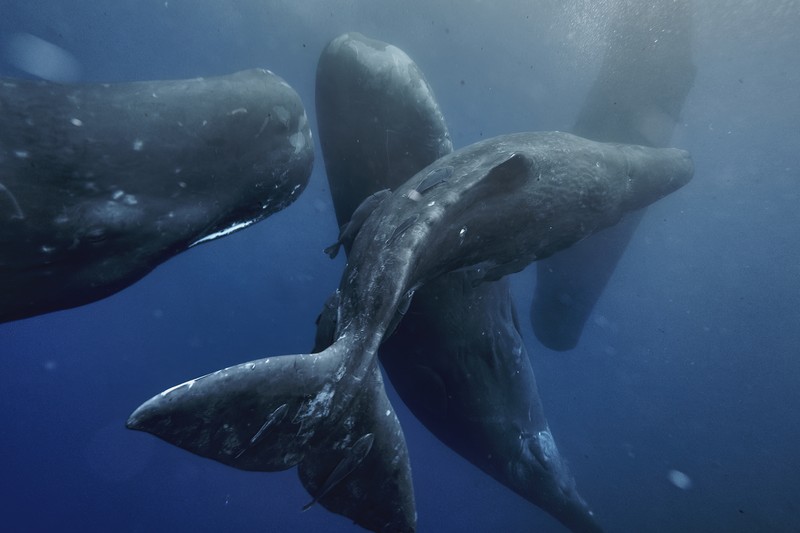
The blood in the water made Shane Gero’s heart sink. His research team had been tracking a pod of sperm whales off the coast of Dominica when the group suddenly clustered together and the sea turned red. “I thought that predators had attacked,” Gero told NPR. “This is going to be a horrible, terrible, no-good, very bad day.”
Instead, they were about to witness something never before captured in such detail: a sperm whale birth attended by a coordinated team of helpers.
The researchers — part of Project CETI, an international effort to decode whale communication — launched drones and spent the next five hours recording. An 11-whale pod surrounded a 19-year-old female named Rounder as she gave birth to her second calf. The labor lasted 34 minutes.
Then something remarkable happened: every whale in the pod took turns lifting the newborn toward the surface.
Newborn sperm whales sink unless helped — they lack the oil-filled organ that keeps adults buoyant. For three hours after the birth, each member of the pod, including whales with no genetic relation to Rounder, nudged and guided the 4-meter calf toward its first breaths.
The findings, published Thursday in Science and Scientific Reports, provide the first quantitative evidence of cooperative birth assistance outside humans and a few other primates. The pod included two distinct family lines that normally maintain social distance. During the birth, those boundaries dissolved.
Rounder’s mother, Lady Oracle, was present. So was her daughter, Accra — three generations of females participating together. The team also recorded audio and found distinct shifts in the whales’ vocalizations at key moments, suggesting coordinated communication during one of life’s most vulnerable moments.
Whale births have been documented in fewer than 10 percent of cetacean species. Capturing one at this level of detail, marine biologist Seán O’Callaghan told Science, is essentially “winning the lottery.”
Discussion (5)