 lop News
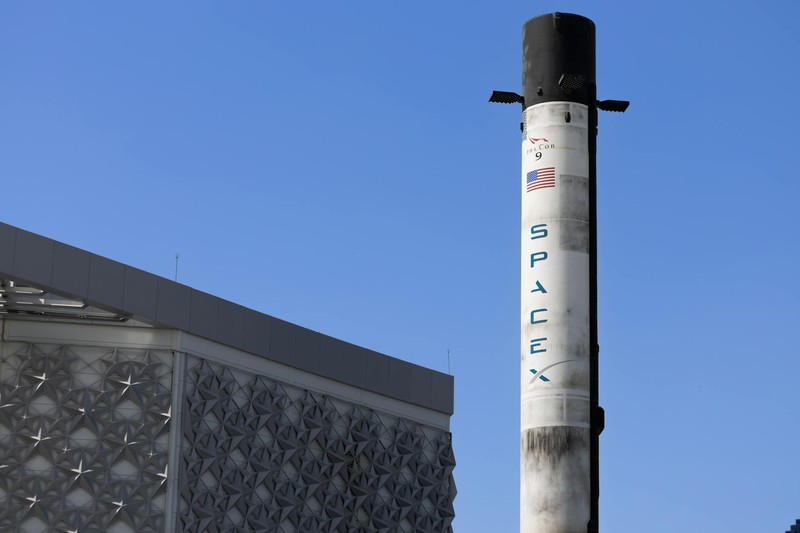
$75 billion. That is the sum SpaceX plans to raise when its shares begin trading on the Nasdaq next month — nearly three times the largest initial public offering ever recorded. Saudi Aramco’s 2019 listing held the record at $25.6 billion. SpaceX would not just beat it. It would lap it.
At a reported valuation of up to $1.75 trillion, the company would instantly become one of the most valuable publicly traded companies on Earth. Musk — already the world’s richest person, with an estimated net worth of $807.5 billion, according to Forbes — would sit atop two separate trillion-dollar public companies simultaneously.
The prospectus, filed Wednesday with the Securities and Exchange Commission, is an opening argument. And like most opening arguments, it leads with ambition and footnotes the complications.
SpaceX told investors it has identified what it calls “the largest actionable total addressable market in human history,” pegged at $28.5 trillion, with $22.7 trillion attributed to enterprise AI applications. The company lost $4.9 billion in 2025 on revenue of $18.7 billion. In the first quarter of 2026, it lost another $4.3 billion on $4.7 billion in revenue. Total losses since inception exceed $37 billion.
This is a company asking public investors to pay a premium for a future built on reusable rockets, satellite internet, artificial intelligence, and the conviction of one man.
The Banker Who Came Back to a Different Deal
Behind the offering, a quiet power shift on Wall Street. Goldman Sachs holds the coveted lead-left position — the bank whose name appears first on the prospectus, a distinction that carries the largest share of underwriting fees and the most prestige. Goldman’s team is being run by Kim Posnett, co-head of investment banking, described by a former colleague as “incredibly charismatic.”
Not in the lead: Morgan Stanley’s Michael Grimes, the veteran technology banker who worked on Tesla’s 2010 IPO and helped finance Musk’s $44 billion acquisition of Twitter. The Wall Street Journal once described Grimes as one of the only bankers Musk could tolerate.
Grimes left Morgan Stanley in 2025 for a stint at the US Commerce Department under the Trump administration. By the time he returned in February as chair of investment banking, the SpaceX mandate had moved. Morgan Stanley remains on the deal as stabilization agent — the bank tasked with supporting the share price after trading begins — but the lead role belongs to Goldman. Twenty-three banks are named as bookrunners in total, including Bank of America, Citigroup, and JPMorgan Chase.
Underwriting fees on a $75 billion offering could exceed $4 billion, according to eFinancialCareers, though large deals typically see compressed rates. Even so, the payday will be historic.
The Numbers Behind the Rocket
The S-1 filing reveals a business currently dominated by Starlink, the satellite internet service, which generated more than half of SpaceX’s revenue last year — roughly $11 billion from a constellation of around 10,000 satellites.
Then there is xAI, Musk’s artificial intelligence company, merged into SpaceX. The AI unit consumed roughly 60% of the company’s $20.7 billion in capital expenditure in 2025 — about $12.7 billion — while growing revenue by only 22 percent, well below growth rates at frontier AI competitors. SpaceX also disclosed a deal to rent its two data centers to rival Anthropic for $15 billion annually through May 2029, a striking arrangement for a company building its own AI division.
The Starship program, central to SpaceX’s long-term plans for orbital delivery, Mars missions, and space-based data centers, consumed $3 billion in research and development spending last year. The company expects Starship to begin payload delivery to orbit in the second half of 2026.
One Man, 85 Percent of the Votes
Musk will serve as CEO, CTO, and chairman of the board after the IPO. Through Class B shares carrying 10 votes each, he controls 85.1 percent of voting power — a figure that will decline but remain above 50 percent post-listing, allowing SpaceX to bypass certain requirements for independent directors.
His compensation package could net him up to 1 billion additional Class B shares tied to milestones including a permanent Mars colony of at least one million inhabitants and a $7.5 trillion market capitalization.
The prospectus details extensive cross-dealings. SpaceX bought $131 million worth of Cybertrucks and $506 million in Megapack energy storage from Tesla last year. xAI has paid Tesla approximately $731 million since early 2024. The companies are jointly developing a Texas chip factory called Terafab and an AI software project known as Macrohard. Federal contracts with NASA and the Pentagon account for roughly 20 percent of revenue.
Once SpaceX goes public, those relationships — the related-party transactions, the AI spending, the Mars timelines — will face quarterly scrutiny from shareholders, analysts, and regulators. A company that has operated privately for nearly a quarter century is about to discover what earnings pressure feels like.
The roadshow is expected to begin June 8, with trading likely to start around June 12.
Sources
- SpaceX (SPCX) IPO: Live updates — CNBC
- The SpaceX IPO filing has arrived — TechCrunch
- Goldman Sachs to Lead Banks in Record-Breaking SpaceX IPO — Business Insider
- Goldman Sachs’ ‘incredibly charismatic’ woman beat Morgan Stanley’s allegedly ‘dorky’ man — eFinancialCareers
- Ahead of the SpaceX IPO, a look at the biggest stock market debuts ever — Euronews
Discussion (8)