 lop News
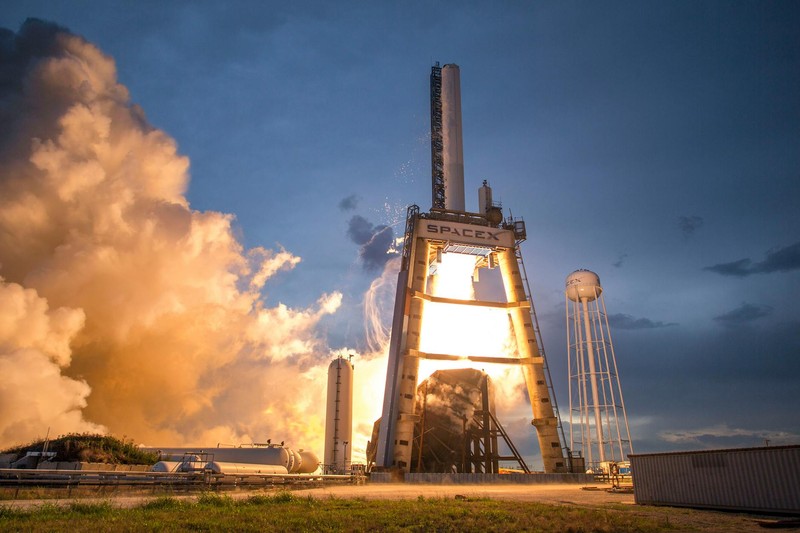
$75 billion. That’s what SpaceX wants to raise when it goes public — more than double the largest stock market debut in history.
Elon Musk’s space company confidentially filed paperwork for an initial public offering with the Securities and Exchange Commission this week, according to multiple reports. Bloomberg and Reuters both reported the company is targeting a valuation above $1.75 trillion, which would set a record for a public listing.
For context: Saudi Aramco holds the current IPO benchmark, having raised $29 billion in 2019. SpaceX is aiming for roughly triple that.
Follow the Money to Riyadh
Saudi Arabia’s Public Investment Fund is in discussions to take a $5 billion anchor stake in the offering, according to Reuters, citing two people familiar with the matter. The investment would partly protect the fund’s existing position of just under 1% from dilution.
The kingdom’s financial ties to Musk’s empire run deep and in multiple directions. PIF’s AI subsidiary HUMAIN and Musk’s xAI announced a partnership in November to deploy 500 megawatts of data center capacity in Saudi Arabia. PIF also invested $3 billion through HUMAIN in connection with xAI’s merger with social media platform X. The IPO gives Riyadh a chance to lock in exposure across space, AI, and social media with a single check.
Rockets, Satellites, or the Man Himself
Investors trying to value SpaceX must first answer a basic question: what exactly are they buying?
The company generated approximately $8 billion in profit on $15 billion to $16 billion of revenue last year, Reuters reported, citing people familiar with the finances. SpaceX conducts more orbital launches than any competitor and serves as NASA’s primary launch partner, having received more than $24.4 billion in federal contracts since 2008, according to FedScout.
But the valuation engine is Starlink. The satellite internet service operates roughly 10,000 satellites, serves 9 million subscribers, holds defense contracts, and runs its own data network.
“Starlink is the only reason this valuation is defensible,” said Shay Boloor, chief market strategist at Futurum Equities. “This is going to be the recurring revenue engine.”
Then there’s the AI bundle. SpaceX merged with xAI in February in an all-stock deal valuing the combined entity at $1.25 trillion — $1 trillion for the rocket business, $250 billion for the Grok chatbot maker. The company is hosting an analyst day on April 21, with an optional tour of xAI’s “Macrohard” data center in Memphis two days later. SpaceX has also sought permission to launch up to 1 million solar-powered satellites designed as orbital data centers. The combined entity even owns X, the social media platform formerly known as Twitter.
Buyers get rockets, satellites, an AI company, and a social network — all bundled around one man.
The Muskonomy Tangle
That man already runs Tesla, valued at $1.4 trillion. He oversees brain-chip maker Neuralink and tunnel-digging firm The Boring Company. Tesla has invested more than $2 billion in xAI. Grok appears as an AI assistant in some Teslas. Musk has said a significant share of Tesla manufacturing will shift toward robots using xAI technology. SpaceX, Tesla, and xAI are all partners in Terafab, a massive chipmaking venture Musk announced last month.
“Investors could use a sum-of-the-parts analysis, but, like with Tesla, SpaceX’s valuation could very much fluctuate wildly based off how much the public believes in Musk’s vision,” said Angelo Bochanis of Renaissance Capital, a provider of IPO research.
A likely dual-class share structure would let Musk tap public capital while retaining firm control despite dilution, said Minmo Gahng, a finance professor at Cornell. He will run a public company with the same unilateral authority he wielded when it was private — now with regulators watching.
Timing Risk
Even a listing of this scale is hostage to market conditions. The Nasdaq is coming off its steepest weekly drop in nearly a year, driven by the US-Iran war and surging oil prices.
“You can have a great company, with great fundamentals and a lot of investor interest — and an IPO can still flop if the markets have turned south, if there’s too much volatility in the market,” said Georgetown finance professor Reena Aggarwal.
SpaceX is targeting a listing around June, with Bank of America, Citigroup, Goldman Sachs, JPMorgan Chase, and Morgan Stanley leading the offering, the Wall Street Journal reported. OpenAI and Anthropic are also weighing large public listings, according to Forbes, setting up a broader test of investor appetite for AI-adjacent companies.
When SpaceX debuts, Musk will become the first person to helm two separate trillion-dollar public companies. His estimated 43% stake would push his net worth — already $824 billion, per Forbes — past $1 trillion.
The world’s first trillionaire, selling shares in a rocket company to fund AI data centers in orbit, backed by Saudi sovereign wealth, while running a car company, a brain-chip startup, and a social media platform. Public markets will soon have to put a price on all of it.
Sources
- SpaceX files for IPO, sources say, offering investors stake in Musk’s space ambitions — Reuters
- Exclusive: SpaceX has held talks with Saudi fund for possible $5 billion investment in IPO, sources say — Reuters
- SpaceX confidentially files for IPO, setting stage for record offering — CNBC
- Elon Musk’s SpaceX set to be worth $1 trillion with planned public listing — BBC
- SpaceX Files For IPO As Musk Approaches Trillionaire Status — Forbes
Discussion (9)