 lop News
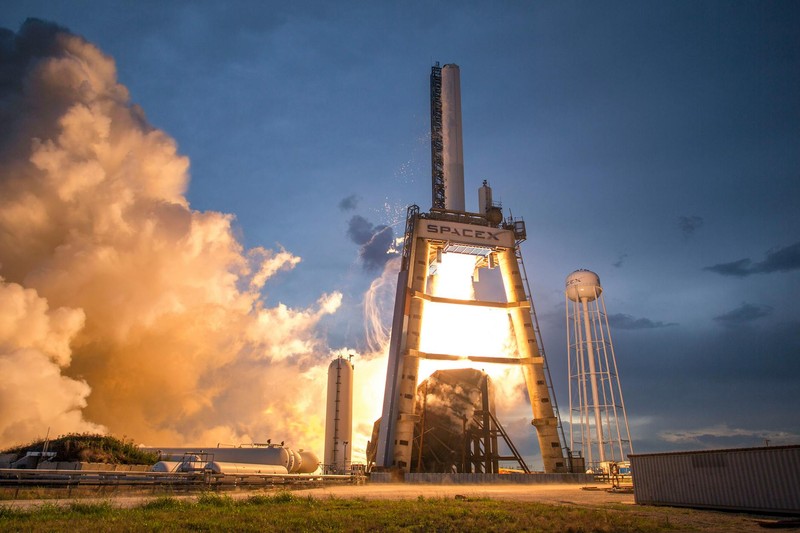
$55 billion. That’s the opening bid from a company whose day job is launching rockets and catching booster stages with mechanical arms.
SpaceX has filed plans to build what it calls Terafab — a vertically integrated semiconductor manufacturing facility in Grimes County, Texas, roughly 20 miles east of Bryan-College Station. According to a public notice filed with the Grimes County Commissioner’s Court, the initial phase carries a $55 billion capital investment, with total costs potentially reaching $119 billion if all subsequent phases are completed. According to reports, SpaceX has already indicated the ultimate cost could be double the initial figure.
The commissioners will hold a public hearing on June 3 to consider a property tax abatement for the project — the first formal step in what could become the largest single private manufacturing investment in US history.
A Rocket Company Walks Into a Fab
Terafab was announced by Elon Musk on March 21, 2026, at the defunct Seaholm Power Plant in Austin. The project is a joint venture involving SpaceX, Tesla, xAI, and — as of April 7 — Intel, which signed on to contribute sub-5-nanometer manufacturing expertise. Intel is one of only three companies worldwide producing chips at that scale, alongside TSMC and Samsung Electronics.
The premise is vertical integration on a staggering scale: chip design, lithography, fabrication, memory production, advanced packaging, and testing, all under one roof. A prototype facility is already planned for Tesla’s GigaTexas site in Austin, targeting 2-nanometer process technology and an initial output of 100,000 wafer starts per month. The full-scale campus would aim for 1 million wafer starts per month — producing between 100 billion and 200 billion custom AI and memory chips per year, according to Musk.
Musk has claimed that every fabrication facility on Earth currently produces roughly 2 percent of what Tesla and SpaceX will need across all projects. If taken at face value, that suggests the existing global semiconductor industry is two orders of magnitude too small for his ambitions.
The Semiconductor Sovereignty Race
The Terafab filing lands in the middle of a global scramble for chip independence. TSMC is building in Arizona. Intel is constructing fabs in Ohio. Samsung has committed to Texas. Governments from Brussels to Beijing have decided that relying on distant supply chains for semiconductors is a strategic vulnerability they can no longer tolerate.
What’s different here is the customer. SpaceX is not a chipmaker diversifying its portfolio. It’s a space company that, alongside its automotive and AI partners, has concluded the existing semiconductor market cannot serve its needs — and is willing to build the supply chain from scratch.
At $55 billion for initial phases, Terafab’s first stage alone would exceed TSMC’s roughly $40 billion commitment to Arizona. The $119 billion total would more than double the cost of the entire CHIPS and Science Act, the US government’s signature industrial policy for semiconductors, which authorized roughly $52 billion in subsidies.
Follow the Money
Who finances a $55 billion chip fab, let alone a $119 billion one? That question hangs over the entire project. SpaceX is privately held. Tesla, while publicly traded and valuable, already carries significant capital expenditure commitments for vehicle and robot production. Intel’s involvement suggests it may bring both expertise and capital, though the company is simultaneously funding its own multi-billion-dollar fab expansion.
The June 3 hearing in Grimes County will test local appetite. A property tax abatement is a standard incentive tool, but it represents just one layer of what will likely be a complex financing structure — state-level incentives from Texas, federal subsidies through the CHIPS Act, and possibly debt markets could all factor in.
Not everyone is welcoming the project. Residents of Grimes County — a rural community of roughly 30,000 — have expressed frustration over a lack of communication from county leadership. A community group that formed in response to earlier data center proposals is already pushing back, according to local reports.
The Foundry Model, Challenged
If Terafab proceeds, it would reshape the semiconductor landscape beyond mere capacity. A vertically integrated fab owned by its end customers — rather than operating as a contract manufacturer — challenges the foundry model that has dominated chipmaking for decades. TSMC’s entire business is built on manufacturing chips for everyone. Terafab’s business, by design, would serve Musk’s companies first.
Whether that model works at the bleeding edge of semiconductor manufacturing — where yields are uncertain, timelines slip, and costs multiply — is an open question. Intel has spent years learning that lesson the hard way.
Musk has described Terafab as “the largest and most advanced chip fabrication facility in the world” and confirmed that Grimes County is one of several locations under consideration. The site near Gibbons Creek Reservoir offers something Austin cannot: thousands of acres of land. Whether it also offers the water, power, and workforce a fab of this scale demands — and whether the financing holds together — will become clearer after June 3.
Sources
- Musk, SpaceX to invest $55 billion for Terafab chip facility in Texas — USA Today
- Terafab — Wikipedia
- SpaceX TeraFab Eyes Grimes County TX for $119B Chip Fab Megaproject — GearMusk
Discussion (9)