 lop News
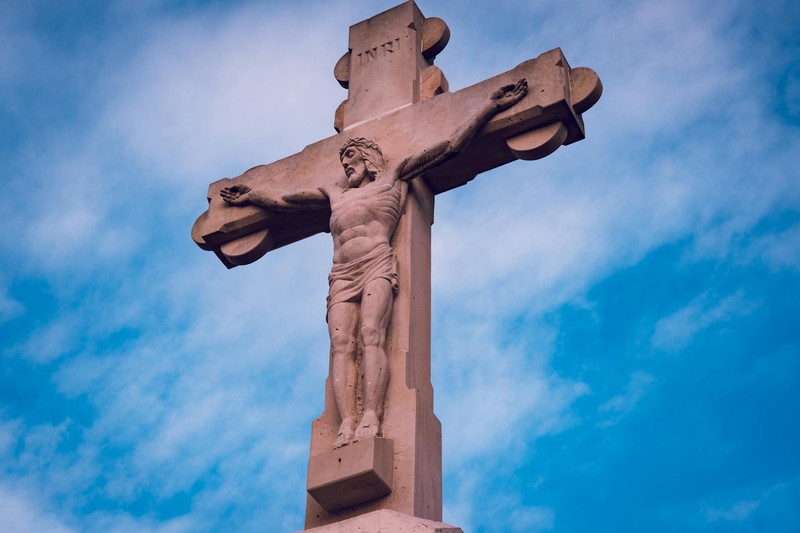
A sledgehammer swinging at the head of a crucified Christ. An Israeli soldier in uniform, caught on camera, striking again and again. The image spread across social media over the weekend, and by Sunday evening the Israel Defense Forces had confirmed what the photograph appeared to show: one of its own deliberately destroying a religious statue in a Christian village in southern Lebanon.
The confirmation itself is significant. Israel rarely acknowledges individual acts of destruction by its troops, let alone opens a criminal investigation within 24 hours. By Monday, the military said it had identified and located the soldier responsible. Prime Minister Benjamin Netanyahu said he was “stunned and saddened” and condemned the act “in the strongest terms.” Foreign Minister Gideon Saar went further, calling it “shameful and disgraceful” and offering a direct apology: “We apologise for this incident and to every Christian whose feelings were hurt.”
The statue stood on a crucifix outside a family home on the edge of Debel, a Maronite Christian village roughly five kilometres from the Israeli border. Father Fadi Flaifel, head of Debel’s congregation, told the BBC the community “totally reject[s] the desecration of the cross” and claimed similar acts had occurred before.
Debel is not an arbitrary backdrop. It is one of the few villages in southern Lebanon where residents chose to remain during Israel’s military campaign against Hezbollah, which began on March 2 after the Shia militant group began firing rockets into Israel in support of Iran. The campaign has killed more than 2,290 people and displaced over a million, according to Lebanese authorities. Thirteen Israeli soldiers and two Israeli civilians have been killed in the same period. A US-brokered ceasefire took effect last Friday, though thousands of Israeli troops remain deployed across the south.
A pattern, not an aberration
The speed of Israel’s official response suggests an awareness of exactly how damaging this image could be — and not only because of the religious symbol at its centre. The desecration fits a documented pattern of Israeli attacks on houses of worship during the current conflicts.
In 2024, Israeli troops filmed a mock wedding between two soldiers inside a church in Deir Mimas, Lebanon, and vandalised the building. An Israeli tank demolished a statue of Saint George in the southern village of Yaroun last year. In Gaza, local officials report that Israeli forces have destroyed more than 1,000 mosques and three churches since the war began.
The Assembly of Catholic Ordinaries of the Holy Land, in a statement published by the Latin Patriarchate of Jerusalem, expressed “profound indignation and unreserved condemnation,” noting that the Debel incident “adds to other reported incidents of desecration of Christian symbols by IDF soldiers in southern Lebanon.” The body called for “immediate and decisive disciplinary action” and renewed its appeal to end the war.
Wadie Abunassar, coordinator of the Christian Forum in the Holy Land, said he had received the image from several sources. “It is impossible to remain silent in the face of such violations,” he said, calling for formal complaints to bring the perpetrator to justice.
The diplomatic reverberations
The fallout has been unusually wide-reaching. US Ambassador to Israel Mike Huckabee — a Baptist minister and one of the most reliably pro-Israel figures in American public life — wrote on X that “swift, severe, & public consequences are needed.” The directness of the statement from a sitting ambassador to Israel was striking.
The image also cracked open a fissure within President Donald Trump’s political base. Former Fox News host Tucker Carlson wrote that “the Israeli government has permitted its soldiers to behave like barbarians for decades, all while sucking up generous funding from the United States.” Former Republican congresswoman Marjorie Taylor Greene pointed to the billions in annual US military aid. Former congressman Matt Gaetz posted a single word: “Horrific.”
That breadth of condemnation carries weight. Support for Israel in the United States has been sliding for months. A Pew Research Center survey found that 60 percent of American adults now hold an unfavourable view of Israel, up from 53 percent last year — a historic low. The incident also follows last month’s controversy, when Israeli police prevented the top Roman Catholic leader in Jerusalem from entering the Church of the Holy Sepulchre for a private Mass on Palm Sunday, citing safety concerns during the Iran war.
Netanyahu used his condemnation to reframe the narrative. “‘The Christian population in Israel thrives unlike elsewhere in the Middle East,’ he wrote, adding that Israel is ‘the only place in the Middle East that adheres to freedom of worship for all.’” Lebanon, which has the largest per capita Christian population in the Middle East and whose president is a Maronite Catholic, might dispute the characterization.
The IDF has pledged to work with the Christian community to “restore the statue to its place.” It is the kind of gesture that addresses the photograph while leaving untouched the conditions that made it possible.
Sources
- Israel PM vows ‘harsh action’ against soldier vandalising Jesus statue in Lebanon — AFP via France 24
- Outcry grows over Israeli soldier smashing Jesus statue in Lebanon — Al Jazeera
- Outrage over Israeli soldier’s vandalism of Jesus statue in Lebanon — BBC News
- IDF confirms image of soldier smashing Jesus statue in southern Lebanon is authentic — The Jerusalem Post
Discussion (9)