 lop News
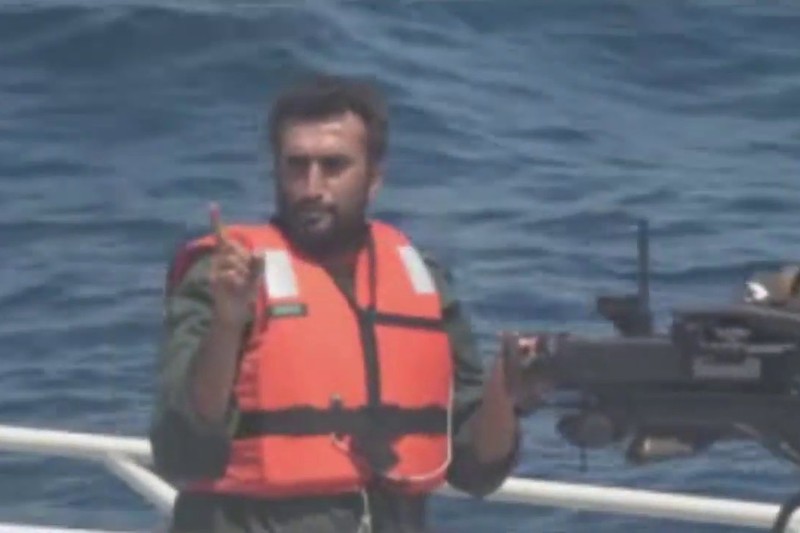
The order was unambiguous. On Thursday, President Donald Trump directed the U.S. Navy to “shoot and kill” any Iranian boat caught laying mines in the Strait of Hormuz — “there is to be no hesitation.”
“I have ordered the United States Navy to shoot and kill any boat, small boats though they may be, that is putting mines in the waters of the Strait of Hormuz,” Trump wrote. He added that U.S. minesweepers are “clearing the Strait right now” and ordered that operation to “continue, but at a tripled up level!”
The directive marks a meaningful shift in the American posture in the Persian Gulf. Until now, U.S. forces had operated under rules of engagement centered on interception, boarding, and seizure — redirecting vessels, confiscating cargo, and enforcing a naval blockade of Iranian ports. “Shoot and kill” moves the threshold to pre-emptive lethal action against Iranian crews before a mining mission is completed, not after. The order effectively eliminates any requirement for warning shots or graduated force.
A Seizure Timed for Effect
The announcement came within hours of the Pentagon releasing video footage of U.S. forces boarding the oil tanker Majestic X in the Indian Ocean — a vessel American officials say was smuggling Iranian crude in violation of sanctions. The ship had been flying a Guyanese flag, though Guyana’s Maritime Administration Department said in a statement it was “FRAUDULENTLY flying the Guyana flag” and had no record in the national registry.
The Majestic X had previously been named Phonix and was sanctioned by the U.S. Treasury Department in 2024 for smuggling Iranian oil. Ship-tracking data showed it in the Indian Ocean between Sri Lanka and Indonesia, roughly the same location as the tanker Tifani, seized earlier by American forces.
The footage dropped one day after Iran’s Revolutionary Guard attacked three cargo ships in the strait, capturing two: the MSC Francesca, with a crew that includes four Montenegrin nationals and two Croatians, and the Liberia-flagged Epaminondas, carrying 21 Ukrainian and Filipino crew members bound for India. Each side, in other words, is seizing ships — and making sure cameras are present when they do.
Dueling Blockades, Deadlocked Diplomacy
The confrontation reflects two mutually exclusive preconditions. Iran says it will not return to negotiations until the U.S. lifts its naval blockade of Iranian ports. The White House says it will not attend talks until Tehran reopens Hormuz to international traffic. Neither condition has been met, and talks planned for this week in Islamabad have not materialized.
The U.S. has redirected 33 vessels since its blockade began, according to U.S. Central Command. Iran has effectively shut down traffic through the strait — through which roughly 20 percent of all crude oil and natural gas traded globally passed before the war — and has begun tolling ships for passage and firing on vessels attempting transit. Since the conflict began on Feb. 28, more than 30 ships have come under attack in the Persian Gulf, the Strait of Hormuz, and the Gulf of Oman, according to the AP.
Iran’s judiciary chief, Gholam Hossein Mohseni Ejei, called the Revolutionary Guard’s operations in the strait “a source of pride” and claimed Americans “lack the courage” to approach it. Iran’s foreign ministry spokesperson, Esmail Baghaei, said Iran’s actions in Hormuz are “entirely lawful” under both international and domestic law.
The Mine Problem and the Energy Shock
The economic consequences are compounding. Fatih Birol, head of the International Energy Agency, told CNBC on Thursday that the world faces “the biggest energy security threat in history,” with 13 million barrels per day removed from global supply. Oil has surged to around $90 a barrel; U.S. gasoline has surpassed $4. Trump has downplayed the toll: “If you would have told me that oil is at 90 as opposed to 200, I would be frankly surprised,” he told CNBC on Tuesday. When asked whether Americans should expect higher prices for the foreseeable future, he said “for a little while,” adding that the trade-off is “Iran without a nuclear weapon.”
Pentagon officials told Congress this week that Iran has placed at least 20 mines in the strait and has lost track of where some of them are, according to the New York Times. Both Iran and the U.S. lack advanced mine-removal capabilities, officials said. The Washington Post reported that officials briefed Congress on a potential six-month clearing timeline — a figure the Pentagon subsequently called “inaccurate,” without providing an alternative.
Jakob Larsen, head of maritime security for BIMCO, the world’s largest shipowners’ association, said most companies require a stable ceasefire and explicit safety assurances from both sides before resuming transits. Mines remain a “particular concern.” Italy’s navy chief of staff, Giuseppe Berutti Bergotto, told state broadcaster RAI that Italy is ready to deploy two minesweepers, an escort vessel, and a logistics vessel to assist.
A Ceasefire That Holds on Paper
Trump this week extended the ceasefire that began April 8, giving Iran what he described as more time to produce a “unified proposal” on ending the war. He also announced a three-week extension of a separate ceasefire between Israel and Hezbollah in Lebanon, after talks between the Israeli and Lebanese ambassadors.
But the truce has not produced a diplomatic breakthrough. Trump has claimed a leadership rift in Tehran between “hard-liners” and “moderates” is obstructing negotiations. “Iran is having a very hard time figuring out who their leader is!” he wrote Thursday. He also shared a post by conservative commentator Marc Thiessen calling for the assassination of Iranian officials who oppose diplomacy: “If there are two factions in Iran, one that wants a deal and one that doesn’t, let’s kill the ones who don’t want a deal.”
Iranian officials have rejected the rift narrative uniformly. President Masoud Pezeshkian said there are “no radicals or moderates” in Iran: “We are all ‘Iranian’ and ‘revolutionary.’” Foreign Minister Abbas Araghchi wrote that “the battlefield and diplomacy are fully coordinated fronts in the same war” and that “Iranians are all united, more than ever before.”
Israel’s Defense Minister Israel Katz said in a video statement that Israel is “prepared to renew the war against Iran” and is waiting “for the green light from the U.S.” to “complete the elimination of the Khamenei dynasty.” Three U.S. aircraft carriers are now in the region — one in the Indian Ocean, one in the Arabian Sea, and one in the Red Sea.
The Toll
The human cost continues to mount. Iran’s forensics chief said nearly 3,400 people have been killed in the country since U.S.-Israeli strikes began. More than 2,200 have been killed in Lebanon, 32 in Gulf states, and 23 in Israel. Thirteen U.S. service members have died in combat, with two more from non-combat causes. Iran has been under an internet blackout for 55 consecutive days, with connectivity at roughly 2 percent of normal levels, according to the monitoring group NetBlocks.
Pope Leo XIV urged both sides to return to talks. Kuwait has fully reopened its airspace for the first time since February. But the core demands remain unchanged, the blockades remain in place, and the rules of engagement just became considerably more lethal.
Trump told reporters at the White House that he is under “no time pressure.” “I don’t want to rush myself,” he said.
Sources
- Trump orders US military to ‘shoot and kill’ Iranian small boats choking Strait of Hormuz — AP News
- US to ‘shoot and kill’ Iranian boats laying mines in Hormuz, Trump says — Al Jazeera
- Trump Orders Navy to ‘Shoot And Kill’ Mine-Laying Boats Amid Hormuz Blockade — Forbes
- Live updates: Trump orders U.S. military to ‘shoot and kill’ Iranian boats mining Strait of Hormuz — NBC News
Discussion (15)