 lop News
Article 9 of Japan’s constitution renounces war “forever.” On Tuesday, Prime Minister Sanae Takaichi’s Cabinet decided that selling the instruments of war to other nations is compatible with that promise.
Japan scrapped a decades-old ban on lethal weapons exports, clearing the way for sales of fighter jets, missiles, and destroyers to 17 partner nations. The decision overturns one of the last pillars of the country’s postwar pacifist framework — a framework steadily dismantled as Tokyo confronts what it calls the most severe security environment since 1945.
For decades, Japanese arms exports were limited to five noncombat categories: rescue, transport, alert, surveillance, and minesweeping. The new guidelines, approved by both the Cabinet and the National Security Council, eliminate those restrictions entirely. Exports will be screened case-by-case and limited to countries that have signed defense equipment and technology transfer agreements with Japan. Sales to nations currently at war remain prohibited in principle, though the revised rules permit exceptions in “special circumstances” — a carve-out that accounts for US military operations in the Indo-Pacific.
“No country can now safeguard its own peace and security alone, making it necessary to have partners that support each other in areas including defense equipment,” Takaichi wrote on social media after the announcement.
Chief Cabinet Secretary Minoru Kihara told reporters the policy would “ensure safety for Japan and further contribute to the peace and stability in the region and the international society.” He said the government would “strategically promote defense equipment transfer to create a security environment that is desirable for Japan and to build up the industrial base that can support fighting resilience.”
A Dormant Industry Awakens
Japan’s domestic arms sector has long operated in a state of suspended animation. With only the Self-Defense Forces as a customer, profit margins were thin and corporate image was a liability. Dozens of contractors withdrew from the sector entirely. The country depended heavily on imported American weaponry and the protective umbrella of US military bases.
That calculus shifted as China expanded its naval capabilities, North Korea refined its missile arsenal, and Russia’s invasion of Ukraine reordered threat assessments from Tokyo to Brussels. Japan has increased military spending to roughly 2% of GDP, according to Deutsche Welle, with further rises expected under the Takaichi government.
The defense sector is now one of 17 strategic industries targeted for economic growth. Mitsubishi Heavy Industries is accelerating mass production of long-range missiles — deployed to southern Japan beginning in March — and planning significant staffing increases in its missile and shipbuilding divisions. Last week, 30 NATO representatives visited Japan to discuss deepening defense ties, touring a Mitsubishi Electric facility involved in the trilateral sixth-generation fighter jet project with Britain and Italy.
Buyers at the Door
Global conflicts are straining US weapons production, creating openings for new suppliers at precisely the moment Japan is entering the market.
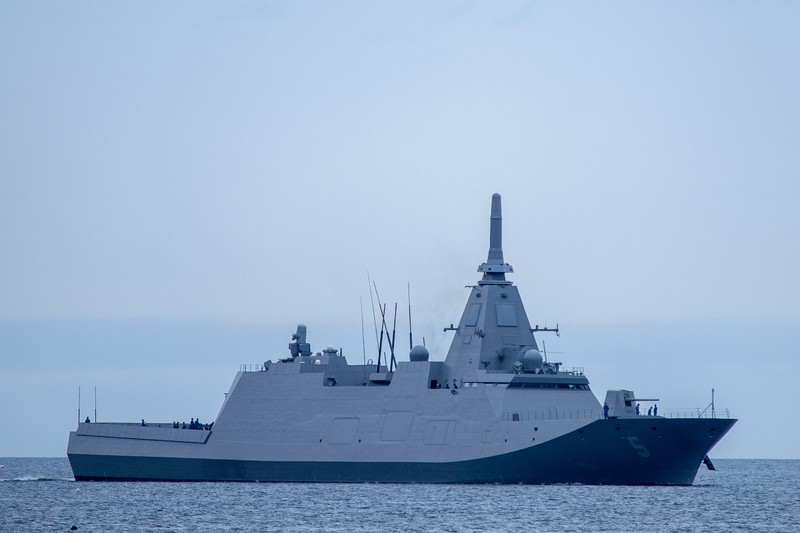
Australia signed a $6.5 billion deal last week for three Mitsubishi-designed Mogami-class frigates, with plans to jointly build eight more. Australian Defense Minister Richard Marles called the relaxation of export controls “really important to developing the seamless defense industrial base.”
New Zealand, the Philippines, and Indonesia have also expressed interest in Japanese defense equipment, according to Defense Minister Shinjiro Koizumi. European nations, eager to diversify supply chains beyond American manufacturers, are watching closely.
Beijing Objects
China’s Defense Ministry did not wait for the formal announcement to register its objections. Spokesperson Zhang Xiaogang accused “Japanese right-wing forces” of pushing “a more offensive and expansionist defense policy” whose acts “gravely violate instruments with legal effect under international law” and pose “a serious threat to the post-war international order.”
Zhang invoked Japan’s wartime record directly: “Japanese militarism once inflicted untold suffering on the region and beyond.” He warned that without “a clean break with militarism,” Japan would lose “the trust of its Asian neighbors and the international community.”
Domestic opposition parties have raised separate concerns, arguing that parliament should have prior approval over weapons exports rather than being notified after the fact. Under the current framework, the National Security Council decides on exports, with only the next-generation fighter jet requiring Cabinet-level approval.
Seventy years after the Self-Defense Forces were given their euphemistic name, the country that coined it is now an arms dealer. Its neighbors — some welcoming, some alarmed — will have to live with the consequences.
Sources
- Japan approves scrapping a ban on lethal weapons exports in a change of its postwar pacifist policy — Associated Press
- Japan eases arms export rules to enable weapons sales — Nikkei Asia
- China urges Japan to break with militarism — People’s Daily Online
Discussion (9)