 lop News
Five hundred and twenty-four drones. Twenty-two missiles. One Chinese cargo ship, burning in the Black Sea.
That is the arithmetic of Russia’s latest overnight assault on Ukraine, which struck two civilian vessels approaching ports in the Odesa region early Monday — including the KSL Deyang, a Chinese-owned bulk carrier with an all-Chinese crew. The ship was sailing under a Marshall Islands flag, heading to the port of Pivdennyi to load iron ore concentrate, when a Russian Shahed drone slammed into its hull.
No crew members were injured. The ship continued on its journey, its side charred but seaworthy, according to Ukrainian navy spokesman Dmytro Pletenchuk. A Reuters source confirmed the vessel was empty at the time, sailing to pick up cargo.
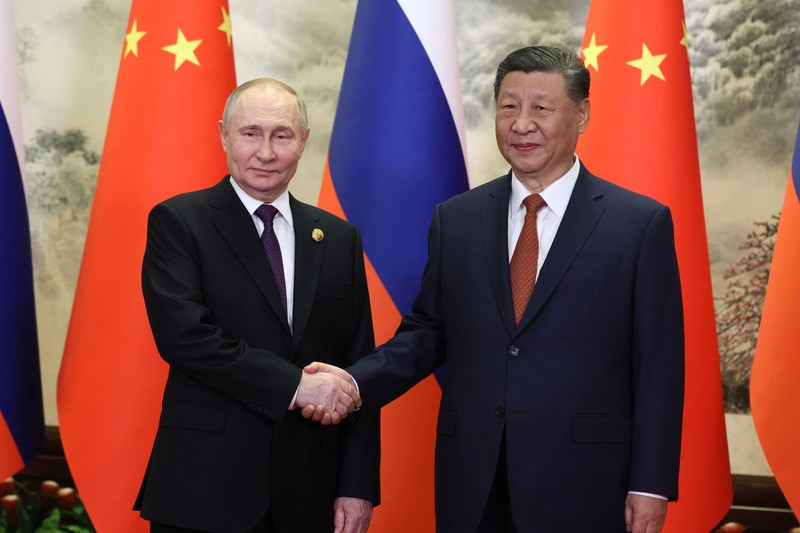
On Tuesday, Vladimir Putin arrives in Beijing for a two-day state visit with Xi Jinping. Chinese state media has already prepared the script.
“Unshakeable as a Mountain”
On Sunday, state news agency Xinhua declared that China-Russia relations will remain “as unshakeable as a mountain amid wind and rain.” The People’s Daily, the Communist Party’s flagship newspaper, called the relationship “at their best period in history,” describing Beijing and Moscow as “true friends who stand together through adversity, support each other, and develop together.”
The phrasing is precise and deliberate. “Wind and rain” is standard Chinese diplomatic shorthand for external pressure — Western sanctions, international isolation, the compounding costs of a war now in its fifth year. The mountain is the partnership itself, presented as permanent and immovable.
But Monday’s drone strike presents a different kind of weather. This is not Western pressure testing the alliance from outside. This is Russian ordnance striking Chinese interests directly.
Ukrainian President Volodymyr Zelenskyy made the point plainly. “The Russians could not have been unaware of what vessel was at sea,” he wrote on social media.
A Carefully Maintained Neutrality
China’s official position on the war has remained consistent since February 2022: call for peace talks, present itself as a neutral mediator, and never condemn Russia by name for the invasion. That posture has allowed Xi to sustain his partnership with Putin while selling China as a responsible stakeholder to the Global South.
Beijing denies providing Moscow with weapons or military components. It blames Western countries for prolonging “Europe’s deadliest conflict since World War II” by arming Ukraine instead.
The economic relationship tells a less neutral story. China is the world’s largest buyer of Russian fossil fuels and has become Moscow’s critical economic partner since Western sanctions took effect. Bilateral trade has exceeded $200 billion for three consecutive years, reaching $227.9 billion in 2025, according to China’s Ministry of Commerce. In the first four months of 2026, trade reached $85.2 billion — up 19.7 percent year on year.
Xinhua described “practical cooperation” as the “driving force” behind the relationship, citing growth in artificial intelligence, aerospace, the green economy, and cross-border e-commerce. Visa-free travel between the two countries, introduced by Beijing in September and reciprocated by Moscow in December, has turned border towns like Suifenhe into showcases of warming ties.
The Silence After the Strike
As of Monday, China had not publicly commented on the drone strike. No Foreign Ministry statement. No summoned ambassador. No démarche. For a government that has built its diplomatic identity around the protection of Chinese citizens and commercial interests abroad — and that has invoked that principle forcefully when convenient — the silence is telling.
Any public complaint would require Beijing to acknowledge that its “neutral” position carries a direct cost. It would also force Xi into an unenviable choice: extract an apology from Putin, publicly or privately, or demonstrate that Chinese interests can be damaged without consequence. Neither option fits the image of an unshakeable partnership between equals.
The timing compounds the awkwardness. Putin’s visit comes just four days after US President Donald Trump concluded a two-day trip to Beijing, which Xi described as a “milestone visit” establishing a relationship of “constructive strategic stability.” The diplomatic calendar has Xi moving seamlessly from one superpower summit to another, projecting balance and command. A burning Chinese cargo ship is not part of the program.
What the Alliance Can Absorb
History suggests this incident will be absorbed quietly. Russia has attacked civilian vessels in the Odesa port area regularly since the invasion began. The KSL Deyang appears to have been struck in the course of a massive, indiscriminate assault — 524 drones and 22 missiles fired across Ukraine in a single night — rather than deliberately targeted. The ship was empty. The crew was unharmed. The vessel sailed on.
The practical damage is negligible. The symbolism is harder to contain.
Zelenskyy’s statement was calibrated for exactly this purpose — to highlight the dissonance between Putin’s strategic partnership with Beijing and his military’s willingness to hit anything near Odesa’s ports, Chinese-flagged or otherwise. It was a message aimed as much at Beijing as at the West: your partner is not protecting your interests. Your mountain has a crack.
For Xi, the calculation remains straightforward. China gains more from the Russian partnership — discounted energy, a strategic counterweight to the United States, shared opposition to Western sanctions architecture — than it loses from a scorched hull and a diplomatic bruise. The mountain stays. The rain is managed.
Negotiations to end the fighting, brokered by the US, have appeared stalled since the outbreak of the US-Israeli conflict with Iran in late February. Moscow has ruled out a ceasefire or comprehensive talks unless Kyiv accepts the Kremlin’s maximalist demands. There is no active peace process for China to mediate, and no evident incentive for Beijing to manufacture one.
On Tuesday, Putin and Xi will stand side by side in Beijing. They will discuss stability, cooperation, and an international order anchored by “the United Nations at its core,” as Xinhua put it. They will affirm that the “right path is more evident against adverse currents.”
They will not discuss the KSL Deyang — not on camera, at least. The ship will likely have loaded its iron ore by then and sailed on. The char marks on its hull are someone else’s problem now.
Discussion (13)