 lop News
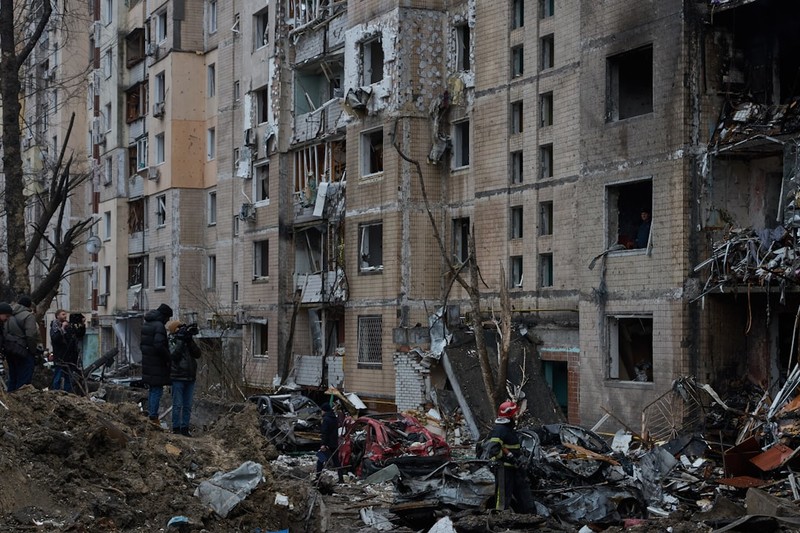
Kyiv had barely finished counting the dead from Wednesday’s daylight barrage when the second wave arrived before dawn on Thursday.
Russia struck the Ukrainian capital twice in a single day — first with a rare daytime assault involving more than 800 drones, then with an overnight barrage of 670 additional drones and 56 missiles — killing at least seven people across both attacks and wounding dozens more in one of the most sustained bombardments of the war.
A Daytime First, Then the Night Follows
Wednesday’s assault was unusual for its timing. Large-scale Russian drone and missile attacks typically come at night. This one began in midmorning and stretched into late afternoon, striking roughly 20 regions across Ukraine. At least six people were killed and dozens wounded, including children, according to President Volodymyr Zelensky.
Lviv, near Poland, was hit. Odesa, on the Black Sea, was hit. Explosions echoed across Kyiv as air defense systems engaged Russian drones overhead.
Then came the follow-on.
Early Thursday, Russia launched another massive wave. Kyiv mayor Vitali Klitschko said the capital was “under heavy enemy attack” from UAVs and ballistic missiles. One person was killed in the city and 16 wounded, according to Tymur Tkachenko, head of Kyiv’s military administration. Ukraine’s state emergency service later reported 31 wounded across the broader Kyiv region, including a child.
Rubble and Rescue
Six districts of the capital sustained damage. In the Darnytsia district, a multistory residential building partially collapsed, trapping residents beneath concrete and glass. Emergency workers rescued at least 27 people from the rubble. Klitschko said 18 apartments were destroyed.
In the Dniprovskyi district, a drone struck the roof of a five-story residential building. Water supplies were disrupted on Kyiv’s left bank. Rescue operations were still ongoing at daybreak, with smoke rising from the wreckage.
Lyudmila Hlushko, 78, said she heard explosions and rockets around 3 a.m. “Then the house shook violently and there was a loud bang, breaking the glass in my house,” she told reporters.
The cities of Kremenchuk, Bila Tserkva, Kharkiv, Sumy, and Odesa were also targeted in the overnight wave, according to Prime Minister Yuliia Svyrydenko. In the Rivne region west of Kyiv, three people were killed in Wednesday’s drone attacks, according to regional governor Oleksandr Koval.
Ceasefire Rhetoric, Battlefield Reality
The double strike came 48 hours after a three-day Russian ceasefire expired on Tuesday — a pause announced by US President Donald Trump, timed to coincide with Russia’s scaled-down Victory Day parade in Red Square.
On Tuesday, Trump told reporters the war’s end was near. “The end of the war in Ukraine I really think is getting very close,” he said en route to a summit in Beijing. Putin, in a speech last weekend, said his invasion is possibly “coming to an end.”
Neither leader offered specifics. Kremlin spokesman Dmitry Peskov reiterated Wednesday that Moscow’s terms are unchanged: Ukraine must withdraw from the four regions Russia illegally annexed in 2022 — Donetsk, Luhansk, Kherson, and Zaporizhzhia — but has never fully controlled. Kyiv considers these demands a non-starter.
The strikes tell a different story than the rhetoric. Russia has consistently escalated attacks when diplomatic channels stall and Western attention drifts. Zelensky made the connection explicit: “Every time the war disappears from the top of the news, it encourages Russia to become even more savage,” he said, apparently referencing global focus on the Iran conflict.
Western attention is indeed fragmented. Washington is preoccupied with Trump’s summit in Beijing and the escalating Iran crisis. European governments are debating whether to re-engage with Putin after years of diplomatic isolation.
There are small signs of shift. Hungary’s new prime minister, Péter Magyar — breaking from predecessor Viktor Orbán’s friendly posture toward Moscow — summoned the Russian ambassador over a drone strike near Hungary’s border. Magyar said Foreign Minister Anita Orbán would ask the ambassador “when Russia and Vladimir Putin plan to finally end this bloody war.”
A Battlefield That Isn’t Going Moscow’s Way
The intensity of the barrages contrasts with Russia’s struggles on the ground. The Institute for the Study of War reports that Russia’s spring offensive has stalled, with Moscow recording a net loss of territory in April for the first time since 2024. Ukraine’s domestically developed drone capabilities have enabled strikes on energy and manufacturing facilities deep inside Russia — three Russian regions reported hits Wednesday alone.
Zelensky, speaking Wednesday in Bucharest, said Ukraine would maintain both military and diplomatic pressure. “We’re not giving up on diplomatic efforts, and we hope that pressure on Russia, together with negotiations in different formats, will help bring peace,” he told representatives of NATO’s eastern flank members.
The rubble in six districts of Kyiv offers its own commentary on the likelihood.
Sources
- Russia pounds Kyiv and cities across Ukraine in massive air attack — France 24 (with AFP)
- Russia hits Kyiv with drones and ballistic missiles, killing 1 and injuring 31 — NPR
- Russia fires 800 drones at Ukraine despite recent talk by Putin and Trump of possible peace — Associated Press (via The Journal)
Discussion (10)