 lop News
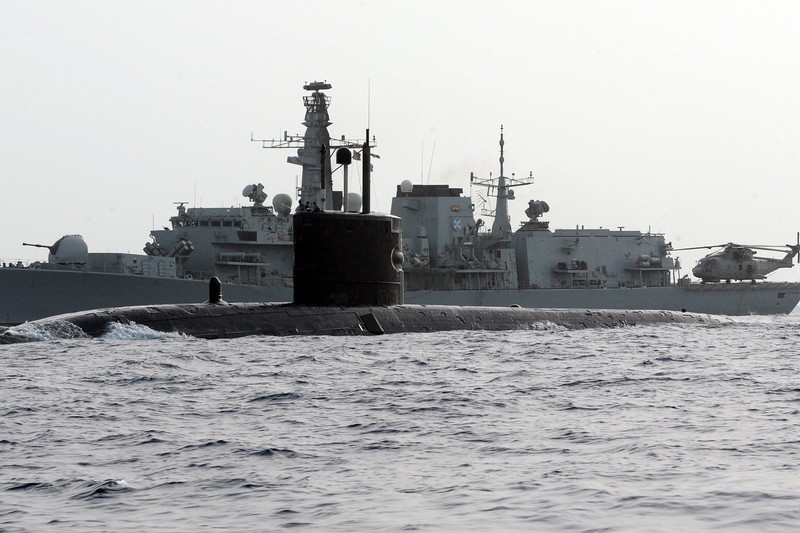
Three Russian submarines slipped into the North Atlantic last month, positioning themselves above the cables carrying 99 per cent of Britain’s international data and the pipelines supplying half its gas. British and Norwegian forces were tracking them from the start.
On Thursday, Defence Secretary John Healey revealed the full scope of the operation — an unusually public account of a submarine encounter that Western governments typically handle with studied ambiguity.
The Submarines and the Chase
The Russian deployment consisted of an Akula-class nuclear-powered attack submarine and two specialised spy vessels from GUGI — Russia’s Main Directorate for Deep-Sea Research, the same unit Healey first called out last November for hybrid warfare activities targeting critical undersea infrastructure.
The Akula served as a diversion, Healey said, while the two GUGI submarines — designed to survey underwater infrastructure during peacetime and sabotage it during conflict — conducted surveillance of cables and pipelines north of the UK, in its exclusive economic zone.
The British response lasted more than a month. The Type 23 frigate HMS St Albans, support vessel RFA Tidespring, Merlin helicopters, and RAF P-8 submarine-hunting aircraft maintained round-the-clock surveillance alongside Norwegian allies. Some 500 British personnel were involved. Aircraft logged over 450 hours. The frigate covered several thousand nautical miles.
Healey said British forces dropped sonar buoys to make clear to the Russian crews that their movements were being tracked. “Our armed forces left them in no doubt that they were being monitored, that their movements were not covert, as President Putin planned, and that their attempted secret operation had been exposed.”
The Akula retreated home early in the operation. The two GUGI vessels remained longer before eventually heading back north. Healey confirmed there was “no evidence” of any damage to UK infrastructure, though verification with allies was continuing.
What Hangs in the Balance
Around 60 undersea cables come ashore along the British coastline, clustered around East Anglia and south-west England. More than 90 per cent of the UK’s day-to-day internet traffic passes through them. The country also depends on a network of underwater gas pipelines, primarily from Norway — 77 per cent of British gas imports arrive through subsea connections including the 724-mile Langeled pipeline.
Globally, more than 600 undersea cables spanning 870,000 miles carry electricity and information across the world’s oceans. They are the connective tissue of the modern economy, and an obvious target for any adversary seeking leverage short of open war.
NATO’s senior expert on cyber and hybrid threats, James Appathurai, described the Russian Undersea Research Programme late last year as “a euphemism for a paramilitary structure, very well-funded, that is mapping out all of our cables and our energy pipelines,” employing research ships, mini-submarines, remotely operated vehicles, divers, and explosives. He called persistent attacks on undersea cables “the most active threat” to Western infrastructure.
Why Britain Went Public
Healey’s decision to name vessel classes, release images of the GUGI base, and address Putin directly — “We see you. We see your activity over our cables and our pipelines, and you should know that any attempt to damage them will not be tolerated and will have serious consequences” — signalled that the strategic value of exposure now outweighs the usual preference for silence.
The timing was deliberate. The operation unfolded while global attention was fixed on the Middle East, specifically the US-Israeli attack on Iran, according to the Guardian. Healey said Putin had hoped to exploit that distraction. “We will not take our eyes off Putin,” he added.
The disclosure also served a domestic purpose. Healey used the moment to announce an extra £100 million for P-8 aircraft, the Atlantic Bastion programme to build a hybrid naval force combining autonomous technologies with warships, and the deployment of the UK carrier group to the High North to lead NATO’s new Arctic Sentry mission — framed as part of “the biggest sustained increase in defence spending since the end of the Cold War.”
An Escalating Pattern
British officials say Russian naval activity around UK waters has risen 30 per cent in two years. In December, the UK and Norway announced a combined fleet of at least 13 warships to hunt Russian submarines in the North Atlantic. In late March, Britain declared its readiness to seize vessels from Russia’s “shadow fleet” of sanctions-busting oil tankers.
Last November, two Baltic Sea cables — one linking Sweden and Lithuania, the other Germany and Finland — were severed, alarming NATO members. The Russian embassy has previously said it was “not interested in British underwater communications.”
The cables beneath the Atlantic carry trillions of pounds in daily trade and nearly all of Britain’s connection to the digital world. Russia has been mapping them for years. Britain chose this week to say so — loudly, and with consequences attached.
Sources
- Defence Secretary No9 speech - 09 April 2026 — GOV.UK
- UK says Russia ran submarine operation over cables and pipelines — BBC News
- UK navy foiled Russian submarines surveying undersea cables in North Atlantic — The Guardian
- UK and Norway foil Russian submarine plot to survey undersea cables in North Atlantic — Euronews
Discussion (9)