 lop News
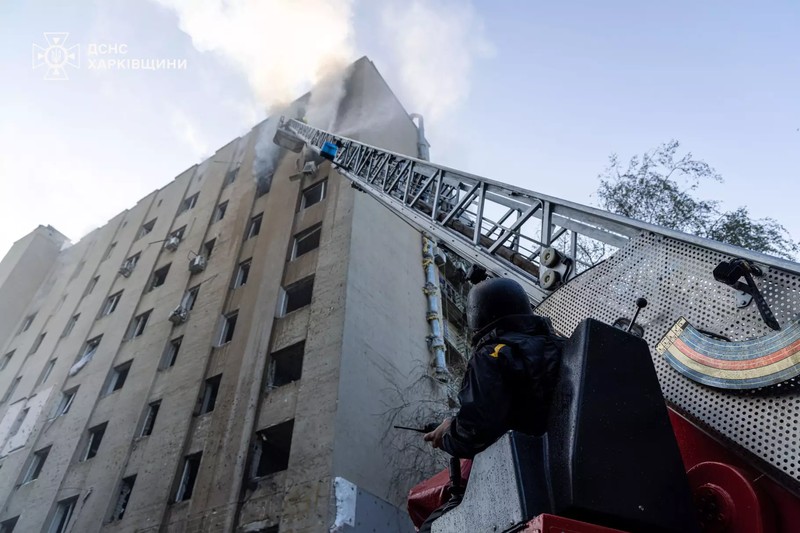
The ceasefire offer and the drone strike arrived on the same day.
On Thursday, President Volodymyr Zelenskyy signalled Kyiv’s readiness for an Easter truce, the proposal communicated to Moscow through American channels. By Friday, Ukrainian long-range drones were striking an explosives plant more than 1,100 kilometers inside Russian territory.
In between, Russia killed at least 15 civilians across Ukraine in what officials described as one of the largest aerial barrages of the full-scale invasion. The Ukrainian Air Force said Russia launched 542 drones and 37 missiles over Thursday night and into Friday, with a second wave of almost 300 more drones following overnight into Saturday.
The dual messaging from Kyiv is not a contradiction. It is the strategy: a willingness to pause, a refusal to absorb punishment passively.
An Easter Escalation
The assault, coinciding with the war’s 1,500th day, stretched from Kharkiv in the northeast to Nikopol in the south. Five people were killed at a morning market in Nikopol when Russian drones struck at 09:50 local time, smashing kiosks and littering the scene with glass and twisted metal, according to Ukraine’s prosecutor general. A 14-year-old girl was among the injured.
In the Kyiv region, one person died and at least eight were wounded in strikes on Bucha, Fastiv, and Obukhiv — satellite towns surrounding the capital. Three people were killed in the Sumy region, including one who died when a guided aerial bomb struck an apartment block. Casualties were reported across Kherson, Zhytomyr, Kharkiv, and Donetsk regions as well.
Zelenskyy had previously offered a ceasefire for the Easter holiday, which falls on April 12 for Orthodox churches. Kremlin spokesperson Dmitry Peskov said Moscow wants a lasting peace settlement, not a temporary truce. President Vladimir Putin unilaterally declared a 30-hour ceasefire last Easter, but both sides accused the other of violating it.
“At the very moment of our conversation, the Russians attacked Ukraine yet again,” Zelenskyy said, describing a phone call with Pope Leo XIV during the bombardment. “The Russians have only intensified their strikes, turning what should have been silence in the skies into an Easter escalation.”
New Tactics From Moscow
Ukrainian officials said Russia is shifting methods. For months, Moscow relied on nighttime barrages. Now it is layering in daytime attacks — a change Prime Minister Yulia Svyrydenko said is designed to “deliberately” increase civilian casualties and “spread fear.”
In Kharkiv, 40 kilometers from the Russian border, officials reported the deployment of Iranian-built Shahed drones fitted with jet engines — fast enough to cover the short distance that interception becomes extremely difficult. The scale of the assault prompted Poland to scramble fighter jets and put its air defense systems on maximum readiness.
Ukraine Strikes Deep
Ukraine’s retaliation was far-reaching. Russia’s Defence Ministry said it shot down 192 Ukrainian drones overnight. But enough reached their targets.
Two people were hospitalised in the Leningrad region after a strike on the Morozov industrial zone, which houses a state-owned plant producing solid fuel for Topol-M missile systems. In Taganrog, a southwestern port city, at least one person was killed and four seriously injured when drones hit a logistics warehouse, according to the regional governor. Drones also targeted Togliatti in the Samara region and a foreign-flagged commercial vessel in the Sea of Azov.
Ukraine’s Security Service separately reported a strike on the Alchevsk metallurgical plant in Russian-occupied Luhansk, claiming blast furnaces and key production areas were damaged.
The Diplomatic Track
Zelenskyy was in Istanbul on Friday, meeting Turkish President Recep Tayyip Erdogan, who pledged continued support for negotiations. Zelenskyy said the two agreed on “new steps in security cooperation,” including Ukrainian technology transfers — a transactional offer he extended across the Middle East last week, visiting Saudi Arabia, the UAE, Qatar, and Jordan.
The diplomatic circuit reflects a strategic concern: surging oil prices from the Iran conflict threaten Ukraine’s war effort, and Russia’s systematic destruction of energy infrastructure has left the country heavily dependent on imported fuel.
US-brokered peace talks have stalled since the Trump administration shifted focus to the Middle East. Zelenskyy said he invited American negotiators to Kyiv for a technical-level meeting, though whether Washington can sustain diplomatic focus on two simultaneous conflicts remains unclear.
The frontline, at least, is holding. Zelenskyy described the battlefield situation as the most favorable for Ukraine in 10 months, with Russian forces capturing only around 500 square kilometers since January — a sharp slowdown from previous advances. A Russian offensive planned for March was “thwarted,” he said.
But the drones keep flying in both directions, and the Easter truce offer has gone unanswered.
Sources
- Fifteen dead in ‘massive’ Russian attack while Kyiv signals readiness for Easter ceasefire — Euronews
- Ukraine war: Russian attack on Nikopol market kills five — BBC News
- Ukraine: ‘Massive’ Russian airstrikes kill at least 14 — Deutsche Welle
- Zelenskyy Accuses Russia Of ‘Easter Escalation’ After Deadly Overnight Strikes — Radio Free Europe/Radio Liberty
Discussion (9)