 lop News
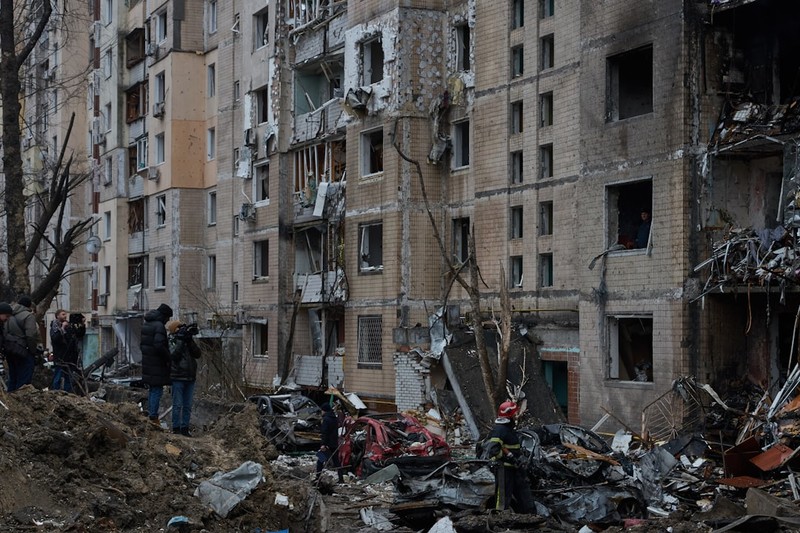
Four cities. Three hours of air raid alerts. At least nine dead and more than 100 injured — a toll still climbing as dawn broke over Kyiv on Tuesday.
Russia launched a coordinated overnight assault on Ukraine, deploying missiles and drones against Kyiv, Dnipro, Kharkiv, and Zaporizhzhia in what officials described as one of the broadest barrages in weeks. The strikes hit residential buildings, a medical facility, and areas near a kindergarten, leaving fires burning across multiple districts.
Kyiv bore the brunt. Four people were killed and at least 58 injured in the capital, including two children, according to Mayor Vitali Klitschko. The first explosion sounded at approximately 1:30 a.m. local time, with additional waves at 2:15 a.m., 4 a.m., and 7:20 a.m., a Kyiv Independent journalist on the ground reported.
In the Podilskyi district, a nine-story residential building partially collapsed after what officials described as a double-tap strike — a tactic in which attackers return to hit the same target after first responders arrive. Klitschko warned that people may be trapped under the rubble.
Across the capital, fires broke out at gas stations, a construction site, and multiple apartment blocks. Drone debris fell near a kindergarten in the Obolonskyi district. A medical facility in the Holosiivskyi district suffered a partial collapse. Power outages cut across at least three districts.
Dnipro Suffers the Heaviest Toll
The central city of Dnipro recorded the highest death toll. At least six people were killed and 36 injured, including a 13-year-old girl who was among 23 requiring hospitalization, according to regional governor Oleksandr Hanzha. Photos posted online showed partially collapsed low-rise residential buildings across the city.
In Kharkiv, drones and missiles struck multiple districts, damaging residential and administrative buildings. Ten people were injured, Mayor Ihor Terekhov reported. An industrial facility was also hit in Zaporizhzhia. Three people in the wider Kyiv region were wounded by a mix of drones, cruise missiles, and ballistic weapons, regional governor Mykola Kalashnyk said.
Poland’s Air Force scrambled fighter aircraft overnight to protect its own airspace during the attack.
A Strike Announced in Advance
The assault came as no surprise. President Volodymyr Zelensky had warned for days that Moscow was preparing a mass attack, repeating the alert in his nightly addresses on May 29, May 30, and June 1.
“The intelligence warnings regarding Russian strikes remain in effect. A massive strike may happen — they have prepared it,” Zelensky said on Monday evening. “Our defenders of the sky are ready 24/7, to the extent possible with the supplies currently available.”
That reference to supplies was pointed. Zelensky recently sent a letter to US President Donald Trump warning of Ukraine’s worsening shortage of air defense systems, particularly anti-ballistic missile capabilities, according to the Kyiv Independent.
Russia, for its part, had publicly announced the attack. Foreign Minister Sergey Lavrov told US Secretary of State Marco Rubio on May 25 that Moscow planned to strike Ukrainian “decision-making centers” and urged Washington to evacuate its embassy in Kyiv. Russia’s Foreign Ministry separately called on foreign citizens and diplomats to leave the city. No foreign embassies complied.
An Escalating Campaign
The barrage continues a pattern that has intensified since a brief ceasefire expired in May. On May 24, Russia launched 90 missiles and 600 drones against Kyiv and the surrounding region, damaging the Cabinet of Ministers building, the Foreign Ministry, and the Kyiv Opera Theater — one of the largest single attacks of the past year. That strike included an Oreshnik intermediate-range ballistic missile, a weapons system Moscow has heavily promoted.
Moscow frames the escalation as retaliation for a Ukrainian drone strike that killed 21 people in a dormitory in Russian-held Luhansk. Ukraine’s military confirmed conducting an attack near Starobilsk that night but said it struck a Russian military unit, not civilian infrastructure. Kyiv called Russia’s threats “nothing short of shameless blackmail.”
The bombing campaign coincides with a diplomatic impasse and mounting battlefield losses. Ukrainian counterattacks in March reclaimed most of the Russian-occupied areas of Dnipropetrovsk Oblast. UK intelligence estimated on May 27 that approximately 500,000 Russian soldiers have been killed since the full-scale invasion began — a figure that underscores the disconnect between Moscow’s expenditure of lives and its territorial gains.
Russia appears to be wagering that sustained bombardment of Ukrainian cities can extract political concessions its forces cannot secure on the ground.
For residents sorting through rubble in Podilskyi on Tuesday morning, the cost of that bet was being measured in collapsed buildings and destroyed neighborhoods.
Sources
- Large-scale Russian missile and drone attack across Ukraine, including Kyiv, kills 9, injures 105 — Kyiv Independent
- Massive Russian attack on cities across Ukraine kills at least nine people — BBC News
- Eight Killed, At Least 70 Wounded in Massive Overnight Russian Missile and Drone Barrage Across Ukraine — Kyiv Post
Discussion (9)