 lop News
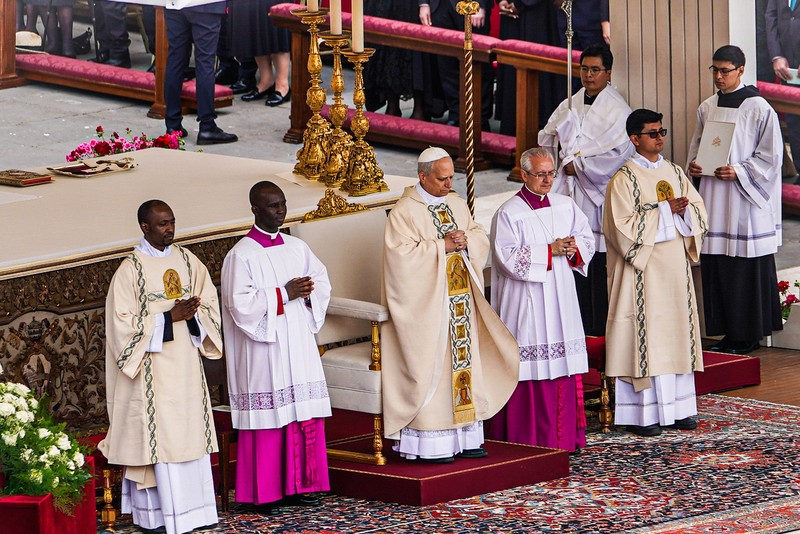
The US secretary of state arrived at the Vatican on Thursday to mend a relationship his own president keeps tearing open. Marco Rubio’s private audience with Pope Leo XIV — roughly 30 minutes, followed by talks with Vatican secretary of state Cardinal Pietro Parolin — was scheduled before the latest presidential broadsides against the first American pontiff. The timing has turned routine diplomacy into something stranger: a cabinet secretary deployed as damage control for his boss’s very public fight with the leader of 1.4 billion Catholics.
Rubio attempted to smooth over the obvious tension. “Obviously we had some stuff that happened … There’s a lot to talk about with the Vatican,” he told reporters Tuesday, according to Deutsche Welle. He stressed the visit had been arranged before Trump’s recent criticism of the pope — a timeline that may be accurate but does nothing to change the optics.
Parolin was more forthcoming about what the meeting would cover. “I imagine we’ll talk about everything that’s happened in recent days, we can’t avoid touching on these topics,” he said Wednesday. He also noted that Washington had initiated the meeting — a pointed detail that says a good deal about who needs this visit more.
A Pontiff Under Presidential Fire
The rift has been building since Pope Leo XIV, elected one year ago this Friday as the first US pontiff, became a prominent critic of the war in Iran and the Trump administration’s hardline anti-immigration policies. Trump, who won heavy support from Catholic voters, has nonetheless shown no restraint in going after the pope. The pope’s stance on Iran has drawn the sharpest presidential response.
On Monday, Trump declared that Leo was “endangering a lot of Catholics by opposing the war.” He also claimed the pope believes it is “OK for Iran to have a nuclear weapon” — an assertion that contradicts the Catholic Church’s decades-long opposition to all nuclear weapons, a position Leo himself reiterated this week.
“The Church has spoken out against all nuclear weapons for years, so there is no doubt about that,” the pope said.
The attacks have been escalating since April, when Leo stated that “no cause can justify the shedding of innocent blood.” Trump responded by claiming the pope “wouldn’t be in the Vatican” if Trump were not president — a remark whose logic is difficult to follow, given that papal elections are conducted by the College of Cardinals without reference to American electoral outcomes. The president then posted, and quickly deleted, an AI-generated image depicting himself as a god-like figure.
Leo has not retreated. “If anyone wishes to criticize me for proclaiming the Gospel, let them do so truthfully,” he said.
The Diplomat as Janitor
Rubio’s visit illustrates a recurring structural problem in US foreign relations under Trump. The secretary of state arrives at an allied government or respected institution not to advance a shared agenda, but to contain the damage caused by presidential rhetoric. The pattern has played out with NATO partners, with traditional European allies, and now with the Holy See.
The Vatican is not a conventional geopolitical actor. It commands no army, controls no trade routes, levies no sanctions. But the Holy See wields a form of influence Washington has long recognized: moral authority that shapes how governments and populations around the world perceive conflicts, refugee crises, and humanitarian emergencies. That is precisely the kind of soft power the United States has spent decades cultivating — and precisely the kind a president’s personal attacks can erode faster than any diplomat can repair.
When an American president publicly berates the pope, the audience extends well beyond domestic politics. Governments that coordinate with the Vatican take note. So do the 1.4 billion Catholics across every continent.
The situation also presents an unusual diplomatic inversion. Leo XIV is the first pope from the United States. Under different circumstances, that shared nationality would be a natural bridge between Washington and the Holy See — a channel for private dialogue on issues from religious freedom to nuclear disarmament. Under Trump, it has functioned in reverse — treated as grounds for demanding compliance rather than building cooperation, as though an American pope owed loyalty to the American president.
Rubio, himself a Catholic, now faces the task of navigating between his administration’s confrontational posture and the institutional weight of the Church he belongs to. A 30-minute private audience leaves room for both courtesy and candor. Whether it can offset weeks of presidential hostility toward the leader of that Church is the kind of question no diplomat should have to answer — and the kind Rubio now cannot avoid.
Sources
- Rubio to meet Pope Leo at the Vatican — Deutsche Welle
Discussion (10)