 lop News
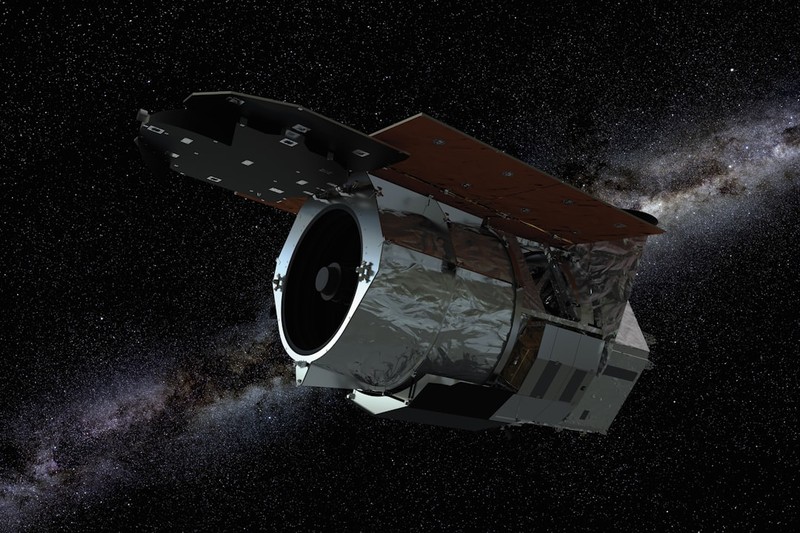
Two administrations tried to kill it. Congress said no. Now NASA’s next great observatory is built, tested, and ahead of schedule.
The Nancy Grace Roman Space Telescope, unveiled this week at NASA’s Goddard Space Flight Center in Maryland, is targeting an early September launch — a full eight months before NASA’s commitment deadline of May 2027. It arrives both early and under budget, a combination rarely associated with billion-dollar space missions.
That the telescope exists at all is remarkable. Both the first and second Trump administrations attempted to eliminate its funding. The FY2020 budget proposal stated plainly: “The Budget proposes to terminate the WFIRST mission” — the telescope’s original name, before it was renamed for Nancy Grace Roman, NASA’s first chief of astronomy and the driving force behind Hubble. Another defund attempt came in 2025. A third is underway now. Each time, Congress pushed back, and the telescope survived.
Now it stands complete — a 12-meter silvery structure with towering orange solar panels, ready to be shipped to Kennedy Space Center and loaded onto a SpaceX Falcon Heavy.
A Wide Eye on the Cosmos
What makes Roman different from Hubble and the James Webb Space Telescope (JWST) is a matter of perspective. Those instruments are deep-staring scopes, trained on small patches of sky with extraordinary resolution. Roman is the opposite: a survey telescope built to sweep enormous swaths of the universe in a single frame.
Its field of view is at least 100 times wider than Hubble’s, with surveying speed roughly 1,000 times faster. NASA Administrator Jared Isaacman put it plainly: “What would take Hubble 2,000 years to process, Roman can do in a year — the images it captures will be so large there is not a screen in existence large enough to show them.”
Roman will send 1.4 terabytes of data to Earth every day, according to Ars Technica — a firehose compared to Hubble’s roughly 400 terabytes over its entire 35-year career. Over its five-year primary mission, NASA expects the archive to reach 20,000 terabytes, enabling scientists to identify 100,000 exoplanets, hundreds of millions of galaxies, and billions of stars.
Roman’s Wide Field Instrument houses a 300-megapixel visible-to-near-infrared camera. Its images will be about 50 times wider than JWST’s, though less deep — a deliberate tradeoff. Where JWST drills, Roman sweeps.
Dark Energy, Exploding Stars, and New Worlds
Roman’s science agenda is expansive. It will study dark energy and dark matter by imaging vast numbers of galaxies and building three-dimensional maps of cosmic structure. It will catch transient events in real time — supernovae, fast radio bursts, colliding neutron stars — thanks to its enormous field of view.
“We’ll trace the history of the universe through exploding stars,” Dominic Benford, program scientist for the Roman telescope, told Space.com. Some of those supernovae will be farther away than any ever observed.
The telescope’s coronagraph blocks the glare of host stars, enabling it to detect exoplanets 100 million times fainter than their suns — 100 to 1,000 times more sensitive than current space-based instruments. That could dramatically expand the census of known worlds.
Julie McEnery, Roman’s senior project scientist, may have best captured the real excitement: “I very much hope, and in fact, expect, that the most exciting science from Roman is going to be the things that we didn’t expect, that we couldn’t predict, but that will set the new deep questions for future missions to address.”
Born From Spy Hardware
Roman’s origin story includes an odd twist. Its 2.4-meter primary mirror — the same size as Hubble’s — came from surplus hardware originally built for US spy satellites. The National Reconnaissance Office donated the optics to NASA in the 2010s, and the mission was redesigned around a mirror nearly double what the original WFIRST team had planned.
Once in space, Roman will travel to Lagrange Point 2, a gravitationally stable position about 1.5 million kilometers from Earth — the same orbital neighborhood JWST occupies today.
An Uncertain Future for Flagship Science
Roman’s survival is worth celebrating, but the broader picture is uneasy. The current administration is again proposing deep cuts to NASA’s science budget. If those cuts succeed, missions like the planned Habitable Worlds Observatory — designed to directly image Earth-like planets — could face the same battles.
The telescope cost more than $4 billion and took over a decade to build. In September, if all goes well, it will ride a Falcon Heavy into space and begin building what Isaacman called “a new atlas of the universe.”
Not bad for something that was supposed to have been canceled twice.
Sources
- Eight months early and under budget, the Roman Telescope is ready to launch — Ars Technica
- Nancy Grace Roman Space Telescope trumps Trump cuts, is launch-ready ahead of schedule — The Register
- NASA Targets Early September for Roman Space Telescope Launch — NASA
- The Nancy Grace Roman Space Telescope, NASA’s next great observatory, is finally complete — Space.com
- NASA unveils new space telescope to give ‘atlas of the universe’ — Le Monde
Discussion (9)