 lop News
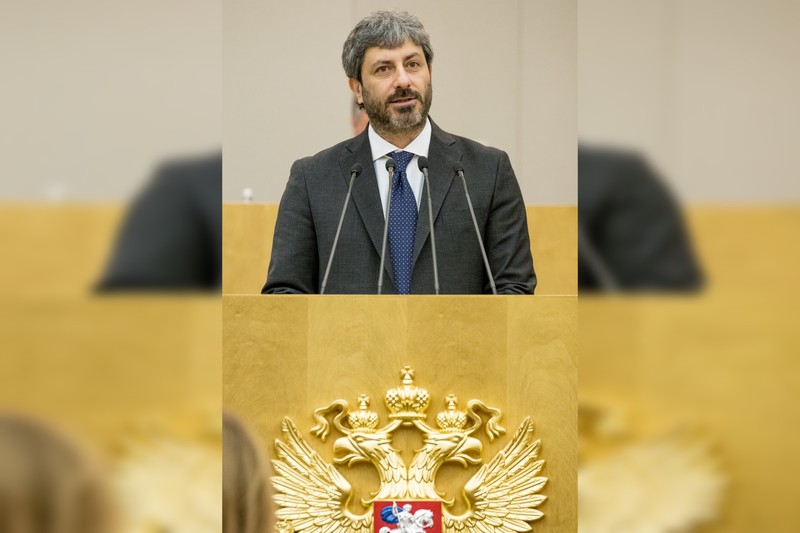
State Duma speaker Vyacheslav Volodin — one of Vladimir Putin’s closest allies — sat quietly and listened as the leader of Russia’s Communist Party told parliament that without urgent economic action, the country faces a repeat of 1917.
The setting was as striking as the words. Gennady Zyuganov, 81, does not lead an insurgent movement. He leads the second-largest faction in Russia’s lower house — a party that has spent decades as the Kremlin’s managed opposition, backing Putin’s core policies while offering carefully calibrated criticism from within the system. For Zyuganov to invoke revolution from the floor of the State Duma itself, with Volodin presiding and an audience of lawmakers clapping, signals that something in Russia’s wartime consensus has begun to crack.
“We’re doing everything we can to support Putin and his strategy and policies, but you are not listening,” Zyuganov told Tuesday’s plenary session, directing his remarks at the government and the ruling United Russia party rather than the president.
A War Economy Running Out of Runway
The numbers behind his alarm are stark. Russia’s economy contracted by 1.8 percent in January and February of 2026 — a reversal that Putin himself disclosed at a televised meeting with economic officials last week, demanding to know why growth had fallen short of the government’s own forecasts.
GDP growth had already decelerated sharply, from 4.9 percent in 2024 to just 1 percent last year, as the strain of sustained military spending, double-digit interest rates, and acute labor shortages wore down the gains that massive defense outlays had produced.
The federal budget deficit ballooned to 4.5 trillion rubles (roughly $60 billion) in the first quarter — double the same period a year earlier — as oil tax revenue in March fell by half compared to March 2025. Economics Minister Maksim Reshetnikov told a recent business forum that the economy’s reserves have been “largely exhausted,” according to the daily Nezavisimaya Gazeta.
Higher oil prices from the US-Israeli conflict with Iran could offer some relief — the IMF has raised its growth forecast for Russia this year to 1.1 percent, from 0.8 percent, according to Reuters. But Ukrainian drone strikes on Russian export infrastructure have prevented Moscow from fully capitalizing on the windfall.
Workers, Factories, and Cascading Warnings
Central Bank governor Elvira Nabiullina, on the receiving end of Putin’s public scolding, told officials the following day that Russia was contending with something unprecedented in its modern economic history: a structural labor shortage rather than a temporary external shock.
The official unemployment rate sits at 2 percent, a historic low. But Zyuganov told parliament the figure was false, citing major factories — Kirovsky, Rostselmash, GAZ, and KAMAZ — that have been forced to close or move employees to four-day weeks. He described the reality as disguised unemployment.
Average interest rates have run at 19 percent over the past 16 months, Zyuganov said, warning that if they remain above 12 percent for another 16 months, the economy will collapse. He also pointed to inequality: Russia’s 24 richest oligarchs have seen their combined wealth increase by $20 billion since the start of the year, while senior officials’ incomes rose an average of 63 percent — all during wartime.
The alarms are not coming from Zyuganov alone. A state-linked think tank warned in December of a potential banking crisis by October if bad loans continue to mount. The head of the Russian Union of Industrialists and Entrepreneurs cautioned in June that many companies were in a “pre-default situation.” An anonymous Russian official told the Washington Post that both a banking crisis and a nonpayments crisis were possible.
A Warning, With Caveats
There is currently no sign of serious social unrest in Russia. Wartime censorship, protest bans, and lengthy prison sentences for dissidents have kept public discontent contained. The Federal Security Service, successor to the Soviet KGB, has grown only more influential since the full-scale invasion of Ukraine.
Zyuganov’s speech, coming months before September’s parliamentary elections, was partly electoral positioning — an effort to win over voters feeling the pinch while shielding Putin from direct blame. Intelligence agencies in Sweden and Germany have both assessed that Moscow is manipulating economic data to understate its problems, according to the Financial Times.
But even allowing for political theater, the moment marks a shift. When the leader of the parliament’s managed opposition stands up inside the building and warns that the country is approaching the conditions that toppled the Tsar, the Kremlin has a problem — and this one isn’t coming from outside.
Sources
- Leader of Russia’s Communist Party warns country faces revolution due to faltering economy — Reuters via Irish Independent
- Putin finally admits Russia’s economy is in trouble and grasps for answers — Fortune
- Entangled In Russia’s Faltering Economy: The Fate Of Its Respected Central Banker — Radio Free Europe/Radio Liberty
- Gennady Zyuganov : Les défaillances à l’arrière empêchent la victoire sur le front — Histoire et Société
Discussion (10)